Almost every fantasy town name list gives you two nouns glued together and a line of poetry instead of a meaning. This page does the opposite. Every one of the 610 names below is built from a real place-name elements or taken from a real record: Old English ham, tun, burh, wic, ford, stow, mere and leah, Old Norse by, thorpe, thwaite, beck, garth, gata and holm, Celtic pen, aber, caer and inis, Latin castra and portus, and the Arabic wadi, erg, qasr and qanat that desert cities are actually named from.
Start with the generator: pick Classic, Magical, Dark or Medieval and it answers with 10 names per click, all drawn from the tables below. Then work down through meanings, the best names, forty-five real medieval towns with their documented etymologies, dark and evil, elven, dwarven, cute, unique, magical, mysterious, mythical and legendary, forest, mountain, coastal, desert, DnD, famous towns from fiction, and market and port towns. Where a name is coined rather than recorded, the table says which elements it was coined from, because a made-up meaning is worse than no meaning at all.
Fantasy Village Name generator
Pick a register and the generator answers in tens: 🏘️ Classic for the element-built English names, ✨ Magical for charm, starlight and hidden places, 🌑 Dark for gallows, barrows and bog towns, 🏰 Medieval for real recorded towns whose meanings are documented in Domesday and in the Old Norse of the Danelaw.
Every result is clickable, tap or press Enter to copy it, and every name comes straight from a table on this page, so its real elements and meaning are written down below. Four clicks give you forty names, and no name repeats inside one click.
🏘️ Fantasy Town Name Generator
Generate 10 classic, magical, dark, or medieval fantasy town names instantly.
antasy Town Names With Meanings
This is the table the whole page exists for. Every name here is coined, but nothing about it is guessed: each one is built from place-name elements that are recorded in real English, Norse and Celtic place names, and the meaning column tells you which elements and what they meant. Mor was not dry heath in Old English, it was the wet open waste, so Ravenmoor is a bog town rather than a moorland one. Herg was an outdoor heathen shrine, which is why the real Harrogate means the road past the shrine, and wic could mean a dwelling, a dairy farm or a trading place, which is why Sandwich, Warwick and Droitwich all end the same way and mean different things.
| Name | What the parts mean | Root language | Best for |
|---|---|---|---|
| Moorcombe | Mor, the wet open waste, plus cumb, a short deep valley; a bog in a valley | Old English | A bog valley town |
| Thornfield | Thorn plus feld, land cleared of trees and opened up for grain | Old English | A farming town |
| Ashby | AEsc, ash tree, plus ON byr, a farmstead; Ashby is one of the commonest real Danelaw names | Old Norse | A Danelaw village |
| Stonecote | Stan, stone, plus cot, a small shelter; a stone cot was a shepherd’s hut | Old English | A high shepherd hamlet |
| Wolfharrow | Wulf plus hearg, a heathen shrine on a hill; Harrow in London is the same word | Old English | A pagan hill town |
| Deerbourne | Deor plus burna, a fast small stream; bourne and burn are the same word | Old English | A stream town |
| Frostgarth | Frost plus garth, an enclosed yard; a frost garth is a yard that never thaws | Old Norse | A cold northern croft |
| Mereford | Mere, a lake, plus ford, a shallow crossing; the ford at the end of the lake | Old English | A crossing town |
| Barrowden | Beorg, a burial mound, plus denu, a valley; a valley with a mound in it | Old English | A valley with old graves |
| Hartholme | Hjortr, hart, plus holmr, dry ground in a marsh; a deer island in a fen | Old Norse | A fen village |
| Gallowsgate | GE galga, a gallows, plus gata, the road; the road past the gallows was real in many towns | Old English | A grim gate town |
| Silvercombe | Seolfor, silver, plus cumb, a short deep valley | Old English | A mining valley |
| Brackenthorpe | Bracan, bracken, plus thorp, an outlying farmstead | Old Norse | A bracken hamlet |
| Cinderwick | Sinder, cinder, plus wic, a working settlement; a wick by a furnace | Old English | A smelting village |
| Drakemere | Draca, dragon or great serpent, plus mere, a lake | Old English | A lake with a rumour in it |
| Eldergarth | Eald, old, plus garth, an enclosure; the oldest yard in the parish | Old English | An ancient croft village |
| Fenholme | Fen plus holmr, dry ground in the marsh; the safest place to build in a fen | Old English | A fen island town |
| Goldthwaite | Gull, gold, plus thveit, a woodland clearing; a clearing where gold was washed | Old Norse | A panning village |
| Hollowbeck | Hoh, a hollow or heel of land, plus bekkr, a stream | Old Norse | A stream hamlet |
| Ironstow | Iren plus stow, a holy or meeting place; a stow was where people gathered | Old English | A forge and meeting town |
| Juniperhill | The juniper plus hyll; juniper grows on chalk and limestone, so the geology is in the name | Old English | A chalk hill town |
| Kettleby | Ketil, a helmet or a cauldron, used as a personal name, plus byr | Old Norse | A Danelaw farmstead |
| Lanternmoor | Lantern plus mor, the wet waste; the light that guides people off the bog | Old English | A beacon moor town |
| Mistfell | Mist plus fjall, a fell; a hill you can hear before you can see | Old Norse | A high foggy town |
| Nettleworth | Nettle plus worth, an enclosed homestead | Old English | A poor hedgerow farm town |
| Oakenshaw | Ac, oak, plus sceaga, a small wood; an oak shaw is a copse, not a forest | Old English | A copse village |
| Pikegarth | Pic, a pointed hill, plus garth, an enclosure | Old Norse | A pointed hill croft |
| Quarrycombe | The quarry plus cumb, a short valley; quarries were always in valleys for drainage | Old English | A stone-cutting village |
| Rookfield | Hroc, a rook, plus feld, open land; rooks colonise the first tall trees in a cleared field | Old English | A crow-haunted farm town |
| Sedgeholme | Secg, sedge, plus holmr, dry ground in water | Old Norse | A reedy fen island |
| Tarnbeck | Tjorn, a small mountain lake, plus bekkr, a stream; a tarn feeding a beck | Old Norse | A lake stream village |
| Ulfgarth | Ulfr, wolf, plus garth, an enclosure; a wolf-proof yard | Old Norse | A frontier croft |
| Valebridge | Fael, a valley, plus brycg; the bridge everybody in the vale uses | Old English | A valley bridge town |
| Woldmere | Wold, high open land, plus mere, a lake; a lake on the top of a wold is rare and gets named | Old English | An upland lake town |
| Yewgarth | Iw, yew, plus garth; yew was bow wood, so a yew garth is an armoury | Old English | A bow-making village |
| Amberbeck | Ambr, a river name, plus bekkr; many real becks take the river name twice | Old Norse | A river village |
| Bromworth | Brom, broom, the yellow shrub that covers cleared ground, plus worth, an enclosed homestead | Old English | A broom-covered farm town |
| Crowfield | Crawe, a crow, plus feld; the field where the crows wait | Old English | A battlefield town |
| Duncombe | Dun, a hill, plus cumb; a valley cut into a hill | Old English | A hill valley village |
| Eldenhurst | Eald, old, plus hyrst, a wooded hill | Old English | An old wooded hill town |
| Firbeck | Fyrh, fir or pine, plus bekkr; Firbeck is a real South Yorkshire place | Old Norse | A pine stream village |
| Galemere | Gala, a gale, plus mere; a lake that is never calm | Old English | A storm lake town |
| Hazelworth | Haesel, hazel, plus worth; hazel was coppice wood, so the village cut something | Old English | A coppice village |
| Ironby | Iren plus byr; a Norse farmstead that worked iron | Old Norse | A mining village |
| Kirkholt | Kirkja, a church, plus holt, a small wood; a church in a copse | Old Norse | A parish hamlet |
Best Fantasy Town Names
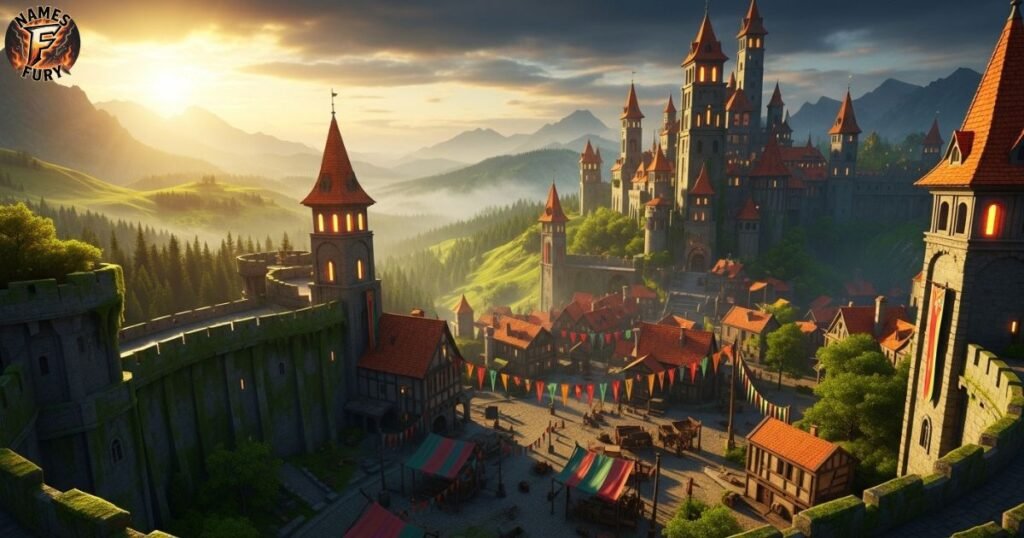
These forty-five are the names to reach for first, because each one is a real English or Norse pattern with the geography still visible in it: Thornbury is a fortified place among thorns, Coldmere is a lake, Fenwick is a dwelling in the fen, Kirkgate is the church road and Saltwick is the settlement that boiled brine. A good town name should tell a reader where the water is, what the ground does and what the people sold, and every name here does at least two of those three things.
| Name | What it means | Best for |
|---|---|---|
| Thornbury | Coined from OE thorn plus burh, a fortified place; the burh element is the same one in Canterbury and Aylesbury | A walled market town |
| Ravensmoor | Raven plus OE mor, the wet open waste where carrion birds feed | A border town in bad weather |
| Coldmere | Cold plus OE mere, a lake; a mere is standing water, not a river | A lake settlement |
| Oakgarth | Oak plus ON garth, an enclosed yard or croft | A farming village |
| Ferncombe | Fern plus OE cumb, a short deep valley; the same element as Ilfracombe | A valley hamlet |
| Wychford | OE wic, here a dairy farm, plus ford; wych is also the wych elm | A river crossing |
| Alderley | Alder plus OE leah, a woodland clearing | A woodland village |
| Brackenridge | Bracken plus OE hrycg, a long narrow hill | A hill town |
| Woldham | OE wold, high open upland, plus ham, a homestead | An upland farm town |
| Fenwick | Fen plus OE wic, a dwelling or trading place | A marsh village |
| Castleton | Castle plus OE tun, an enclosure that became a farm then a town | A fortress town |
| Grimshaw | The Norse personal name Grim plus OE sceaga, a small wood | A dark woodland hamlet |
| Thorpwood | ON thorp, an outlying dependent farmstead, plus wood | A satellite village |
| Netherfield | OE nether, lower, plus feld, open land rather than forest | A low farming town |
| Highmoor | High plus OE mor, the wet upland waste | A windswept town |
| Saltwick | Salt plus OE wic; the wich towns were real salt-working settlements | A brine or salt town |
| Beckdale | ON bekkr, a stream, plus ON dalr, a valley | A stream valley village |
| Crowholme | Crow plus ON holmr, dry ground rising out of marsh | A marsh island village |
| Deepdale | Deep plus dalr; several real Deepdales exist in the Dales | A remote valley |
| Elmfield | Elm plus feld, cleared open land | A farmland town |
| Fellgate | ON fjall, a fell or hill, plus ON gata, a street or road | A hill road town |
| Firthtown | ON fjordr, an inlet, plus tun; a firth is the Scottish word for the same inlet | A coastal inlet town |
| Garthwick | ON garth, an enclosure, plus OE wic, a dwelling or dairy farm | A small crofting village |
| Goldwell | Gold plus OE wella, a spring; a well was the reason most villages existed | A spring town |
| Kirkgate | ON kirkja, a church, plus gata, a road; still a real street name across the north | A church town |
| Longstone | OE lang plus stan, a standing stone; real Longstone in Derbyshire | A standing-stone village |
| Mossdale | Moss, the peat bog, plus dalr | A peat valley hamlet |
| Ormsby | ON Ormr, serpent, plus byr, a farmstead | A coastal Norse village |
| Ridgefield | OE hrycg, a ridge, plus feld | A ridge farm town |
| Springthorpe | OE springa plus thorp, an outlying farmstead | A well-fed hamlet |
| Stonehythe | Stone plus OE hythe, a landing place for small boats | A river port |
| Strathmore | Gaelic strath, a broad river valley, plus mor, great | A highland valley town |
| Thornthwaite | Thorn plus ON thveit, a clearing cut out of woodland | A cleared hill village |
| Wheatley | OE hwaete, wheat, plus leah, a clearing; real Wheatleys exist everywhere | A grain village |
| Whitbarrow | OE hwit, white, plus ON berg or OE beorg, a hill or barrow; real Whitbarrow Scar is in Cumbria | A limestone hill town |
| Yewdale | Yew plus dalr; Yewdale Beck is real, beside Coniston | A valley village |
| Blackthorpe | Black plus thorp, an outlying farmstead | A poor satellite village |
| Bramblecote | Bramble plus OE cot, a cottage or shelter | A hedgerow hamlet |
| Hollowmere | Hollow plus mere, a lake in a bowl of land | A hidden lake town |
| Kingscroft | King plus OE croft, a small enclosed field; a croft is the smallest farm there is | A royal farm village |
| Lanternhill | Lantern plus OE hyll; a hill where a light was kept for travellers | A beacon town |
| Misthollow | OE mist plus hollow; a hollow that keeps its fog until noon | A fog-bound hamlet |
| Nettlecombe | Nettle plus cumb, a short valley | An overgrown valley village |
| Pinegarth | Pine plus garth, an enclosed yard | A northern timber village |
| Quietmere | Quiet plus mere; the only sound is water | A still lake town |
Medieval Town Names
Every name in this table is a real place, and every meaning is the one place-name scholars give it, which makes this the only medieval town list on the internet that can be fact-checked.
You can also compare early recorded forms using the historical place-name records collected through the English Place-Name Society’s surveys.
| Name | Documented meaning | Record or county | Best for |
|---|---|---|---|
| Nottingham | Snotingaham, the homestead of Snot’s people; the S fell away in later spelling | Domesday Book, Nottinghamshire | A town with a founder |
| Buckingham | The homestead of Bucca’s people, from ham plus the ingas ending | Domesday Book, Buckinghamshire | A market town |
| Birmingham | The homestead of Beorma’s people | Domesday Book, Warwickshire | A working city |
| Oxford | Oxenaforda, the ford where oxen crossed | Anglo-Saxon Chronicle | A river crossing with a school |
| Cambridge | Grantanbrycge became Cambridge, the bridge over the river Cam | Domesday Book, Cambridgeshire | A river town |
| Warwick | Wæringwíc, the dwellings by the weir, from wer plus wic | Domesday Book, Warwickshire | A walled town |
| Chester | Ceaster, the Old English word for a Roman camp, from Latin castra | Roman Deva | A Roman-walled town |
| Manchester | Mamucium plus ceaster; mamm means breast, so the fort on the breast-shaped hill | Roman Mamucium | A fort town |
| Lancaster | Lon, the river Lune, plus ceaster, the Roman camp | Roman Calunium | A river fort town |
| Winchester | Wintanceaster, Winta’s Roman fort, from Venta Belgarum | Roman Venta Belgarum | An old capital |
| Exeter | Isca plus ceaster; isca is the Celtic word for water, so this is the fort on the Exe | Roman Isca Dumnoniorum | A south-west fort town |
| Norwich | Norwic, the north trading place, from wic | Domesday Book, Norfolk | A trading city |
| Ipswich | Gipeswic, the trading place on the river Gipping | Anglo-Saxon emporium | A port town |
| Sandwich | Sand plus wic, the market place on sand; the ending means a trading settlement, not food | One of the Cinque Ports | A coastal trading town |
| Greenwich | Grenewic, the green trading place | Domesday Book, Kent | A riverside town |
| Derby | Deoraby, the farmstead of the deer, from ON dýr plus býr | Danelaw, one of the Five Boroughs | A Norse town |
| Whitby | Hvítabýr, the white settlement, from ON hvítr plus býr | Domesday Book, Yorkshire | A coastal cliff town |
| Grimsby | Grimr’s farmstead; Grimr is a Norse personal name and also one of Odin’s names | Domesday Book, Lincolnshire | A fishing town |
| Kirkby | Kirkjubýr, the church village, from ON kirkja plus býr | Common across the Danelaw | A parish village |
| Ormskirk | Ormr’s church; a village named from a church rather than a farm | Domesday Book, Lancashire | A market town |
| Lowestoft | Hlothver’s toft, from a Norse personal name plus toft, a building site | Domesday Book, Suffolk | The most easterly town in England |
| Skipton | Scipeton, the sheep farm, from ON skip, sheep, plus tun | Domesday Book, Yorkshire | A moorland market town |
| Sedbergh | Setr plus beorg, the shieling on the hill; a setr was summer grazing | Domesday Book, Yorkshire | A high summer-pasture town |
| Threlkeld | Thræl plus kelda, the thrall’s spring, from ON thrael and kelda | Domesday Book, Cumberland | A spring village |
| Thirsk | Thresk, the Old Norse for a clearing or a farmstead cut out of woodland | Domesday Book, Yorkshire | A market town |
| Ulverston | Ulfr’s tun, the wolf’s farmstead | Domesday Book, Lancashire | A northern town |
| Pocklington | Poccel’s people plus tun; the inga ending always means a family or a following | Domesday Book, Yorkshire | A farming town |
| Stamford | Stanford, the stone ford, from OE stan plus ford | Domesday Book, Lincolnshire | A crossing town |
| Stony Stratford | The stony ford on the Roman road, from stræt plus ford | Domesday Book, Buckinghamshire | A road town |
| Barrowford | Beorg plus ford, the ford by the burial mound | Domesday Book, Lancashire | A mound-and-ford village |
| Stapleford | Stapol plus ford; a stapol was a post, often a market post | Domesday Book, several counties | A market crossing |
| Hardwick | Heord plus wic, the flock farm; a wic that kept sheep | Domesday Book, common name | A sheep village |
| Haythwaite | Heath plus thveit, the clearing on the heath | Domesday Book, Cumberland | A heath village |
| Holmfirth | Holm plus frith, the enclosed woodland on the island ground | Domesday Book, Yorkshire | A valley town |
| Ingleby | Engill’s byr, the Englishman’s farmstead, a Norse name for an English settler | Domesday Book, Yorkshire | A border village |
| Langdale | Langr plus dalr, the long valley | Lake District | A long valley |
| Micklegate | Micel plus gata, the great street; still the name of York’s main gate street | City of York | A walled city street |
| Harrogate | Harrow plus gate, the road past the hearg, an outdoor heathen shrine | Domesday Book, Yorkshire | A shrine town turned spa |
| Silverdale | Seolfor plus dalr, the silver valley | Domesday Book, Lancashire | A coastal valley |
| Greystoke | Graeg plus stoc, the grey outlying farmstead; a stoc was a dependent farm | Domesday Book, Cumberland | An outlying farm village |
| Troutbeck | Trout plus bekkr, the stream with trout in it | Lake District | A stream village |
| Bury St Edmunds | The burh of St Edmund, a fortified monastery town that grew around a martyr’s shrine | Domesday Book, Suffolk | A shrine town |
| York | Eboracum became Eoforwic, the boar village, then Jorvik, then York | Roman and Viking capital | A capital city |
| Chipping Norton | Ceping, the market, plus Nortun, the north farmstead; chipping means market | Domesday Book, Oxfordshire | A market town |
| Market Harborough | Market plus haran-beorg, the hoar-stone barrow or boundary mound | Domesday Book, Leicestershire | A boundary market town |
Dark and Evil Fantasy Town Names
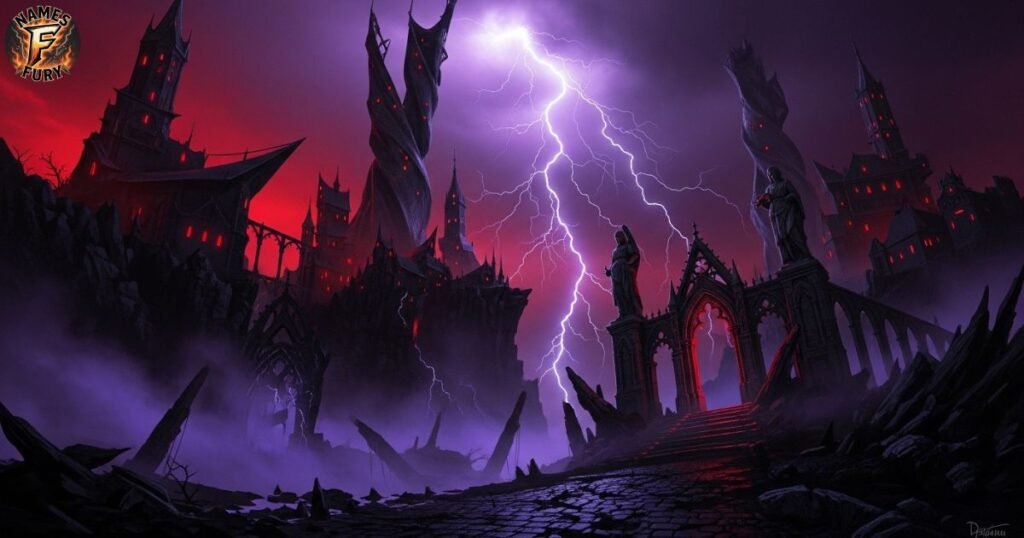
A dark town name works when the darkness is a fact about the place rather than an adjective.
| Name | What the root means | Best for |
|---|---|---|
| Gallowsmere | The gallows plus mere, the lake; the gallows stood outside the gate on purpose | A town that executes people |
| Crowbarrow | Crow plus beorg, the burial mound; crows wait on barrows | A plague town |
| Blackfen | Black plus fen, the marsh that does not drain | A sinking town |
| Ashfall | Ash plus feall; ash from a fire or a volcano, and also the ash tree | A burned town |
| Bonegate | Ban plus gata, the road of bones | A siege town |
| Wretchcombe | Wrecce, an exile or an outcast, plus cumb; the valley nobody wants | An exile valley |
| Sloughmere | The slough, a swamp you sink in, plus mere | A bog town |
| Thornmire | Thorn plus mir, the mire; both parts hurt | A marsh prison town |
| Hagholm | Hag, a witch or an old hag, plus holmr, dry ground in the marsh | A fen island with a witch |
| Pyrewick | Pyre plus wic, the settlement by the burning ground | A plague-pit town |
| Shroudmoor | Shroud plus mor; a moor under a shroud of cloud | A fog town |
| Wolfmoot | Wulf plus mot, the meeting place; a moot was where judgement happened | A judgement town |
| Grimhollow | Grim plus hoh; grim also means masked, and was a name of Odin | A masked-god town |
| Ravenfeld | Raven plus feld, the open ground where ravens feed after a battle | A battlefield town |
| Miregate | Mir plus gata, the road through the mire | A causeway town |
| Bloodbeck | Blood plus bekkr, the stream; a beck that runs red after a fight | A war stream town |
| Deadmansworth | The dead man plus worth, the enclosed homestead | A haunted farm town |
| Fellcrypt | Fell, deadly, plus crypt; the crypt under the hill | A tomb town |
| Hollowstone | Hollow plus stan; a standing stone with nothing inside it | A cursed stone circle |
| Wraithcombe | Wraith plus cumb; the valley that keeps the dead | A haunted valley |
| Netherbarrow | Nether, lower, plus beorg; the low burial mound | A barrow town |
| Cinderthorpe | Cinder plus thorp; the outlying farm that burned down | A burned hamlet |
| Blightmere | Blight, crop-rot, plus mere | A sick lake town |
| Sablewick | Sable, the black of heraldry, plus wic | A black trading town |
| Griefmoor | Grief plus mor; the wet waste where nothing grows | A mourning town |
| Duskfield | Dusk plus feld; the field that is dark before the rest of the country | A twilight town |
| Ironhollow | Iron plus hoh; the hill that was dug out for ore and left empty | An exhausted mine town |
| Marrowfen | Marrow, the inside of bone, plus fen | A bone-collecting fen town |
| Nightgarth | Night plus garth; the yard that is locked after dark | A curfew town |
| Palestoke | Pale plus stoc; the outlying farm at the end of the light | A frontier farm |
| Rustwick | Rust plus wic; the settlement where the metal goes bad | A wet iron town |
| Sorrowby | Sorrow plus byr; the Norse farmstead with an English grief in it | A plague village |
| Thornpyre | Thorn plus pyre; the burning ground ringed in thorn | An execution town |
| Undermoor | Under plus mor; the land below the moor, which usually means tunnels | A mining town |
| Vilegarth | Vile plus garth | A cursed croft |
| Weepingstone | The weeping plus stan; a stone that stays wet all year | A spring shrine gone wrong |
| Whisperbeck | Whisper plus bekkr; the stream you hear before you find it | A haunted stream village |
| Witherholt | Wither plus holt, the small wood; a copse where the trees died standing | A dying wood town |
| Wormhollow | Wyrm, the Old English serpent or dragon, plus hoh | A dragon-hill town |
| Yewcrypt | Yew plus crypt; yew was planted in churchyards because it is poisonous and long-lived | A churchyard town |
Elven Town Names
Elvish place names are the one fantasy register that already has a documented grammar, so the honest way to build one is to use the elements Tolkien actually recorded and say that you are using them.
| Name | Element breakdown | Built from | Best for |
|---|---|---|---|
| Amonlond | Amon, hill, plus lond, a haven; a haven under a hill, the way Edhellond is built | Sindarin elements | A coastal elf haven |
| Baradithil | Barad, tower, plus ithil, moon; the tower of the moon | Sindarin elements | A moonlit tower city |
| Caladhaven | Calad, light, plus lond, a haven; a bright landing place | Sindarin elements | A river port |
| Dolgaladh | Dol, head or hill, plus galadh, tree; the hill of trees, the pattern behind Caras Galadhon | Sindarin elements | A forest city |
| Elenost | Elen, star, plus ost, a city or fortress; the star city | Sindarin elements | A high elf capital |
| Falasring | Falas, shore, plus ring, cold; the cold shore | Sindarin elements | A northern coastal town |
| Gilmenel | Gil, star, plus menel, the heavens; a name that puts the sky in the street | Sindarin elements | A stargazing town |
| Hithloen | Hith, mist, plus loen; the misty place, built on the pattern of Hithlum | Sindarin elements | A mist valley town |
| Imladlass | Imlad, a deep valley, plus las, leaf; the leaf valley, built on Imladris | Sindarin elements | A hidden vale |
| Lindonwen | Lind, song, plus the Welsh-flavoured wen, white or blessed; the white song | Sindarin and Welsh pattern | A singing city |
| Mirost | Mir, jewel, plus ost, a city; the jewel city | Sindarin elements | A rich elf city |
| Nenuilind | Nenui, water lily, plus lind, song; the lily song | Sindarin elements | A lake town |
| Oradorn | Or, above, plus adorn; the high place, built on the pattern of Amon | Sindarin elements | A mountain town |
| Rathcelebrin | Rath, a walled street, plus celebrin, silvery; the silver street | Sindarin elements | A silver-mining city |
| Sarnithil | Sarn, a pebble or a stone ford, plus ithil, moon; the moonlit stone crossing | Sindarin elements | A river crossing |
| Taurimlad | Taur, forest, plus imlad, a deep valley; the forest in the valley | Sindarin elements | A woodland vale |
| Thondring | Thond, a root, plus ring, cold; the cold root, which is what an old forest feels like | Sindarin elements | An ancient forest town |
| Aireloston | Aire, holy, plus los, snow, plus ton; the holy snow town | Quenya and Sindarin mix | A mountain shrine town |
| Alqualonde | Alqua, swan, plus londe, a landing place; the pattern Tolkien used for Alqualonde, the Swanhaven | Quenya elements | A swan haven |
| Calaquendi Port | Cala, light, plus quendi, the people; a port of the light people | Quenya elements | A high elf port |
| Lauriel | Laure, gold, plus iel; the golden one, built on the pattern of Galadriel | Quenya elements | A golden tree town |
| Meneltir | Menel, the heavens, plus tir, to watch; the watcher of the sky | Quenya and Sindarin mix | An observatory town |
| Silmegarth | Silme, starlight, plus the Sindarin garth, an enclosure; the starlight yard | Quenya and Sindarin mix | A walled garden town |
| Tinwelond | Tinwe, a star, plus lond, a haven; the star haven | Quenya elements | A harbour town |
| Turamenel | Tura, power, plus menel, the heavens; the power of the sky | Quenya elements | A fortress city |
| Urloste | Ur, fire, plus los, snow; fire and snow in one name | Quenya elements | A volcanic snow town |
| Amrothgar | Am, up, plus roth, a cave; the cave up high | Sindarin elements | A cliff cave town |
| Caradost | Carad, red, plus ost, a city; the red city | Sindarin elements | A red-stone city |
| Duilond | Dui, the two rivers, plus lond; the town where two rivers meet | Sindarin elements | A confluence town |
| Erebdol | Ereb, lonely, plus dol, a head or hill; the lonely hill | Sindarin elements | An isolated outpost |
| Falosthir | Falas, shore, plus ost, a city, plus tir, watch; the city that watches the shore | Sindarin elements | A coast guard city |
| Gondring | Gond, stone, plus ring, cold; the cold stone | Sindarin elements | A stone circle town |
| Laerimlad | Laer, summer, plus imlad, a deep valley; the summer valley | Sindarin elements | A warm hidden vale |
| Morlund | Mor, black, plus lun; the dark place, the elvish answer to a dark town | Sindarin elements | A dark elf town |
| Neldorgarth | Neldor, beech, plus garth, an enclosure; the beech yard | Sindarin elements | A beechwood village |
Dwarven Town Names
Dwarf place names come from three documented systems rather than from one.
| Name | Element breakdown | Built from | Best for |
|---|---|---|---|
| Khazadost | Khazad, the dwarves, plus ost; the dwarf city, built the way Khazad-dum is built | Khuzdul elements | A dwarf capital |
| Karakgrimm | Karak, the Warhammer word for a fortified hold, plus grim; the grim hold | Warhammer dwarfish | A war hold |
| Barukhalla | Baruk, axes, plus halla; the hall of axes, from the war cry Baruk Khazad | Khuzdul elements | An axe-makers hold |
| Tumunbaruk | Tumun, hollow, plus baruk, axes; the hollow of axes, built on Tumunzahar, the Khuzdul name for Nogrod | Khuzdul elements | A cave smithy |
| Gabilgathol | Great fortress; this is the actual Khuzdul name Tolkien gave Belegost | Tolkien canon | A canon city |
| Nulukkhizdin | The Khuzdul name Tolkien gave Nargothrond; the dwarves claimed the caves first | Tolkien canon | A contested hold |
| Zirakdol | Zirak, silver, plus dol, a head or hill; the silver head, built on Zirakzigil | Khuzdul elements | A silver mine |
| Fanuikarak | Fanui, cloudy, plus karak, a hold; the cloudy hold, built on Fanuidhol | Khuzdul and Warhammer mix | A cloud-wrapped hold |
| Shathurdun | Shathur, clouds, plus dun, a fort; the cloud fort | Khuzdul elements | A peak fortress |
| Felekgarth | Felek, to hew rock, plus garth, an enclosure; the yard where the rock is cut | Khuzdul and Norse mix | A quarry hold |
| Dumbaruk | Dum, the excavations or mansion, plus baruk, axes; the axe excavations | Khuzdul elements | A deep hold |
| Niðavellir | The dark fields; one of the two dwarf realms named in the Prose Edda | Norse canon | A Norse dwarf realm |
| Svartalfaheim | The world of the black elves, which in the Prose Edda means the dwarves | Norse canon | A Norse dwarf realm |
| Jarnvidhold | Jarnvidr, the iron wood, plus hold; a hold beside the forest of iron trees | Norse and English mix | An iron forest hold |
| Ironkarak | Iron plus karak, a hold; the plainest dwarf hold name there is | Warhammer pattern | An iron hold |
| Grimbad | Grim plus bad; Gunbad and Kadrin follow the same blunt shape | Warhammer pattern | A mountain hold |
| Anvilkarak | Anvil plus karak; a hold named for one object, which dwarves do constantly | Warhammer pattern | A smith hold |
| Deepdum | Deep plus dum, the excavations; the deeper the hold, the older it is | English and Khuzdul mix | An ancient hold |
| Runehalla | Rune plus halla; the hall of runes | Norse and English mix | A rune hall |
| Stonegabil | Stone plus gabil, great; the great stone | English and Khuzdul mix | A stone city |
| Orekarak | Ore plus karak; a hold that exists because of one seam | Warhammer pattern | A mining hold |
| Hearthdum | Hearth plus dum; the home fires of a deep hold | English and Khuzdul mix | A home hold |
| Grudgehall | The hall where the grudges are read out; the Book of Grudges is Dammaz Kron in the dwarfish tongue | Warhammer pattern | A court hold |
| Bronzekarak | Bronze plus karak; the older metal, so the older hold | Warhammer pattern | An ancient hold |
| Mithrildun | Mithril plus dun, a fort; the fort built on the one seam worth dying for | Tolkien pattern | A rich hold |
| Slaggarth | Slag plus garth; the yard where the waste is tipped | English and Norse mix | A smelting town |
| Quarrykarak | Quarry plus karak; the working face becomes the town | Warhammer pattern | A quarry hold |
| Deepgatehold | Deep plus gate plus hold; three dwarf words doing one job | English pattern | A gate town |
| Angrboðakarak | Named on the pattern of the Norse giantesses; Angrboda means she who brings grief | Norse pattern | A cursed hold |
| Hammerfellhold | Hammer plus fell, a hill, plus hold | English and Norse mix | A hill forge |
| Karaknauk | Karak plus naukr; naukr is Old Norse for a ship, so this is the hold that built ships | Norse and Warhammer mix | A river hold |
| Goldveinkarak | Gold plus vein plus karak | Warhammer pattern | A gold hold |
| Emberdun | Ember plus dun, a fort; the fort that stays warm | English pattern | A forge fort |
| Frostkarak | Frost plus karak; the hold that freezes shut in winter | Warhammer pattern | A northern hold |
| Barazindun | Barazin, red, plus dun, a fort; the red fort, built on Barazinbar | Khuzdul elements | A red-stone fort |
Cute and Peaceful Town Names
A cute town name is not a soft name, it is a small concrete thing attached to a real place element, which is why Honeywick works: a wic was a dairy farm, so this is the farm that made honey, and the sweetness is a fact rather than a decoration.
| Name | What it means | Best for |
|---|---|---|
| Honeywick | Honey plus OE wic, the dairy farm; a wic made honey and butter, so the name is a job | A sweet farming village |
| Wrencombe | Wren plus cumb, a small valley; the smallest bird in the smallest valley | A tiny valley hamlet |
| Larkfield | Lark plus feld; a field named for what you hear in it | A morning-bright village |
| Blossomgarth | Blossom plus ON garth, an enclosed yard; an orchard yard | An orchard village |
| Butterwell | Butter plus OE wella, a spring; a spring rich enough to name for dairy | A dairy village |
| Berryholme | Berry plus ON holmr, dry ground in a marsh | A berry island village |
| Applecote | Apple plus OE cot, a cottage or shelter; a shelter under the apple trees | An orchard hamlet |
| Lanternby | Lantern plus ON byr, a farmstead; the farm with a light in the window | A welcoming village |
| Kettlethorpe | Kettle plus ON thorp, an outlying farmstead; Kettlethorpe is a real name in several counties | A homely hamlet |
| Cradlebeck | Cradle plus ON bekkr, a stream; a stream that rocks | A sleepy stream village |
| Nestholme | Nest plus holmr; dry ground where the birds nest | A bird island village |
| Woolgarth | Wool plus garth; the yard where the fleece was sorted | A sheep village |
| Thimblecote | Thimble plus cot; the smallest cottage in the parish | A very small hamlet |
| Posycombe | Posy plus cumb; a valley of flowers | A flower valley |
| Marigoldmere | Marigold plus mere; marsh marigolds grow at the edge of a lake | A lakeside village |
| Willowhythe | Willow plus OE hythe, a landing place; willows grow where the boats tie up | A river landing |
| Robinfield | Robin plus feld; a field named for the bird that follows the plough | A friendly farm village |
| Badgerholt | Badger plus OE holt, a small wood; a badger sett in a copse | A woodland hamlet |
| Otterbeck | Otter plus bekkr; a stream with otters in it is a clean stream | A clean stream village |
| Hedgerow End | Hedge plus row plus end; end is a real English place-name element meaning the far part of a parish | A hamlet at the edge |
| Cloverley | Clover plus OE leah, a woodland clearing; Cloverley is a real Shropshire name | A clover clearing |
| Posyworth | Posy plus OE worth, an enclosed homestead; the farm with flowers at the door | A flower farm hamlet |
| Pumpkinfield | Pumpkin plus feld; the field that feeds everyone in autumn | An autumn village |
| Turnipwick | Turnip plus wic; the honest vegetable, honestly named | A poor but cheerful village |
| Acornshaw | Acorn plus OE sceaga, a small wood; an oak copse named for what falls out of it | An oak hamlet |
| Hazelnook | Hazel plus OE halh, a nook of land; halh became nook in meaning and in sound | A tucked-away hamlet |
| Sparrowgate | Sparrow plus ON gata, a road; the road the sparrows use | A busy little village |
| Finchthwaite | Finch plus ON thveit, a woodland clearing | A clearing village |
| Sleepyholme | Sleepy plus ON holmr, dry ground in a marsh; the hamlet where nobody hurries | A sleepy island hamlet |
| Pippinby | Pippin, the apple, plus byr; an orchard farmstead | An apple village |
Unique and Rare Town Names
The rarest town names are not invented, they are the real ones nobody has borrowed yet. Wetwang is the Old Norse for the field where the legal assembly met, Fangfoss is a piece of land beside a waterfall, Duggleby is the farmstead of a man called Dugald, and Wharram Percy is a whole village that was abandoned and never rebuilt, which is why its streets still show in the grass.
| Name | Documented meaning or record | Best for |
|---|---|---|
| Wetwang | Vettvangr, the field where the legal assembly was held; a real Yorkshire village with a Norse name that still makes sense | A place of law |
| Fangfoss | Fang plus foss, a piece of land or a catch beside a waterfall; a real East Yorkshire village | A waterfall village |
| Duggleby | Dugald’s byr, the farmstead of a man called Dugald; a real Yorkshire village | A Danelaw farmstead |
| Langtoft | Lang plus toft, the long building site; a real village in both Yorkshire and Lincolnshire | A long street village |
| Crackpot | Recorded in Swaledale, usually read as crow plus pot or hollow; a real hamlet with an unforgettable name | A high dale hamlet |
| Wharram Percy | Hvarf, a bend in the land, plus ham, plus the Percy family who held it; the best-preserved deserted medieval village in England | A lost village |
| Wharram le Street | The same wharram plus the Roman road, written down in French after the Conquest | A Roman road village |
| Uffington | Uffa’s tun, the farmstead of a man called Uffa; famous for the white horse cut into the chalk | A chalk hill village |
| Worminghall | Wyrma’s people plus halh, a nook of land between a river and a hill; a real Buckinghamshire village | A nook village |
| Cuckney | Cucu, the cuckoo, plus ey, an island; the cuckoo island, a real Nottinghamshire village | An island village |
| Grimston | Grimr’s tun; Grimston hybrid names are the classic proof of Norse settlers using an Old English ending | A hybrid Norse-English town |
| Piddlehinton | Piddle, the Dorset river, plus hean tun, the high farmstead; two real elements making one unforgettable name | A river village |
| Whippingham | The halh, a nook of land, of a personal name that scholars still argue about; a real village on the Isle of Wight | A disputed etymology village |
| Rillington | Rylla’s people plus tun; a real East Yorkshire village | A family-named town |
| Wigginton | Wicga’s tun, the farmstead of a man called Wicga; a real name in several counties | A founder-named town |
| Heslerton | Haesel, hazel, plus tun; the hazel farmstead, a real Yorkshire village | A hazel village |
| Foston | Fotr’s tun, the farmstead of a Norseman called Fotr, meaning foot | A founder-named farmstead |
| Borrowdale | Borg plus dalr, the fortress valley; the great Lakeland dale | A defended valley |
| Wasdale | Vatn plus dalr, the lake valley; Wasdale Head sits under England’s highest mountain | A lake valley |
| Eskdale | Aesc plus dalr, the ash valley; the Esk is a river name older than English | A river valley |
| Garsdale | Gar, a spear, plus dalr; the spear valley | A border valley |
| Arkengarthdale | Built from arc plus engi, a meadow, plus garth, an enclosure, plus dalr; four elements in one valley name | A complicated dale |
| Coverdale | The river Cover plus dalr; a valley named from its own water | A river valley |
| Swaledale | Svalr, cool or rushing, plus dalr; the dale of the Swale | A fast river valley |
| Wath | Vath, the Old Norse for a ford; a whole village named with one syllable | A ford village |
| Crackenthorpe | Krakan plus thorp, the crow’s outlying farmstead; a real Cumbria village | A crow farmstead |
| Thwing | Recorded in Domesday as Tuinc, of uncertain origin; honesty beats a made-up meaning | A village with no settled etymology |
| Fimber | Recorded in Domesday, origin uncertain; another name scholars will not force a meaning onto | A village with no settled etymology |
| Nafferton | Recorded as Nafre’s tun in most readings, a farmstead named from a man | A founder-named farmstead |
| Slaidburn | Slaed or ON sletta, a smooth valley, plus burn, a stream; a real Lancashire village | A smooth valley stream |
| Uggeshall | Ugge’s halh, the nook of a man called Ugge; a real Suffolk village | A nook village |
| Muston | Recorded as Mustone in Domesday, usually read as mouse plus tun | A mouse farmstead |
| Folkton | Folc’s tun, the farmstead of a man called Folc; a real Yorkshire village | A founder-named town |
| Settrington | Saeter’s people plus tun, the farmstead of Saeter’s followers | A followers-named town |
| Boythorpe | Bothi plus thorp, the outlying farmstead of a man called Bothi | A small farmstead |
Magical Town Names
Magical town names fail when the whole name is magic, because then nothing in it is a place.
| Name | What it means | Best for |
|---|---|---|
| Moonmere | Moon plus OE mere, a lake; the lake the moon uses as a mirror | A lake of reflection |
| Starfall Hollow | Star plus feall plus hollow; where the star landed, and the hole it made | A meteor village |
| Wispwick | Will-o-the-wisp plus wic, a settlement; the marsh light has a village of its own | A marshlight town |
| Chimecombe | Chime plus cumb, a valley; the valley where bells carry | A bell valley |
| Glassmere | Glass plus mere; water so still it looks manufactured | A mirror lake town |
| Mirrorford | Mirror plus ford; the crossing where you see yourself | A crossing town |
| Veilgarth | Veil plus garth, an enclosure; a yard with a curtain over it | A hidden yard town |
| Dreamthwaite | Dream plus thveit, a clearing; the clearing where you fall asleep | A sleeping village |
| Echowold | Echo plus wold, high open land; an echo needs open ground | A hillside echo town |
| Runestone | Rune plus stan, a standing stone; the stones already existed, the runes came after | A carved stone circle |
| Hexhollow | Hex plus hollow; a valley that holds a curse the way a bowl holds water | A cursed valley |
| Wardmere | WEard, a guard, plus mere; the lake that is guarded | A guarded lake |
| Lanternwisp | Lantern plus wisp; the light that moves is the whole point of the name | A moving-light moor |
| Auroracombe | Aurora, the dawn, plus cumb; the valley that catches the first light | A dawn valley |
| Twilightthorpe | Twilight plus thorp, an outlying farmstead; the farm that is always at dusk | A dusk hamlet |
| Embercombe | Ember plus cumb; a valley that stays warm after the fire is out | A warm valley |
| Frostglass | Frost plus glass; ice as a window | A frozen lake town |
| Tidecharm | Tide plus charm; a charm that only works at a certain water level | A tidal village |
| Whisperwick | Whisper plus wic; the settlement that speaks quietly | A quiet trading town |
| Oraclemere | Oracle plus mere; the lake that answers | A prophecy town |
| Omenfield | Omen plus feld; the field where the sign appeared | A sign-marked town |
| Sigilgate | Sigil plus gata, the road; the sealed gate | A sealed town |
| Glyphhollow | Glyph plus hollow; the valley with writing on the walls | A carved valley |
| Leycrossing | The ley line plus the crossing; two lines meeting is why the place matters | A ley-line crossing |
| Spellthorpe | Spell plus thorp; OE spell meant a story or a saying before it meant magic | A story village |
| Charmcombe | Charm plus cumb; OE galdor was the real word for a charm, and galdor-stan is a charm stone | A charm valley |
| Glimmerbeck | Glimmer plus bekkr, a stream | A sparkling stream village |
| Halolund | Halo plus lund, a grove; a grove with a ring around it | A holy grove town |
| Nimbuscombe | Nimbus, the cloud, plus cumb | A cloud valley |
| Phantasmere | Phantasm plus mere; a lake that is not quite there | A ghost lake |
| Soothgarth | Sooth, truth, plus garth; the yard where the truth is told | A judgement yard |
| Talismanby | Talisman plus byr; the farmstead that keeps the charm | A charm-keeping village |
| Vesperholm | Vesper, the evening star, plus holmr, dry ground in a marsh | An evening island village |
| Willowisp End | The will-o-the-wisp plus end, the far part of a parish | A marsh-edge hamlet |
| Zephyrgarth | Zephyr, the west wind, plus garth; a yard that is never still | A windy croft |
Mysterious and Ancient Town Names
Ancient is the one register where you do not have to invent anything, because the real sites are stranger than anything coined. Dark fantasy town names pair wonderfully with pirate names when you want gritty coastal intrigue. Shadow town names make every corner feel alive with danger.
| Name or site | What it is | Record | Best for |
|---|---|---|---|
| Calleva Atrebatum | The Roman town now called Silchester in Hampshire, abandoned around 400 and never rebuilt, so the whole street plan still survives under a field | Real Roman-British town | A ruin that nobody reused |
| Wroxeter | Viroconium Cornoviorum, the fourth largest Roman city in Britain, now a field with one free-standing wall | Real Roman-British town | A fallen capital |
| Old Sarum | Sorviodunum, the hill fort, cathedral and castle that were all moved down to the water and became Salisbury | Real abandoned town | A town that walked away |
| Skara Brae | A Neolithic village in Orkney, older than the pyramids, uncovered by a storm in 1850 | Real Neolithic village | A buried village |
| Maeshowe | A Neolithic chambered cairn in Orkney with Viking runes cut into it nine hundred years later | Real cairn with runes | A tomb with graffiti |
| Dun Carloway | An Iron Age broch on Lewis, a dry-stone tower with no mortar that still stands fourteen metres high | Real Scottish broch | A stone tower village |
| Vindolanda | A Roman fort below Hadrian’s Wall famous for the ink-on-wood tablets that record ordinary letters | Real Roman fort | A fort with paperwork |
| Housesteads | Vercovicium, a Roman fort on the Wall with the best-preserved barracks and latrines in Britain | Real Roman fort | A frontier fort town |
| Hardknott | Mediobogdum, a Roman fort in Eskdale built square on a thirty percent slope | Real Roman fort | An impossible fort |
| Aldborough | Isurium Brigantium, a Roman town whose walls now make a lane and a churchyard | Real Roman-British town | A quiet ruin |
| Caerwent | Venta Silurum, the Roman market town of the Silures, with walls you can still walk | Real Roman-British town | A walled market ruin |
| Portchester | Portus Adurni, the Saxon Shore fort whose Roman walls contain a Norman keep and a church | Real Roman fort | A fort with three lives |
| Richborough | Rutupiae, the port where the Roman invasion landed, now two miles from the sea | Real Roman port | A port the sea abandoned |
| Silbury Hill | The largest man-made mound in Europe, built over centuries and containing no burial anybody has found | Real Neolithic mound | A mound with no answer |
| West Kennet | A Neolithic long barrow whose stones were dragged from the Marlborough Downs | Real long barrow | An old grave town |
| Avebury | A village built inside the largest stone circle in the world, with a road through it | Real stone circle | A village inside a monument |
| Maiden Castle | The largest Iron Age hillfort in Europe, taken by Rome and left with a war cemetery inside | Real hillfort | A captured fortress |
| Caerleon | Isca Augusta, the Roman legionary fortress in south Wales, with an amphitheatre you can still walk into | Real Roman fortress | A fortress with an arena |
| Cairndel | Coined: caer, a fort, plus denu, a valley; the fort in the valley | Coined from Celtic and Old English | A hillfort valley |
| Cromlechwy | Coined from cromlech, the Welsh word for a capstone grave, plus the Welsh place ending | Coined from Welsh | A standing-stone village |
| Tumultbarrow | Coined: tumulus, a burial mound, plus beorg; two words for the same thing | Coined from Latin and Old English | A barrow town |
| Tellhollow | Coined: a tell is the mound a town makes when it is rebuilt on its own ruins for a thousand years | Coined from archaeology | A mound city |
| Nuraghe | A real Sardinian dry-stone tower, and there are seven thousand of them; the word works as a name on its own | Real Sardinian word | A tower village |
| Brochgarth | Coined: broch plus garth, the tower yard | Coined from Norse and Scots | A tower croft |
| Crannogmere | Coined: a crannog is a real Iron Age lake dwelling built on timber piles, plus mere | Coined from Gaelic and Old English | A lake-pile village |
| Oppidumfell | Coined: oppidum, the Latin word for a defended Iron Age town, plus fell | Coined from Latin and Norse | A defended hill |
| Vicusstone | Coined: a vicus was the civilian settlement that grew outside a Roman fort, plus stan | Coined from Latin and Old English | A fort-side village |
| Mansio Moor | Coined: a mansio was a Roman posting station where officials slept, plus mor | Coined from Latin and Old English | A posting station |
| Cursuscombe | Coined: a cursus is a long Neolithic earthwork whose purpose nobody knows, plus cumb | Coined from Latin and Old English | An earthwork valley |
| Sarsenhollow | Coined: sarsen is the hard sandstone the Avebury stones are made of, plus hollow | Coined from English geology | A stone valley |
Mythical and Legendary Town Names
Legendary towns split into two kinds, and the second kind is better than most writers realise. The invented ones are Atlantis, Avalon, Camelot, Ys, Vineta, Kitezh and Hy Brasil, an island that stayed on real charts from 1325 into the 1800s.
Explorers arrive knowing something important hides within the walls. You sense layers of history peeling back with every visit. I smile warmly whenever the ancient vibe feels perfectly right. Mystical place names enhance the sense of lost knowledge. You can even blend them with alien names to create fascinating hybrid settings that surprise everyone.
| Name | Legend or record | Source | Best for |
|---|---|---|---|
| Atlantis | The island Plato invented in Timaeus and Critias as a moral story about hubris, and which never left the culture afterwards | Plato, 4th century BC | A drowned empire |
| Avalon | The island of apples where Arthur was taken; the name comes from Welsh afal, an apple | Geoffrey of Monmouth | A healing island |
| Camelot | Arthur’s court, which appears nowhere in the earliest Welsh material and may be invented by Chretien de Troyes | French romance | A court city |
| Lyonesse | The drowned land between Land’s End and the Isles of Scilly, with a bell that rings in storms | Cornish legend | A drowned coast town |
| Ker-Ys | The Breton city of King Gradlon, flooded when his daughter opened the sea gate | Breton legend | A flooded port |
| Cantre’r Gwaelod | The Lowland Hundred beneath Cardigan Bay, drowned by a keeper who forgot the sluice | Welsh legend | A drowned hundred |
| Hy Brasil | The phantom island west of Ireland that appeared on maps from 1325 into the 1800s | Charted phantom island | An island that is not there |
| Thule | The farthest north land in classical geography, first named by Pytheas of Massalia | Classical geography | The edge of the world |
| Hyperborea | The land beyond the north wind, which the Greeks wrote about but nobody could find | Greek myth | A northern paradise |
| Vineta | The rich Baltic trading city sunk as punishment, sometimes placed near Usedom | Baltic legend | A sunken trade city |
| Rungholt | A real Frisian market town destroyed in the Grote Mandrenke storm of 1362, whose bells were said to ring | Real lost town | A storm-drowned port |
| Ravenser Odd | A real Humber port town that grew from a sandbank in 1235 and was completely gone by 1362 | Real lost town | A town the sea ate |
| Dunwich | A real Suffolk port and bishopric that fell into the sea cliff by cliff between 1286 and 1900 | Real lost town | A cliff-eaten capital |
| Doggerland | The real land bridge between Britain and Europe, flooded around 6500 BC, now trawled up by fishing nets | Real drowned land | A drowned plain |
| Kitezh | The invisible Russian city that sank into a lake rather than be taken, and can only be seen by the pure heart | Russian legend | A hidden city |
| Buyan | The Slavic island that appears and disappears with the tide, holding the alatyr stone | Slavic myth | A shifting island |
| El Dorado | Originally the gilded man, a Muisca chief dusted in gold, later turned into a golden city by Spanish writers | Spanish conquest myth | A city of gold |
| Cibola | The Seven Cities of Gold that sent Coronado north in 1540 and turned out to be adobe pueblos | Spanish conquest myth | A promised city |
| Paititi | The lost Inca refuge east of the Andes, still searched for in the Madre de Dios jungle | Amazonian legend | A jungle city |
| Zerzura | The white city of the oasis, sought in the Libyan Desert by real explorers in the 1930s | Saharan legend | A desert city |
| Ubar | Iram of the Pillars, a real frankincense outpost in Oman identified from satellite photographs in 1992 | Real lost caravan city | A caravan city |
| Shambhala | The hidden kingdom of Tibetan Buddhism, ruled from a palace on an eight-petalled lotus | Tibetan tradition | A hidden kingdom |
| Shangdu | The real summer capital of Kublai Khan, which Coleridge turned into Xanadu | Real and literary | A summer capital |
| Shangri-La | The valley James Hilton invented in Lost Horizon in 1933, and which several real towns have since claimed | Modern fiction | A perfect valley |
| Thonis-Heracleion | A real Egyptian port city that sank into Aboukir Bay and was found again in 2000 | Real sunken city | A sunken port |
| Port Royal | The real Jamaican pirate capital that sank in the 1692 earthquake, described as the wickedest city on earth | Real sunken city | A pirate city |
| Pavlopetri | The oldest submerged town in the world, off Laconia in Greece, dated to around 3000 BC | Real submerged town | An ancient drowned town |
| Atlit-Yam | A submerged Neolithic village off Haifa with a stone circle and the oldest known case of tuberculosis | Real submerged village | A stone-age drowned village |
| Nan Madol | The real megalithic city built on basalt rafts in Micronesia, the Venice of the Pacific | Real megalithic city | A reef city |
| The City of the Caesars | The lost Patagonian city of gold that kept moving whenever Spanish expeditions came close | South American legend | A moving city |
Famous Town Names in Fiction
The towns people actually search for are the ones they half remember from a book or a game, and almost all of them are built on the same rules the rest of this page uses.
| Town | Work | What it is | Best for |
|---|---|---|---|
| Hobbiton | The Lord of the Rings | The hobbit village in the Westfarthing of the Shire, with Bag End above it and the Party Tree below | A small village |
| Michel Delving | The Lord of the Rings | The chief township of the Shire, cut into the White Downs; michel is the old word for great | A county town |
| Bree | The Lord of the Rings | The village of men and hobbits on the great east road, with The Prancing Pony; bree is a Celtic word for a hill | A crossroads inn town |
| Minas Tirith | The Lord of the Rings | The Tower of Guard, from minas, a tower, and tirith, watching; seven walls cut into the hill | A capital city |
| Edoras | The Lord of the Rings | The court of Rohan, from the Old English edras, dwellings; a town that is one hall on one hill | A hill capital |
| Dale | The Hobbit | The town of men at the foot of the Lonely Mountain, rebuilt after Smaug; dale simply means valley | A rebuilt town |
| Esgaroth | The Hobbit | The Lake-town, built on wooden piles out in the Long Lake rather than on any shore | A lake town |
| Tharbad | The Lord of the Rings | The crossway, from thar, across, and pad, a road; the ruined river crossing of Eriador | A ruined crossing |
| Fornost Erain | The Lord of the Rings | The northern fortress of the kings, from for, north, ost, a city, and erain, kings | A fallen capital |
| Annuminas | The Lord of the Rings | The tower of the west, from annun, sunset, and minas, a tower; the old capital of Arnor | An ancient capital |
| Novigrad | The Witcher | The free city of the north, and the name is Slavic for new town, novi plus grad | A free city |
| Oxenfurt | The Witcher | The university city on the Pontar, and the name is the same oxen ford that exists in England | A university town |
| Vizima | The Witcher | The capital of Temeria on its lake, with a swamp district outside the walls | A capital with a slum |
| Ankh-Morpork | Discworld | The twin city on the river Ankh, where the river is thick enough to walk on | A dirty great city |
| Lancre | Discworld | The small mountain kingdom that fits on one map and produces three witches | A small kingdom town |
| Goldshire | World of Warcraft | The first human town most players ever see, in Elwynn Forest, with an inn and a road | A starting town |
| Kharanos | World of Warcraft | The dwarven town at the foot of Ironforge, famous for its inn and its beer | A dwarven town |
| Gadgetzan | World of Warcraft | The goblin city in the Tanaris desert, which sells water at goblin prices | A desert trade city |
| Booty Bay | World of Warcraft | The goblin port in Stranglethorn Vale, built into the cliff and run by whoever pays | A pirate port |
| Dalaran | World of Warcraft | The city of mages, which floats after it was flattened once | A wizard city |
| Roke | Earthsea | The isle of the wizards and their school, at the centre of the archipelago | A school island |
| Darujhistan | The Malazan Book of the Fallen | The last free city of Genabackis, called the city of the gem, with a warren under it | A rich last city |
| Shadizar | Conan | Shadizar the Wicked, the jewel of Zamora, where stealing is a trade with guilds | A thieves city |
| Arrakeen | Dune | The imperial city on Arrakis, built in the shield wall against the coriolis storms | A desert capital |
| Trantor | Foundation | The capital of the Galactic Empire, whose whole surface was roofed over and fed by twenty agricultural worlds | A planet city |
| Waterdeep | Dungeons and Dragons | The City of Splendors, ruled by a masked Lord and a hidden guild, with a dungeon under a mountain inside the city | A big neutral city |
| Baldur’s Gate | Dungeons and Dragons | Named for the sailor Balduran, whose returned wealth built the wall; a port city with an upper and a lower town | A walled port |
| Neverwinter | Dungeons and Dragons | Named for the hot water spirits that keep the river from freezing, so the city never has a winter | A warm northern city |
| Candlekeep | Dungeons and Dragons | The library fortress on the Sword Coast, where you must bring a book to enter and leave it behind | A library town |
| Phandalin | Dungeons and Dragons | The frontier town of Lost Mine of Phandelver, rebuilt on the site of an older ruined mining settlement | A frontier town |
Forest and Woodland Town Names
English has at least six different words for a small wood, and a woodland town name should pick the right one. A sceaga or shaw is a narrow strip of trees, a holt is a copse, a hyrst a wooded hill, a leah a clearing cut out of the wood, a frith a wood under legal protection, a weald a whole forested region, and the Norse lundr was a sacred grove.
These gentle spots feel like home the second you step inside. Fantasy village names bring instant comfort to any story. Enchanted town names make readers want to stay forever.
| Name | What it means | Best for |
|---|---|---|
| Woodmoot | Wudu plus mot, the meeting place; a moot was a real outdoor court, and a wood moot met under trees | A woodland court village |
| Frithgarth | Frith, an enclosed woodland or a peace, plus garth; a frith was land where the king’s peace held | A protected wood village |
| Lundholm | Lundr, the Old Norse for a sacred grove, plus holmr; a grove on dry ground | A sacred grove village |
| Skogby | Skogr, Old Norse for deep forest, plus byr; a farmstead in the big wood | A deep forest farmstead |
| Holtwick | Holt, a small wood, plus wic; the settlement by the copse | A copse village |
| Hurstmere | Hyrst, a wooded hill, plus mere; a lake under a wooded hill | A wooded lake village |
| Leafield | Leah, a woodland clearing, plus feld; the clearing became a field, which is how most fields happened | A cleared-field village |
| Wealdstone | Weald, the great forest, plus stan; the Weald is still a real place name for the wooded belt of the south east | A forest-edge village |
| Sceagaby | Sceaga, a small wood or a hedge, plus byr; the same word as shaw | A hedged farmstead |
| Thicketthorpe | Thicket plus thorp, the outlying farmstead in the scrub | A scrub hamlet |
| Brackenfell | Bracken plus fjall; bracken is the first thing that grows on a felled wood | A cut-over hill |
| Greenwoodend | Green plus wudu plus end, the far part of the parish; the end of the green wood | A forest-edge hamlet |
| Alderholt | Alder plus holt; alder means wet ground, so the name tells you where to dig | A wet copse village |
| Birchcombe | Birch plus cumb; a valley of silver birch | A pale valley village |
| Yewhurst | Yew plus hyrst; yew was bow wood, so a yew hurst was an armoury | A bow-wood hill village |
| Oakmere | Oak plus mere; an oak by a lake, which is where a village would start | An oak lake village |
| Beechdale | Beech plus dalr; a beech dale, the same root as neldor in Sindarin | A beech valley village |
| Elmhollow | Elm plus hollow; the elms died, the hollow stayed | A hollow village |
| Hazelshaw | Hazel plus sceaga; a coppiced hazel shaw was cut every few years for poles | A coppice village |
| Mosswold | Moss plus wold; a boggy upland, which is the opposite of what wold usually means | A mossy upland village |
| Fernhurst | Fern plus hyrst; Fernhurst is a real Sussex village | A fern hill village |
| Thornwood | Thorn plus wudu; a wood that keeps people out | A hedged wood village |
| Willowgarth | Willow plus garth; willow withies were cut for baskets and for tying roofs | A basket-making village |
| Bramblehurst | Bramble plus OE hyrst, a wooded hill; the hill the brambles took back | An overgrown hill hamlet |
| Rowanbeck | Rowan plus bekkr; rowan was planted by doors to keep trouble out | A protected stream village |
| Ashenlea | Ash plus leah; an ash clearing | A clearing village |
| Wildwoodmere | Wild plus wudu plus mere; the lake at the heart of an unmanaged wood | A deep forest town |
| Grovehold | Grove plus hold; the smallest defended place, one copse and a wall | A defended grove |
| Rookhurst | Rook plus hyrst; the rookery in the wooded hill, which is how you find a rookery | A crow-hill village |
| Treewick | Tree plus wic; the settlement named for one tree, which means the tree was enormous | A great-tree village |
Mountain and Highland Town Names
Hill words are the most precisely mapped part of English place naming, because each one describes a particular shape. A beorg is a rounded hill and often a burial mound, a dun is a hill fort, a hlaw a low mound, a haugr the Norse version of the same mound, a fjall or fell a high bare hill, a pic a pointed one, a tor a bare rock outcrop, a crag a cliff and a scar a rock face. Pen and ben are the Celtic head and mountain, and a shieling, from the Norse setr, was the summer hut on high pasture, which is why so many upland villages are empty in winter.
| Name | What it means | Best for |
|---|---|---|
| Highgarth | High plus garth, the enclosure; the highest yard in the dale | A high croft village |
| Beorgstow | Beorg, a hill or burial mound, plus stow, a meeting or holy place; the hill where people gathered | A hill meeting place |
| Dunpike | Dun, a hill fort, plus pic, a pointed hill; two words for the same thing, which is why it is so steep | A pointed hill fort |
| Torfield | Tor, the Celtic word for a rock outcrop, plus feld; a tor is a bare rock on a hilltop | An outcrop village |
| Pencombe | Pen, the head or the top in Welsh and Cornish, plus cumb; the head of the valley | A valley-head village |
| Benmore | Ben, the Gaelic for a mountain, plus mor, great; Ben More is a real name on several Scottish mountains | A great mountain village |
| Cragholm | Crag plus holmr; a rock with dry ground beside it, which is where you build | A crag village |
| Scarbeck | Scar, a rock face, plus bekkr; the stream under the cliff | A cliff stream village |
| Knollby | Knoll plus byr; a small round hill farmstead | A rounded hill village |
| Howgate | Howe, the Norse haugr for a mound, plus gata, a road; the road past the mound | A mound road village |
| Lawton | Hlaw, an Anglo-Saxon burial mound, plus tun; a mound farmstead | A barrow village |
| Fellgarth | Fjall plus garth; the fell croft | A fell village |
| Pikeholme | Pic, a pointed hill, plus holmr; dry ground under a point | A pointed hill village |
| Stonehowe | Stan plus haugr; two words for a standing stone and a mound | A stone mound village |
| Cloudfell | Cloud plus fjall; the fell that is always in cloud | A clouded hill town |
| Snowmass | Snow plus the OE maes, a field or a mown meadow; a snow field | A snowfield village |
| Iceridge | Ice plus hrycg; the ridge that ices over first | A frozen ridge village |
| Windrow | Wind plus hoh, the heel of land; a row of houses on the windy side | A windy row village |
| Eaglenest | Eagle plus nest; the highest reachable nest, which is what a mountain keep looks like | A cliff keep |
| Hawksgarth | Hawk plus garth; the yard where the hawks were kept | A falconry village |
| Goatfell | Goat plus fjall; Goat Fell is a real mountain on Arran | A goat mountain village |
| Ramshaw | Ram plus sceaga; a ram copse | A grazing copse village |
| Steeplecombe | Steeple plus cumb; the valley with a spire in it | A spire valley village |
| Summitholme | Summit plus holmr; dry ground at the top, which is rare | A summit village |
| Passgate | The pass plus gata; the road that goes through, and the toll it paid | A mountain pass town |
| Alpgarth | Alp, the high pasture, plus garth; the summer yard | A summer pasture village |
| Shielingbeck | A shieling is the real word for the summer hut on high pasture, from ON setr, plus bekkr | A summer hut village |
| Uplaw | Up plus hlaw; the high mound | A high barrow village |
| Whitescar | Hwit plus scar; the white rock face, usually limestone | A limestone cliff village |
| Moorpike | Mor plus pic; a boggy pointed hill | A moorland point village |
Coastal and Island Town Names
Coastal names are the easiest to get right because the coast supplies the vocabulary itself. A hythe is a landing place for small boats, a wic a trading settlement, a strand a beach, a skerry a rock just under the water, a vik an inlet, and a ness a headland, which is why Totnes is the headland of a man called Tota.
| Name | What it means | Best for |
|---|---|---|
| Saltmouth | Salt plus the river mouth; a mouth is where a river dies into the sea | A river-mouth port |
| Hythewick | Hythe, a landing place for small boats, plus wic; two words for the same job | A small boat landing |
| Quayfield | Quay plus feld; the open ground behind the quay, which is where the goods were sorted | A quay village |
| Strandby | Strand, the beach, plus byr; a farmstead on the beach, and Strandby is a real Danish name too | A beach farmstead |
| Skerryholm | Skerry, the Norse sker for a rock just under the water, plus holmr | A rock island village |
| Vikgarth | Vik, an inlet, plus garth; the yard in the bay, and vik is where the word Viking comes from | An inlet village |
| Fjordsby | Fjord plus byr; the farmstead at the end of the water | A fjord village |
| Soundgate | The sound, a narrow sea channel, plus gata; the road to the channel | A channel town |
| Covefield | Cove plus feld; the field above a small sheltered bay | A cove village |
| Bayholme | Bay plus holmr; dry ground in a bay, which is exactly where a fishing village goes | A fishing village |
| Harbourstow | Harbour plus stow; the meeting place by the harbour | A harbour town |
| Cliffmere | Cliff plus mere; a lake behind a cliff, which usually means a flooded quarry | A cliff lake village |
| Dunemouth | Dune plus mouth; the mouth of the river beside the dunes | A dune port |
| Marshend | Marsh plus end, the far part of the parish; the last houses before the marsh | A marsh-edge hamlet |
| Salternby | A saltern is the real word for the pans where sea water was boiled for salt, plus byr | A salt-boiling village |
| Tidewick | Tide plus wic; the settlement that only works twice a day | A tidal village |
| Ebbfield | Ebb plus feld; the field you can walk on at low water | A tidal flat village |
| Lighthouse End | Lighthouse plus end; the last house at the light | A lighthouse hamlet |
| Bellbuoy | A bell buoy is the real thing, and a whole village can be named after the sound it makes | A warning-coast village |
| Seawick | Sea plus wic; the plainest coast name there is | A coastal trading village |
| Gullgarth | Gull plus garth; the yard the gulls own | A gull-crowded port |
| Stormness | Storm plus ness, a headland; a headland that takes the weather first | A storm headland town |
| Whalewick | Whale plus wic; a whaling settlement, which is what many real wics were | A whaling town |
| Porthleven | Porth, the Cornish for a cove or a harbour, plus levan; Porthleven is a real Cornish port | A Cornish harbour |
| Aberdovey | Aber, the mouth of a river in Welsh, plus the river Dovey; Aberystwyth and Aberdeen follow the same rule | A Welsh river mouth |
| Inishmore | Inis, an island, plus mor, great; Inishmore is real, the largest of the Aran Islands | A great island village |
| Tralee | Tra, a strand or beach, plus li; Tralee in Kerry is the strand of the river Lee | An Irish strand town |
| Ballycotton | Baile, a town, plus the personal name Cottar; baile is the commonest first element in Irish place names | An Irish coastal town |
| Kirkwall | Kirkja plus vollr, the church field; the capital of Orkney, misread for centuries as a wall | A northern capital |
| Wick | Vik, an inlet, which became the town of Wick in Caithness; one syllable, and the whole coast in it | A short coastal town |
Desert and Arid Region Town Names
Desert towns are named for water, because water is the only thing worth naming. A wadi is a valley that carries water only when it rains, an erg the sand sea, a reg the stony pavement, a hamada the bare rock plateau, a bir a well, an ayn a spring, and a qanat or foggara the underground channel that made desert cities possible at all.
They pair wonderfully with Pirate Ship Names for your seafaring tales.
| Name | What it means | Best for |
|---|---|---|
| Wadiford | Wadi, the Arabic for a valley that carries water only in the rains, plus ford | A seasonal river crossing |
| Ergmere | Erg, the sand sea, plus mere; a lake in a sand sea is either a mirage or an oasis | An oasis town |
| Regstone | Reg, the stony desert pavement, plus stan | A stone desert town |
| Hamadawell | Hamada, the bare rock plateau, plus wella, a spring | A rock-plateau well |
| Qsarholm | Qasr, a fortified palace or caravan fort, plus holmr, dry ground; ksar is the Maghreb spelling | A caravan fort |
| Medinagate | Medina, the city, plus gata, the road; the road into the walled city | A walled city gate |
| Soukwick | Souq, the market, plus wic, the trading place; two words for the same thing in two languages | A market town |
| Birhollow | Bir, a well, plus hollow; a well in a hollow is a well that does not blow away | A well village |
| Ayncombe | Ayn, a spring, plus cumb, a valley; a spring valley | A spring town |
| Qanatbeck | A qanat is the real Persian underground water channel that made desert cities possible, plus bekkr | A water-channel town |
| Foggarastead | A foggara is the North African name for the same underground channel, plus stede | An irrigation village |
| Siqgate | The siq is the narrow canyon entrance at Petra, plus gata | A canyon gate town |
| Tellmere | A tell is the mound a settlement makes when it is rebuilt on its own rubble, plus mere | A mound town |
| Caravanserai End | A caravanserai is the roadside inn of the trade routes, plus end, the far part of a parish | A trade-road inn town |
| Ribatstone | A ribat is a fortified monastery on a frontier, plus stan | A frontier fort town |
| Chottgarth | A chott or sebkha is the salt flat that is a lake in winter and a crust in summer, plus garth | A salt-flat village |
| Mesaholme | Mesa, the flat-topped hill, plus holmr | A mesa village |
| Buttewick | Butte, the isolated flat-topped rock, plus wic | A rock-outlier village |
| Arroyoby | Arroyo, the dry creek that runs once a year, plus byr | A dry-creek farmstead |
| Playaford | Playa, the dry lake bed, plus ford; crossing a playa after rain is genuinely dangerous | A dry-lake crossing |
| Presidio | The Spanish word for a garrison fort, used as a town name all over the south west, and San Francisco has one | A garrison town |
| Pueblo Blanco | Pueblo, the town, plus blanco, white; the white town | A whitewashed town |
| Acequiaville | An acequia is the community irrigation ditch of the Spanish south west, plus ville | An irrigation village |
| Cienegamere | A cienega is the desert marsh that stays wet all year, plus mere | A desert marsh town |
| Ojocaliente | Ojo, an eye or a spring, plus caliente, hot; Ojo Caliente is a real New Mexican hot spring | A hot spring town |
| Potrerofield | A potrero is the tongue of mesa land between two canyons, plus feld | A mesa-tongue village |
| Camino Cross | Camino, the road, plus the crossing; two roads meeting in nothing | A crossroads town |
| Sandwell | Sand plus wella; the well that everything else in the desert is measured from | A single-well town |
| Miragecombe | Mirage plus cumb; the valley that is not there in the afternoon | An illusion town |
| Oasis End | Oasis plus end; the last houses before the water runs out | A frontier oasis town |
DnD and RPG Town Names
A campaign map needs towns that do jobs, and the fastest way to make one feel real is to name it after its job. Greenfast is a starting village whose name says it can be shut, Lastwater is the caravan stop that sells the last drink before the waste, Oathgate is where witnesses were sworn, Rookery is the slum district named after the birds, and Templestow is the holy place that became a market. Give each town one problem along with its name and you have a setting rather than a list, because the problem is what the party will actually remember.
| Name | What it means | Best for |
|---|---|---|
| Greenfast | Green plus fast, the OE faesten meaning a defended place or a stronghold; a starting village that can be shut | A starting village |
| Miller’s Crossing | The mill plus the crossing; a mill needs water and a crossing needs a toll, so the two always argue | A contested crossing |
| Rumourmere | Rumour plus mere; the lake in a bowl, which is where the party first hears the story | A rumour town |
| Ironpin | Iron plus pin, the pin that holds a wheel; a mining camp that exists for one seam | A mining camp |
| Thornwall | Thorn plus weall; a wall of thorn is cheaper than a wall of stone and it grows | A poor defended town |
| Lastwater | The last water before the waste; a caravan stop named for what it sells | A caravan stop |
| Greyport | Grey plus port; the port where the ships are all the same colour after one winter | A working port |
| Oathgate | Oath plus gata; the gate where witnesses were sworn, which many real gates were | A law town |
| Beggars Row | Beggar plus row; row is a real place element meaning a terrace of houses, and this one is not proud | A poor district |
| Cindershore | Cinder plus shore; the shore where the forge waste was tipped | A smelting port |
| Whitetable | White plus tabula; the table where the market toll was paid in coin rather than in kind | A market town |
| Rookery | A rookery is the real word for both a crow colony and the worst slum in a city, and the second meaning is Victorian | A slum town |
| Ferry End | Ferry plus end; the last houses before the water | A ferry hamlet |
| Quarryhold | Quarry plus hold; the settlement inside the working face | A quarry town |
| Saltmarch | Salt plus mersc, the marsh; the marsh where brine was boiled | A salt town |
| Timberford | Timber plus ford; the ford where the rafts were broken up | A logging town |
| Sheepwash | A sheepwash is the real thing, the shallow place where fleeces were cleaned, and it is a real English village name | A farming village |
| Blacksmithy | The smithy, plainly; a town that is one trade and nothing else | A trade hamlet |
| Ravenhill | Raven plus hyll; the hill where you see them first | A border fort |
| Watchmoor | Watch plus mor; the tower on the wet waste | A watch tower town |
| Silverbrook | Silver plus broc, a stream; a stream worth panning | A mining village |
| Oldbridge | Old plus brycg; the bridge everyone uses because the new one is a toll | A crossing town |
| Templestow | Temple plus stow, the holy place; Templestow is a real name in several counties | A temple town |
| Bandit’s Rest | Bandit plus rest; the inn that everybody suspects and everybody uses | A bandit town |
| Plaguegate | Plague plus gata; the gate that was sealed and stayed sealed | A quarantined town |
| Wizard’s Holt | Wizard plus holt, the small wood; the copse nobody walks through | A magic town |
| Thiefmarket | Thief plus market; the market that happens after the market | A black market town |
| Halfling Row | Halfling plus row; a terrace of houses with low doors | A halfling town |
| Dragonwake | Dragon plus wacan, to wake; the town built above something that is asleep | A dangerous town |
| Capital of Nothing | A title used as a name; the town that thinks it is important and has no reason to | A proud small town |
Market, Port and Trade Town Names
Towns exist because of a trade, and the trade is usually still visible in the name.
| Name | What it means | Best for |
|---|---|---|
| Chippinggate | Ceping, the Old English for a market, plus gata; chipping survives in Chipping Norton and Chipping Campden | A market gate town |
| Marketstow | Market plus stow, the meeting place; the meeting place became the market | A market town |
| Staplewick | Stapol, a post, plus wic; a staple was the fixed market post where wool had to be sold | A wool market town |
| Woolwich | Wool plus wic, the trading place; Woolwich in London is documented as the wool port | A wool port |
| Saltfleet | Salt plus fleet, an inlet or a creek; Saltfleet in Lincolnshire was a real salt port | A salt port |
| Fishguard | Fish plus garth, the enclosure; Fishguard in Pembrokeshire was a fish weir enclosure | A fishing port |
| Ironbridge | Iron plus brycg; the real Ironbridge in Shropshire was the first iron bridge in the world | An industrial bridge town |
| Briggate | Brycg plus gata, the bridge road; Briggate is still the main street of Leeds | A bridge street town |
| Quayholm | Quay plus holmr; dry ground beside the landing stones | A quay village |
| Portmere | Port, which is Latin portus by way of Old English, plus mere | A lake port |
| Havenby | Hafn, a harbour, plus byr; two words for the same shelter in two languages | A harbour town |
| Cartford | Cart plus ford; the ford the carts used, and a real Cartford exists in Lancashire | A cart crossing |
| Drovergate | The drover, who walked cattle to market, plus gata; drover roads are still visible on the map | A cattle road town |
| Tollbridge | Toll plus brycg; the bridge that paid for itself | A toll town |
| Weighhouse End | The weigh house was where wool and lead were weighed and taxed, plus end | A weigh station |
| Tanners End | The tanner plus end; tanneries were always downstream and always outside the wall | A smelly trade hamlet |
| Maltby | Malt plus byr; Maltby in Yorkshire is a real place, and malt means the town brewed | A brewing town |
| Brewham | Brew plus ham; the homestead that brewed, which every homestead did, so this one sold it | A brewing village |
| Millstow | Mill plus stow; the mill was the meeting place because everybody had to wait | A mill town |
| Kilnwick | Kiln plus wic; Kilnwick in Yorkshire is real, and a kiln means bricks, lime or pottery | A kiln town |
| Fullerbridge | The fuller, who beat cloth clean, plus brycg; fulling needed running water, so it sat on a bridge | A cloth town |
| Cooperfield | The cooper, who made barrels, plus feld; every port needed coopers | A barrel-making town |
| Fletchergarth | The fletcher, who made arrows, plus garth; fletching needed straight shafts and quiet yards | A bow-making town |
| Coalport | Coal plus port; Coalport in the Ironbridge Gorge is real and shipped coal by canal | A coal port |
| Tinmouth | Tin plus mouth; the tin trade of Cornwall ran out of river mouths, and the stannary towns were taxed for it | A tin port |
Conclusion of the Article
You now hold a treasure chest of inspiring options that make world building pure joy from start to finish. Every heading delivered strong ideas perfect for stories, games, or personal projects. I feel happy knowing these names will spark countless memorable tales and help your creations stand out brightly. The variety covers every terrain and mood you could possibly need.
Take your time mixing and matching until the right fit clicks into place. Unique fantasy town names combined with legendary town names create worlds readers will remember for years. Your maps come alive and characters gain deeper roots in places that truly matter. The possibilities stretch as far as your imagination allows.
Go ahead and start using these right away. Watch how quickly your stories gain color, depth, and that special magic only great names can deliver. Your next project is going to feel incredibly alive and ready for readers to explore with wide eyes and happy hearts.
Place-Name Elements and What They Mean
Every convincing town name in English is assembled from a fixed vocabulary, and once you can read that vocabulary you can build names that survive a fact-check.
| Element | Meaning | Real example |
|---|---|---|
| ham | A homestead or a village, the commonest English place element of all | Nottingham, Buckingham, Birmingham |
| ingas plus ham | The people of X, so a whole family is in the name | Snotingaham, the home of Snot’s people, which became Nottingham |
| ton or tun | An enclosure, then a farmstead, then a village, then a town | Skipton, the sheep farm; Paddington, the tun of Padda’s people |
| bury or burh | A fortified place, usually with earthworks | Canterbury, the fort of the Kentish people; Aylesbury, the fort of Aegel |
| by | Old Norse for a farmstead or a village, the mark of the Danelaw | Derby, Whitby, Grimsby, Kirkby |
| thorpe | Old Norse for an outlying dependent farmstead | Scarthorpe, Boythorpe, Crackenthorpe |
| thwaite | Old Norse for a clearing cut out of woodland | Threlkeld-thwaite pattern: Haythwaite, Goldthwaite |
| toft | Old Norse for a building site, the ground a house stood on | Lowestoft, Langtoft |
| wick or wych | Old English wic: a dwelling, a dairy farm, or a trading place; the wich towns worked salt | Warwick, Sandwich, Hardwick, Droitwich |
| ford | A shallow river crossing, which is why so many towns are on one | Oxford, Stamford, Barrowford, Cartford |
| stow | A holy place or a meeting place | Stowmarket, the market at the holy place |
| minster | A mynster, a church with land and a community around it | Ilminster, Axminster, Beaminster |
| cester or chester | Latin castra, a Roman camp, reused by the English for anything Roman | Chester, Lancaster, Towcester, Tadcaster |
| mouth | Where a river meets the sea | Dartmouth, Plymouth, Tinmouth, Saltmouth |
| ness | A headland | Totnes, the headland of Tota |
| combe or cumb | A short deep valley, from a Celtic root | Ilfracombe, Duncombe, Ferncombe |
| dale | Old Norse dalr, a valley | Borrowdale, Wasdale, Eskdale, Langdale |
| beck | Old Norse bekkr, a stream | Troutbeck, Firbeck, Beckdale |
| holme or holm | Old Norse holmr, dry ground rising out of marsh | Crowholme, Fenholme, Kirkholt |
| ey or ay | Old Norse ey, an island | Cuckney, Whitley, Bardsey |
| garth | Old Norse for an enclosed yard or croft | Oakgarth, Frostgarth, Fishguard |
| gate | Old Norse gata, a road or a street, not a gate | Micklegate, Kirkgate, Harrogate |
| kirk | Old Norse kirkja, a church | Ormskirk, Kirkby, Kirkgate |
| stead or stede | A place or a site | Hampstead, Foggarastead |
| field or feld | Open land cleared of trees, not a modern field | Netherfield, Elmfield, Larkfield |
| worth | An enclosed homestead | Brambleworth, Hazelworth, Deadmansworth |
| leah or ley | A woodland clearing, the origin of lea, low and leash | Alderley, Wheatley, Yewdale-ley, Heslerton |
| shaw | Old English sceaga, a small wood | Grimshaw, Hazelshaw, Oakenshaw |
| hurst | A wooded hill | Brackenhurst, Fernhurst, Rookhurst |
| holt | A small wood or a copse | Badgerholt, Kirkholt, Wizard’s Holt |
| weald or wold | Weald is forest, wold is high open land; the same word split into two meanings | Woldham, Woldmere, Wealdstone |
| mere | A lake or standing water, not a river | Coldmere, Moonmere, Marigoldmere |
| hythe | A landing place for small boats | Stonehythe, Willowhythe, Rotherhithe |
| halh or hallow | A nook of land, often between a river and a hill | Worminghall, Hazelnook, Whippingham |
| hoh or howe | A heel of land or a mound | Grimhollow, Windrow, Stonehowe |
| beorg or barrow | A hill, and often a burial mound | Barrowden, Whitbarrow, Crowbarrow |
| don or dun | A hill, and in Celtic a fort | Duncombe, Dunhollow, Dunpike |
| tor | The Celtic word for a rock outcrop, and a real word across Dartmoor | Torfield, Haytor |
| pen, ben, inis, aber, tre, caer, llan | Celtic elements: head, mountain, island, river mouth, farmstead, fort, church | Penzance, Benmore, Inishmore, Aberdovey, Trelawny, Caerwent, Llangollen |
| wadi, erg, qasr, medina, souq, bir, ayn, qanat, tell | Arabic and Persian desert elements: seasonal valley, sand sea, fort, city, market, well, spring, underground channel, settlement mound | Wadiford, Ergmere, Qsarholm, Medinagate, Soukwick, Birhollow, Ayncombe, Qanatbeck, Tellmere |
A to Z Fantasy Town Names
An A to Z index is useful for two reasons: it lets a writer find a name that matches the initial of a town already on their map, and it shows a search engine that the page covers the whole alphabet rather than one sound. Every name below appears in one of the tables above, so this is an index and not a second list. Two letters are honest exceptions: J, because English place names rarely start with it, and X, which almost never starts a place name at all and instead hides inside Exeter and Oxford.
| Letter | Names |
|---|---|
| A | Ashby, Amonlond, Alqualonde |
| B | Brackenridge, Beckdale, Barrowford |
| C | Coldmere, Castleton, Chipping Norton |
| D | Deepdale, Duncombe, Dunwich |
| E | Elmfield, Eskdale, Edoras |
| F | Ferncombe, Fenwick, Fangfoss |
| G | Grimshaw, Goldwell, Grimston |
| H | Hartholme, Hardwick, Holmfirth |
| I | Ironstow, Ironby, Ingleby, Ironbridge |
| J | Juniperhill, Jarnvidhold |
| K | Kirkgate, Kirkby, Kettlethorpe |
| L | Langdale, Longstone, Lowestoft |
| M | Mereford, Mossdale, Micklegate |
| N | Netherfield, Nettlecombe, Nottingham |
| O | Oakgarth, Oakenshaw, Oxford |
| P | Pinegarth, Pocklington, Pencombe |
| Q | Quarrycombe, Quietmere |
| R | Ravensmoor, Ridgefield, Rungholt |
| S | Saltwick, Stonehythe, Silverdale |
| T | Thornbury, Thorpwood, Troutbeck |
| U | Ulfgarth, Ulverston, Uffington |
| V | Valebridge, Vesperholm, Vineta |
| W | Woldmere, Wheatley, Whitby |
| X | English place names almost never start with X, so the letter lives inside them instead: Exeter, Oxford, Auxilium |
| Y | Yewdale, Yewgarth, York |
| Z | Zerzura, a real lost city of the Sahara, and the only honest Z on this page |
How to Name a Fantasy Town
Naming a town is shorter work than naming a character, because the land does half of it for you. Decide where the water is, what the ground does and what the people sold, and the name is usually already there: a ford, a bridge, a landing place, a mill, a market post, a well. Then choose one language layer and stay inside it, since Old English and Old Norse elements do not mix freely, and the line between them is a real historical border. The last step is the one most lists skip: give the town one problem, because a name plus a problem is a setting.
| Step | What to do | Why it works |
|---|---|---|
| Step 1 | Pick the geography before the name | Every real town name records a landscape: a ford, a hill, a lake, a clearing, a landing place. If you cannot say what the land does, you cannot name the town |
| Step 2 | Choose one language layer and stay in it | Old English elements (ham, ton, bury, wic) and Old Norse elements (by, thorpe, thwaite, beck) do not mix freely, and the Danelaw boundary is why. Mixing them makes the map feel random |
| Step 3 | Name the founder if you want an old town | The inga and es endings are how real towns carry a person: Pocklington is Poccel’s people, Otley is Otta’s clearing, Foston is Fotr’s farm |
| Step 4 | Name the trade if you want a working town | Saltwich, Woolwich, Maltby, Kilnwick and Tanners End all tell you what the place did, which is the fastest way to make a town feel lived in |
| Step 5 | Say the name out loud in a sentence | Players will say it dozens of times. Three syllables is the comfortable limit, and a name that needs spelling out loud will get shortened by the table |
| Step 6 | Give the town one problem | A name plus a problem is a setting: Lastwater is a caravan stop that is running out of water, Watchmoor is a tower with nobody to warn |
| Step 7 | Do not use pixel, byte, data or cyber | Computer vocabulary dates a fantasy map instantly. The same goes for x-heavy spellings, which read as invented rather than as grown |
| Step 8 | Write down what the name cost | Real towns are named after floods, fires, plague years, founders who were murdered and tolls that were refused. One line of that history is worth ten adjectives |
Conclusion
The reason most invented town names feel flat is that they describe a mood instead of a landscape. Two nouns glued together with a poetic gloss underneath tells a reader nothing about water, ground or work, and nothing about who lived there. Real names are invoices and weather reports: Sandwich is the market place on the sand, Kirkwall is the church field and has been misread as a wall for centuries, Wetwang is the field where the assembly met, Lowestoft is the building site of a man called Hlothver, and Chipping Norton is the market at the north farmstead. Pick the geography first and the name arrives with history attached.
If you are building a whole region rather than one town, choose a single language layer and stay inside it. Old English ham, tun, burh, wic and leah do not mix freely with Old Norse by, thorpe, thwaite, beck, garth and gata, and the border between them is a real historical one, so a map that mixes them at random will feel wrong even to readers who cannot say why. Consistency is what makes an invented country feel inhabited, and the 610 names on this page are grouped so you can lift a whole set, a Danelaw valley, a Celtic coast, a desert caravan line, at a time.
Frequently Asked Questions
What are fantasy town names with meanings?
A name with a real meaning is built from recorded elements rather than from sound. Ham is a homestead, tun an enclosure, burh a fortified place, wic a dwelling or a trading place, ford a crossing, stow a meeting or holy place, mere a lake and leah a woodland clearing; the Norse layer adds by for a farmstead, thorpe for an outlying one, thwaite for a clearing, beck for a stream, garth for a yard, gata for a road and holm for dry ground in a marsh. So Nottingham is the homestead of Snot’s people, Buckingham the homestead of Bucca’s people, Sandwich the market place on sand, Kirkwall the church field, Chipping Norton the market at the north farmstead and Lowestoft the building site of a man called Hlothver. The full list of forty elements is on this page, and every coined name in the meanings table shows which two elements it was built from.
What are good medieval town names?
Use the real ones, because they are documented and they still sound medieval. Nottingham, Buckingham, Birmingham, Oxford, Cambridge, Warwick, Chester, Lancaster, Winchester and York are all English; Derby, Whitby, Grimsby, Kirkby, Ormskirk, Lowestoft, Skipton, Sedbergh, Threlkeld, Thirsk, Ulverston and Pocklington are all Norse-influenced Danelaw names. The endings tell you which is which: by, thorpe, thwaite, beck, garth and gata mark Norse settlement, while ham, ton, bury, wic, ford and stow mark English. Most of these are searchable in their 1086 spellings in Open Domesday, which is the fastest way to check a meaning before you use it.
What are some dark fantasy town names?
Build the darkness out of a fact rather than an adjective. Gallowsmere is the lake by the gallows, Crowbarrow the burial mound where crows wait, Blackfen the marsh that does not drain, Bonegate the road of bones, Wretchcombe the valley of exiles, Pyrewick the settlement by the burning ground, Hagholm the marsh island with a witch on it and Wolfmoot the meeting place where judgement was given. Every one of those uses a real element, mor for wet waste, beorg for a mound, cumb for a short valley, holmr for dry ground in water, mot for a meeting, which is why they read as places rather than as moods.
Can I use real town names in my story?
Yes. Place names are not owned by anybody, so Whitby, Skipton, Thirsk, Dunwich and Rungholt are all free to use, and the small ones are the safest because they carry fewer associations than London or Paris. Two habits help: check the meaning first, since a real name brings a real landscape with it, and avoid names that are strongly tied to one existing work. If you want a name that sounds invented but is actually real, the Danelaw villages of Yorkshire are the best hunting ground, which is how you get Wetwang, Fangfoss, Duggleby and Crackpot.
How do I name a town for a DnD campaign?
Name the job, then add one problem. Greenfast is a starting village whose name says it can be shut, Lastwater is the caravan stop selling the last drink before the waste, Oathgate is where witnesses were sworn, Rookery is the slum named after the birds, Templestow is the holy place that became a market and Plaguegate is the gate that was sealed and stayed sealed. Then steal the method from the towns that already work: Baldur’s Gate is named for the sailor whose returned wealth paid for the wall, Neverwinter for the hot springs that keep its river from freezing, and Novigrad is simply Slavic for new town. A name plus a problem is a setting, and it is what your players will remember.