

A kitsune’s name should tell you how old it is, because the tails already do.
A fox grows one tail per century, to a maximum of nine. At nine, near a thousand years, its fur turns white or gold and it becomes a tenko, a celestial fox. Japanese lore counts foxes by rank and colour too: tenko, kuko, kiko, byakko, yako. Shrine foxes are myobu; the wild ones are nogitsune.
One more piece, and it is the useful one. A kitsune keeps its power in a small white orb called the hoshi no tama, the star ball. Take it and the fox will agree to almost anything to get it back. So a fox has an age, a rank, and one thing it cannot lose. That is enough to name it.
Below are over 600 names, with the kanji where a name is a real Japanese word and an honest note where it is not.
Kitsune Name Generator
This kitsune name generator has four buttons and gives you ten names at a time. Spirit leans on fire, soul and light words. Forest uses tree and plant words. Moon takes the night and star end of the range, and Trickster the sly one.
Every result pairs a real Japanese given name with a second element, so the names work on a character sheet rather than reading as random syllables. Tap any name to copy it.
🦊 Kitsune Name Generator
Generate 10 shrine, wild, cute, or nine-tail kitsune names instantly.
Best Fantasy Kitsune Names
Fantasy kitsune names work best when the invented part sits on top of a real Japanese word rather than replacing it. Every name below pairs a genuine Japanese element with a second word, and the real element is named so you can swap it for another one.

If the fox is a party member rather than a haunting, the Pathfinder table below lays the same names out for a character sheet. A paladin riding one should be named first, and the paladin names list is the place to start.
| Name | Meaning and root |
|---|---|
| Kaen no Kitsu | Kaen, 火炎, a blaze; kitsu is the older short form of kitsune |
| Shirayuki Kyubi | Shirayuki, white snow; kyubi, nine tails, which marks a fox of a thousand years |
| Yoimachi | Yoimachi, 宵待ち, waiting through the early night for the moon to rise |
| Kagebi | Built from kage, shadow, and bi, fire, on the pattern of kitsunebi |
| Tsukikomori | Tsuki, moon, plus komori, to shut oneself away |
| Akatsuki no Yako | Akatsuki, daybreak; yako is the field fox rank |
| Hoshigari | Hoshi, star, plus gari, hunting, so one who hunts stars |
| Reikaze | Rei, 霊, a spirit, plus kaze, wind |
| Shinonome Byakko | Shinonome, the first light; byakko, the white fox rank |
| Yamibana | Yami, darkness, plus hana, flower, voiced to bana as Japanese compounds do |
| Kitsuneyama | Simply fox mountain, which is how dozens of real Japanese places are named |
| Mayoigitsune | Mayoi, to lose one’s way, plus gitsune, the voiced form of kitsune |
| Tamayura | Tamayura, 玉響, a fleeting moment, literally the trembling of a jewel |
| Kurenai Tenko | Kurenai, crimson; tenko is the celestial fox rank |
| Fuyuzare | Fuyuzare, 冬ざれ, the bleakness of deep winter |
| Hiwatari | Hiwatari, 火渡り, fire walking, a real rite performed at some shrines |
| Nanao | Nanao, 七尾, seven tails, which places the fox at seven centuries |
| Shiroganebi | Shirogane, silver, plus bi, fire |
| Kirisame Kiko | Kirisame, drizzle; kiko is the bodiless spirit fox rank |
| Utsurogi | Utsuro, hollow, plus gi, a tree, so the hollow tree a fox dens in |
| Suzukage | Suzu, a bell, plus kage, shadow |
| Hagaeshi | Hagaeshi, 葉返し, the turning of leaves when wind comes before rain |
| Aotsuki Genko | Aotsuki, blue moon; genko is the black fox rank |
| Yukeburi | Yu, evening, plus keburi, the old form of smoke |
| Komorebi no Kitsu | Komorebi, the light that falls through leaves, a real Japanese word |
| Chidorigafuchi | Chidori, a plover, plus fuchi, a deep pool |
| Mitsuo Kinko | Mitsuo, third man; kinko is the gold fox rank |
| Setsugekka | Setsugekka, 雪月花, snow moon flower, the three classic beauties |
| Haruichiban | Haruichiban, the name Japan gives the first strong south wind of spring |
| Yoinohoshi | Yoi no hoshi, the early evening star |
Good Kitsune Names With Meanings
Zenko is the word for a good fox, and most of these sit on the shrine side of the lore: Inari, the myobu rank, the hoshi no tama. Each row gives the kanji and what the name actually means, so you can check it before you use it.
| Name | Kanji | Meaning | Best for |
|---|---|---|---|
| Zenko Hikari | 善狐 光 | good fox of light; zenko is the class of benevolent fox | a kindly shrine fox |
| Myobu Aoi | 命婦 葵 | myobu is the rank of an Inari messenger fox; aoi is hollyhock | a shrine messenger |
| Inari Megumi | 稲荷 恵 | blessing of Inari | a harvest fox |
| Kuzunoha Wakaba | 葛の葉 若葉 | Kuzunoha was the fox wife of Abe no Yasuna; wakaba is young leaves | a fox mother |
| Shinoda Mori | 信太 森 | the forest of Shinoda, where Kuzunoha was found | a forest zenko |
| Tamamo Kagura | 玉藻 神楽 | jewel algae, the nine-tailed court fox; kagura is shrine dance | a ceremonial fox |
| Byakko Setsu | 白狐 雪 | white fox of snow | a pure white guardian |
| Kiko Hinata | 気狐 日向 | kiko is the rank between yako and kuko; hinata is a sunny place | a young fox of middling rank |
| Kuko Tasogare | 空狐 黄昏 | kuko is the rank above kiko; tasogare is twilight | a high-ranking dusk fox |
| Tenko Akatsuki | 天狐 暁 | tenko is the celestial fox of a thousand years; akatsuki is dawn | a celestial fox |
| Yako Nanori | 野狐 名乗 | yako is a field fox, below the shrine ranks | a common wild fox |
| Nogitsune Kage | 野狐 影 | nogitsune is the wild trickster fox; kage is shadow | a fox that misleads travellers |
| Kitsunebi Hotaru | 狐火 蛍 | foxfire and firefly | a fox carrying pale flame |
| Oji Kasumi | 王子 霞 | Oji is the place in Tokyo where foxes gathered on New Year’s Eve | a fox of the Oji assembly |
| Shozan Kuzunoha | 正三 葛の葉 | a formal given name with the Kuzunoha line | a noble fox |
| Abe no Yasuna | 安倍 保名 | the astrologer whose fox wife left him | the human half of the story |
| Kiyotsune | 清常 | pure and constant | a fox of unbroken promise |
| Mikazuki Kitsu | 三日月 狐 | crescent moon fox | a young fox of the new moon |
| Shiranui Kage | 不知火 影 | shiranui is the mysterious sea fire; kage is shadow | a fox of the coast |
| Kuzunoha no Ko | 葛の葉の子 | the child of Kuzunoha, half fox | a half-fox character |
| Tama no Mae | 玉の前 | lady of the jewel | a fox in court dress |
| Konjin | 金神 | the metal god of the compass, kept company by foxes | a directional fox |
| Yanagi no Kitsune | 柳の狐 | the fox of the willow tree | a riverbank fox |
| Inuko | 犬子 | dog child, a name used to hide a fox from dogs | a disguised fox |
| Sanko | 三狐 | three foxes | a fox of a triple shrine |
| Kannon no Kitsune | 観音の狐 | the fox that serves Kannon | a temple fox |
| Ukanomitama | 宇迦之御魂 | the deity Inari is identified with, whose messengers are foxes | a shrine fox of the highest rank |
| Akagitsune | 赤狐 | the red fox itself, the real animal | a plain red fox |
| Kitsune no Yomeiri | 狐の嫁入り | the fox’s wedding, sun shower | a fox of weather omens |
| Mujina no Michi | 狢の道 | the road of the mujina, the badger rival of the fox | a fox with a rival |
| Yako no Mura | 野狐の村 | village of field foxes | a whole clan of low-rank fox |
| Kitsune Zuka | 狐塚 | fox mound, where a fox is buried | a memorial fox |
| Kitsune no Kaze | 狐の風 | the fox’s wind | a fox of sudden weather |
| Zenko no Michi | 善狐の道 | the way of the good fox | a zenko raised by a shrine |
| Kogitsune no Yume | 子狐の夢 | the dream of a little fox | a cub that has not grown its tails |
Female Kitsune Names
Real Japanese given names, with the kanji they are actually written in. Nothing here is invented, and the meaning is the ordinary meaning of the word.
| Name | Kanji | Meaning | Best for |
|---|---|---|---|
| Akane | 茜 | deep red of the madder root | a fox seen at sunset |
| Akemi | 明美 | bright beauty | zenko of the shrine courtyard |
| Emiko | 笑美子 | smiling beautiful child | a fox who laughs before she tricks you |
| Hana | 花 | flower | a gentle spring fox |
| Hanako | 花子 | flower child | a young zenko |
| Haruka | 遥 | far off, distant | a fox that travels between provinces |
| Hikari | 光 | light | a fox whose fur glows at dusk |
| Hina | 陽菜 | sunlight over young greens | a small sun-warm fox |
| Izumi | 泉 | spring, fountain | a fox of a woodland spring |
| Kanade | 奏 | to play music, harmony | a fox that answers a flute |
| Kiku | 菊 | chrysanthemum | a formal, courtly fox |
| Kotone | 琴音 | the sound of the koto | a fox drawn to music |
| Kozue | 梢 | treetop | a fox that watches from the highest branch |
| Mai | 舞 | dance | a fox that dances at Inari festivals |
| Megumi | 恵 | blessing, favour | a harvest-bringing zenko |
| Michi | 道 | road, path | a fox that guides travellers |
| Midori | 緑 | green | a fox of deep forest |
| Mio | 澪 | waterway, channel | a fox of the river mouth |
| Misaki | 美咲 | beautiful blossom | a fox of a hillside shrine |
| Mitsuki | 美月 | beautiful moon | a moonlit fox |
| Mizuki | 水木 | water tree | a fox of wet woodland |
| Momoka | 桃花 | peach blossom | a fox of early spring |
| Nanami | 七海 | seven seas | a far-travelling fox |
| Riko | 莉子 | jasmine child | a small sweet-scented fox |
| Rin | 凛 | cold and dignified | a proud, untouchable fox |
| Sayuri | 小百合 | small lily | a quiet, pale fox |
| Suzume | 雀 | sparrow | a tiny quick fox |
| Tama | 玉 | jewel, ball | named for the hoshi no tama itself |
| Tamaki | 玉木 | jewel tree | a fox of a sacred grove |
| Ume | 梅 | plum blossom | a fox that flowers before spring |
| Wakaba | 若葉 | young leaves | a first-tail fox |
| Yae | 八重 | eightfold, double petals | a fox of layered illusions |
| Yoko | 陽子 | child of the sun | a sun fox; also read as fox-spirit |
| Yukari | 縁 | connection, affinity | a fox bound to one family |
| Yume | 夢 | dream | a fox met only in sleep |
| Yuri | 百合 | lily | a pale, still fox |
| Chihaya | 千早 | a thousand swift things, and an old word for rushing | a fast fox |
| Fujiko | 藤子 | child of the wisteria | a fox of a wisteria trellis |
| Haruhi | 春日 | a spring day | a fox of the first warm week |
| Hoshimi | 星美 | the beauty of stars | a fox that watches the sky |
| Kaguya | 輝夜 | shining night, the name of the moon princess | a fox of a bright night |
| Kana | 佳奈 | good, with the soft na ending | a household fox |
| Kaori | 香織 | a woven fragrance | a fox you smell before you see |
| Madoka | 円 | a circle, calm and complete | a fox at peace |
| Mayu | 真由 | true reason | a fox with an explanation |
| Michiko | 道子 | child of the road | a fox that travels |
| Mika | 美香 | beautiful fragrance | a temple fox |
| Minato | 湊 | harbour | a fox of the docks |
| Reika | 玲華 | the sound of a jewel, with a flower | a courtly fox |
| Sayaka | 沙耶香 | clear and fragrant, with an old word for a veil | a clear-eyed fox |
| Shiori | 栞 | a bookmark, originally a twig placed to mark a path | a fox that marks the way |
Male Kitsune Names
The same rule as the female list: real given names, real kanji, ordinary meanings. A fox in human shape would use one of these without having to explain itself.

| Name | Kanji | Meaning | Best for |
|---|---|---|---|
| Akio | 明夫 | bright man | a daylight fox |
| Arata | 新 | new | a first-generation fox spirit |
| Daichi | 大地 | great earth | a fox of open country |
| Genji | 源氏 | of the Minamoto line | a courtly fox with a long name |
| Ginji | 銀次 | silver, second in line | a grey fox, second tail |
| Hayate | 颯 | the sound of a sudden wind | a fox that arrives without warning |
| Hideki | 秀樹 | excellent tree | a fox of an old cedar |
| Hiro | 寛 | broad, generous | a fat, easy-going fox |
| Isamu | 勇 | courage | a fox that fights above its rank |
| Iwao | 岩男 | rock man | a stubborn fox of the mountain |
| Jiro | 二郎 | second son | the second-born fox of a litter |
| Kaito | 海斗 | sea and the Dipper star | a fox of coast and night sky |
| Kakeru | 翔 | to fly, to soar | a leaping fox |
| Kazuma | 一真 | one truth | a fox that never lies, only omits |
| Kenji | 健二 | strong second son | a sturdy fox guardian |
| Kiyoshi | 清 | pure, clean | a shrine fox |
| Kuro | 黒 | black | a kurogitsune, the black fox |
| Masaru | 勝 | victory | a fox that always wins the bargain |
| Michio | 道夫 | man of the road | a wandering fox |
| Minoru | 実 | to bear fruit | a fox of the harvest |
| Naoki | 直樹 | honest tree | a straight-dealing zenko |
| Noboru | 登 | to climb | a fox that climbs to nine tails |
| Osamu | 修 | to discipline, to govern | a fox that rules a clan |
| Raizo | 雷蔵 | thunder storehouse | a storm fox |
| Ryo | 涼 | cool, refreshing | a fox of summer shade |
| Ryuu | 龍 | dragon | a fox with dragon ambition |
| Saburo | 三郎 | third son | the third fox of a litter |
| Satoru | 悟 | to perceive, to understand | a fox that reads minds |
| Shigeru | 茂 | luxuriant growth | a fox of thick forest |
| Shiro | 白 | white | a byakko, the white fox |
| Susumu | 進 | to advance | a fox moving up the ranks |
| Takeshi | 武 | warrior | a fox that guards a gate |
| Tamotsu | 保 | to protect, to keep | a fox that keeps a promise |
| Taro | 太郎 | eldest son | the first fox of a household |
| Tatsuya | 達也 | one who reaches | a fox that reaches nine tails |
| Tetsu | 鉄 | iron | an unbending fox |
| Tsubasa | 翼 | wings | a fox that flies without them |
| Ukon | 右近 | of the Right, near the court | a fox in imperial service |
| Wataru | 渡 | to cross over | a fox of ferries and bridges |
| Yamato | 大和 | the old name of Japan | an ancient fox of the capital |
| Yoshi | 義 | righteousness | a fox of honour |
| Yukio | 雪男 | snow man | a fox of deep winter |
| Daiki | 大輝 | great radiance | a fox of open daylight |
| Kazuya | 一也 | one, with the soft ya ending | a single, quiet fox |
| Naoto | 直人 | an honest man | a fox that keeps its word |
| Satoshi | 聡 | quick-witted, perceptive | a fox that already knows |
| Shin | 真 | true, real | a fox with no disguise left |
| Takashi | 隆 | prosperous, high | a fox of a rising clan |
| Toshiro | 俊郎 | a clever young man | a sharp fox |
| Yuto | 勇人 | a brave man | a fox that stands its ground |
Baby Kitsune Name Ideas
A cub has one tail and no rank, so the names are small and physical: food, bells, the noise it makes. Kogitsune is simply the word for a little fox.
| Name | Kanji | Meaning | Best for |
|---|---|---|---|
| Kogitsune | 子狐 | literally ‘little fox’, the word from the children’s song Kogitsune Kon Kon | a first-tail cub |
| Konbo | こん坊 | kon, the fox’s own cry, plus the boyish -bo ending | a noisy little cub |
| Mame | 豆 | bean, and a word for something small and hardworking | the smallest of a litter |
| Chibi | ちび | tiny, short | a runt |
| Tsumugi | 紬 | hand-spun silk | a soft-coated cub |
| Anko | 餡子 | sweet red bean paste | a sweet dark-coated cub |
| Kinako | 黄粉 | roasted soybean flour | a dust-gold cub |
| Goma | 胡麻 | sesame | a speckled cub |
| Komugi | 小麦 | wheat | a pale wheat-coloured cub |
| Azuki | 小豆 | red bean | a russet cub |
| Piku | ぴく | the sound of a small twitch | a cub that cannot hold still |
| Niko | にこ | the shape of a smile | a cub that grins |
| Fuwa | ふわ | the feel of something soft and fluffy | a cub all fur |
| Kuri | 栗 | chestnut | a round brown cub |
| Momo | 桃 | peach | a spring-born cub |
| Suzuko | 鈴子 | bell child, from the bell on a shrine fox’s collar | a cub that jingles |
| Hinano | 雛乃 | of the young bird | the youngest |
| Waka | 若 | young | a junior fox of a clan |
| Maru | 丸 | round, and the old ending for a boy’s name | a round cub |
| Kibi | 黍 | millet | a small gold-furred cub |
| Pyon | ぴょん | the sound of a hop | a cub that travels by bouncing |
| Tamakoromo | 玉衣 | ‘jewel robe’, a coat like the star ball | a cub with a bright coat |
| Yukiko | 雪子 | snow child | a white winter cub |
| Shiroko | 白子 | white child | a pale cub |
| Mameko | 豆子 | bean child | a very small cub |
Cute Kitsune Names
Cute in Japanese usually means a soft, short, often edible word. Mochi, dango, yuzu and tofu are all real things, and tofu is the offering foxes are said to want.

| Name | Kanji | Meaning | Best for |
|---|---|---|---|
| Mochi | 餅 | rice cake, soft and round | a plush-like fox |
| Dango | 団子 | skewered rice dumplings | a fox that follows food |
| Yuzu | 柚子 | citron | a small sharp-scented fox |
| Mikan | 蜜柑 | mandarin orange | an orange winter fox |
| Wasabi | 山葵 | the real grated root | a tiny fox with a kick |
| Tofu | 豆腐 | bean curd, the base of the fox’s favourite offering | a plain white fox |
| Matcha | 抹茶 | powdered green tea | a green-eyed fox |
| Sakuramochi | 桜餅 | the pink rice cake wrapped in a leaf | a spring festival fox |
| Koharu | 小春 | little spring, and the word for warm autumn weather | a warm little fox |
| Pochi | ぽち | the standard Japanese dog name | a fox pretending to be a dog |
| Natsu | 夏 | summer | a summer-born fox |
| Fuyuko | 冬子 | winter child | a winter-born fox |
| Ameko | 雨子 | rain child | a fox of the rainy season |
| Hoshiko | 星子 | star child | a fox that keeps its tama bright |
| Tsumiki | 積木 | building blocks | a cub that stacks things |
| Kurumi | 胡桃 | walnut | a brown nut-furred fox |
| Nanako | 菜々子 | greens child | a garden fox |
| Kotori | 小鳥 | little bird | a fox light as a bird |
| Ayu | 鮎 | sweetfish of the clean rivers | a river fox |
| Suzune | 鈴音 | the sound of a bell | a fox you hear first |
| Yumeko | 夢子 | dream child | a fox met in sleep |
| Kiyomi | 清美 | pure beauty | a shrine-courtyard fox |
| Naomi | 直美 | honest beauty | a fox that cannot lie |
| Umeko | 梅子 | plum child | a fox of the first blossom |
| Konatsu | 小夏 | small summer | a late-spring fox |
| Mitsuba | 三葉 | three leaves, the clover crest | a clover-furred fox |
| Kohane | 小羽 | small feather | a light-footed fox |
| Tsubame | 燕 | swallow | a fast little fox |
| Aoba | 青葉 | fresh green leaves | a midsummer fox |
| Yukimi | 雪見 | snow-viewing, the winter custom | a fox that sits and watches snow |
Funny Kitsune Names
Most of these only land if you know the folklore. Kon kon is the noise a fox makes in Japanese, aburaage is the fried tofu you leave at the shrine, and a tanuki is the rival.
| Name | Meaning | Why it works |
|---|---|---|
| Konkon-san | こんこんさん | the fox’s cry, given an honorific, like calling a dog ‘Mr Woof’ |
| Aburaage | 油揚げ | the fried tofu left at Inari shrines because foxes are said to love it |
| Kitsune Udon | きつねうどん | the noodle dish named after that same piece of tofu |
| Inari-zushi | 稲荷寿司 | sushi packed into a fried tofu pocket |
| Tanuki | 狸 | the raccoon dog, the fox’s folklore rival and fellow shapeshifter |
| Mujina | 狢 | another badger spirit regularly confused with a fox |
| Yakan | 野干 | an old word for a wild fox, from a Chinese term for jackal |
| Hoshi Dorobo | 星泥棒 | ‘star thief’, for a fox caught with somebody else’s tama |
| Yomeiri | 嫁入り | ‘the bride’s going out’, and a sun shower is called a fox wedding |
| Kitsune Tsuka | 狐塚 | ‘fox mound’, where a fox is buried and honoured |
| Age-san | 揚げさん | ‘Mr Fried Tofu’ |
| Kyubi-sama | 九尾様 | ‘Lord Nine-Tails’, the grandest title available |
| Oji | 王子 | the Tokyo district where the foxes were said to gather on New Year’s Eve |
| Zenko no Furi | 善狐の振り | ‘the act of being a good fox’ |
| Tofu Kozo | 豆腐小僧 | the tofu-carrying boy yokai, a fox’s natural colleague |
| Bakekyu | 化九 | ‘transformed nine’, as if the fox passed an exam |
| Nusumitare | 盗まれた | ‘it was stolen’, the fox’s excuse about the tama |
| Kitsunebi Yasai | 狐火野菜 | ‘foxfire vegetables’, a crop nobody planted |
| Konko | こんこ | kon again, spelled as if it were a proper name |
| Kitsunebi Hanabi | 狐火花火 | foxfire fireworks |
Kitsune Ranks and Tail Count
Japanese fox lore has an actual ranking system, and it is the fastest way to choose a name. Tails give the age, colour gives the rank, and the shrine word is myobu. This table is a reference, not a name list.
| Rank | Kanji | Tails | Age | What it means |
|---|---|---|---|---|
| Nogitsune | 野狐 | 1 | any | the wild fox with no shrine rank; the word used for the one that misleads people |
| Yako | 野狐 | 1-2 | under 200 years | a field fox, the lowest rung of the ladder |
| Zenko | 善狐 | 1-3 | any | a good fox; the general word for a benevolent one |
| Myobu | 命婦 | 1-3 | any | a shrine fox serving Inari. Myobu is a court rank for women, which is why the fox statues look dressed |
| Kiko | 気狐 | 3-5 | 300-500 years | a middling rank, above yako and below the colour ranks |
| Byakko | 白狐 | 5-7 | 500-700 years | the white fox, a colour rank carrying great purity |
| Genko | 黒狐 | 5-7 | 500-700 years | the black fox, a colour rank |
| Kinko | 金狐 | 7-9 | 700-900 years | the gold fox, a colour rank |
| Ginko | 銀狐 | 7-9 | 700-900 years | the silver fox, a colour rank |
| Kuko | 空狐 | 8-9 | 800-900 years | the sky fox, one step below tenko |
| Tenko | 天狐 | 9 | 900-1000 years | the celestial fox, white or gold, at the ceiling of the ladder |
| Kyubi | 九尾 | 9 | about 1000 years | nine tails. No source describes a tenth |
| Hoshi no tama | 星の玉 | – | any | the star ball holding a fox’s power. Whoever holds it can compel the fox |
Cool & Edgy Kitsune Names
Short nouns with hard consonants. Kage, yaiba, kiba and tsume are ordinary Japanese words, which is why they read as cool instead of invented.
| Name | Kanji | Meaning | Best for |
|---|---|---|---|
| Kage | 影 | shadow | a fox that walks behind you |
| Yaiba | 刃 | blade | a short-tempered fox |
| Kiba | 牙 | fang | a fox that shows teeth first |
| Tsume | 爪 | claw | a fox that leaves marks |
| Yoru | 夜 | night | a strictly nocturnal fox |
| Arashi | 嵐 | storm | a fox of bad weather |
| Inazuma | 稲妻 | lightning | a fox that arrives and is gone |
| Honoo | 炎 | flame | a fox of open fire |
| Shinku | 真紅 | true crimson | a deep red fox |
| Gin | 銀 | silver | a silver-grey fox |
| Kurogane | 鉄 | black metal, the old word for iron | an unbending fox |
| Kori | 氷 | ice | a cold fox |
| Zanko | 残光 | the afterglow left once the light is gone | a fox seen once |
| Kirikaze | 霧風 | wind in fog | a fox of the mountain pass |
| Raiko | 雷光 | lightning flash | a fox of thunder |
| Kosen | 光線 | a ray of light, a beam | a fox that crosses a room in one line |
| Kageboshi | 影法師 | a silhouette cast on the ground | a fox that is only an outline |
| Mugen | 無限 | infinite | a fox of the ninth tail |
| Shura | 修羅 | a scene of fighting, from the realm of the asura | a battle fox |
| Koya | 荒野 | waste ground, wilderness | a fox with no shrine |
| Ryusei | 流星 | meteor | a falling fox |
| Suisei | 彗星 | comet | a fox on a long return cycle |
| Yamikaze | 闇風 | wind out of the dark | a nogitsune |
| Gekka | 月下 | under the moon | a moonlit fox |
| Koku | 黒黒 | blackness | a fox of the genko rank |
| Hagane | 鋼 | steel | an armoured fox |
| Zangetsu | 残月 | the moon still in the sky at dawn | a fox out too late |
| Tetsukage | 鉄影 | iron shadow | a fox of the forge |
| Kirisame | 霧雨 | mist-rain, drizzle | a quiet cold fox |
| Kageri | 陰り | a shadow falling, a dimming | a fox that dims a room |
Dark and Mysterious Kitsune Names
The nogitsune end of the range. These use real words for dark, haze and being lost; yugen and mujo are older ideas than any monster list.
| Name | Kanji | Meaning | Best for |
|---|---|---|---|
| Yami | 闇 | darkness, the plain word rather than a fancy one | a nogitsune |
| Kurayami | 暗闇 | pitch dark | a fox of unlit roads |
| Mayonaka | 真夜中 | the true middle of the night | a midnight fox |
| Tasogare | 黄昏 | twilight, the hour when faces are hard to read | a fox met at dusk |
| Kawatare | 彼誰 | the ‘who is that’ hour, an old word for dawn | a fox leaving at sunrise |
| Yugen | 幽玄 | depth and mystery too subtle to be seen directly | a fox of a noh play |
| Maboroshi | 幻 | illusion, phantom | a fox whose shape never settles |
| Gen’ei | 幻影 | a phantom image | a fox you swear you saw |
| Yomi | 黄泉 | the land of the dead | a fox that has been there |
| Meido | 冥土 | the dark land, the underworld | a fox that escorts the dead |
| Noroi | 呪い | a curse | a fox that was wronged |
| Mayoi | 迷い | being lost, wandering without direction | a fox that misleads travellers |
| Utsuro | 虚ろ | hollow, empty | a fox with nothing behind the eyes |
| Kageana | 影穴 | shadow hole | a fox of a burrow |
| Yonaki | 夜泣き | crying in the night | a fox heard but never found |
| Yobai | 夜這い | a night visit, in the old sense of the word | a fox at the window |
| Ankoku | 暗黒 | absolute dark | a fox of a sealed shrine |
| Kirisaki | 霧裂き | fog-splitter | a fox that opens the mist |
| Yomotsu | 黄泉つ | belonging to the land of the dead | a fox with underworld business |
| Kageguchi | 影口 | shadow mouth | a fox that speaks through other people |
| Mujo | 無常 | impermanence | a fox that will not stay |
| Yurei | 幽霊 | a ghost | a fox that died and did not stop |
| Yamikitsune | 闇狐 | dark fox | an honest name for a bad fox |
| Kogarasu | 小烏 | little crow, the black bird that keeps fox company | a fox with a spy |
| Shirokage | 白影 | white shadow | a white fox at night |
| Yozakura | 夜桜 | cherry blossom seen at night | a beautiful and wrong fox |
| Kurokage | 黒影 | black shadow | a genko’s servant |
| Mayoigo | 迷い子 | a lost child | the shape a fox borrows |
| Yamiyo | 闇夜 | a night with no moon | a fox that only works then |
| Tamashii | 魂 | soul | a fox that trades in them |
Powerful Kitsune Names
Power in fox lore is counted rather than shouted, so these lean on scale words: mountain, storm, void, ten thousand lights. The rank names themselves are in the ranks table.

| Name | Kanji | Meaning | Best for |
|---|---|---|---|
| Kongo | 金剛 | indestructible, the substance of a thunderbolt | a fox nothing can hurt |
| Taizan | 泰山 | great mountain | a fox the size of a hill |
| Arashiyama | 嵐山 | storm mountain, and a real hill in Kyoto | a fox of the high ground |
| Oroshi | 颪 | the cold wind that pours down off a mountain | a winter fox |
| Nowaki | 野分 | the storm that flattens the fields, an old word for a typhoon | an autumn fox |
| Shiranui | 不知火 | the ‘unknown fire’ seen moving over the sea | a fox of the coast |
| Kitsunebi no O | 狐火の王 | king of foxfire | a fox that commands the pale lights |
| Taisei | 大成 | great completion | a fox that finished growing |
| Taikai | 大海 | the open sea | a fox with no borders |
| Ryu no Kitsune | 竜の狐 | dragon fox, a fox with dragon ambition | a hybrid boss |
| Tenku | 天空 | the sky, the heavens | a fox above the clouds |
| Kyuko | 九光 | nine lights | one light per tail |
| Goka | 業火 | karmic fire, the fire of a hell | a fox of punishment |
| Sanmai | 三昧 | deep absorption, the state of a monk in meditation | a fox of a mountain temple |
| Koten | 皇天 | the imperial heavens | a fox in court service |
| Fudo | 不動 | immovable, from Fudo Myoo | a fox that cannot be pushed |
| Guren | 紅蓮 | the crimson lotus, and the name of a freezing hell | a beautiful and terrible fox |
| Shinko | 神光 | divine light | a shrine fox at full power |
| Taiko | 太鼓 | the great drum, and thunder | a fox announced by sound |
| Mujin | 無人 | nobody there | a fox that empties a village |
| Kaiten | 回転 | a turning, a revolution | a fox that turns the weather |
| Kyuten | 九天 | the ninth heaven | a fox at the top of everything |
| Bakko | 爆光 | a burst of light | a fox that ends a fight |
| Taiki | 大気 | the air, the atmosphere, also great capacity | a fox of the whole sky |
| Taiku | 太空 | the great void, the sky as emptiness | a fox of empty air |
| Banko | 万光 | ten thousand lights | a fox that lights every window |
| Taiga | 大河 | the great river | a fox that cannot be crossed |
| Kosai | 光彩 | brilliance, the light off a surface | a fox that shows off |
Unique Kitsune Name Ideas
The best Japanese words for a fox are the ones for things that only last a moment: tamayura, komorebi, utakata. That is the trick Japanese writers actually use.
| Name | Kanji | Meaning | Best for |
|---|---|---|---|
| Akiakari | 秋明 | autumn brightness, and the name of an autumn anemone | a fox of clear October |
| Kogarashi | 木枯らし | the cold late-autumn wind that strips the trees | a fox of November |
| Komorebi | 木漏れ日 | sunlight leaking through leaves | a daytime forest fox |
| Yoin | 余韻 | the aftertaste of something finished, a note still in the room | a fox that has already left |
| Oboro | 朧 | hazy, as in the hazy moon of spring | a fox out of focus |
| Shizuku | 雫 | a single drop | a small precise fox |
| Utakata | 泡沫 | bubbles on water, and so the fleeting world | a fox that cannot be held |
| Amanogawa | 天の川 | the river of heaven, the Milky Way | a fox that crosses the sky |
| Sazanami | 細波 | ripples, small waves | a fox of a still lake |
| Hisui | 翡翠 | jade, and also the kingfisher | a green-blue fox |
| Ibuki | 息吹 | breath, the breath of life | a fox that revives things |
| Furin | 風鈴 | the wind bell hung under the eaves in summer | a fox of a temple veranda |
| Shigure | 時雨 | the passing drizzle of late autumn | a fox of cold rain |
| Samidare | 五月雨 | the early-summer rains, by the old calendar | a fox of the wet season |
| Tsuyu | 梅雨 | the plum-rain season | a fox of long damp weeks |
| Yukiakari | 雪明かり | the light reflected up off snow | a white fox at night |
| Hanagasumi | 花霞 | a haze of blossom seen from a distance | a fox in a cherry grove |
| Asagiri | 朝霧 | morning fog | a fox that goes when the sun does |
| Kikyo | 桔梗 | bellflower, and a samurai crest | a formal crested fox |
| Hagi | 萩 | bush clover, one of the seven autumn flowers | an autumn fox |
| Susuki | 薄 | pampas grass, another of the seven | a fox of the moon-viewing field |
| Kuzu | 葛 | arrowroot vine, the plant inside the name Kuzunoha | a fox of Shinoda forest |
| Nagisa | 渚 | the water’s edge | a shore fox |
| Shioai | 潮合い | the state of the tide, and so the right moment | a fox of timing |
| Koyo | 紅葉 | autumn leaves turning colour | a red fox in October |
| Yayoi | 弥生 | the old name for the third month, when plants start | a first-spring fox |
| Minazuki | 水無月 | the old name for the sixth month | a midsummer fox |
| Kannazuki | 神無月 | the old tenth month, when the gods are away at Izumo | a fox left in charge |
| Yomogi | 蓬 | mugwort, hung against bad spirits | a warding fox |
| Tokonatsu | 常夏 | eternal summer, and a carnation | a fox that never changes |
Traditional Japanese Kitsune Names
Every name here is a real Japanese given name, shown with the kanji it is actually written with. No invented spellings, and nothing that is a verb or a common noun pretending to be a name.

| Name | Kanji | Meaning |
|---|---|---|
| Akira | 明 | bright, clear |
| Aoi | 葵 | hollyhock, the Tokugawa crest flower |
| Ayame | 菖蒲 | iris, the flower of the Boys’ Day festival |
| Chiyo | 千代 | a thousand generations, from a wish for long life |
| Hikaru | 光 | light, and the name of Genji in The Tale of Genji |
| Hotaru | 蛍 | firefly |
| Kaede | 楓 | maple |
| Kagero | 陽炎 | heat haze, the shimmer that makes distant things waver |
| Kaoru | 薫 | fragrance, scent carried on air |
| Kasumi | 霞 | the thick spring mist, as opposed to autumn mist |
| Kazuki | 一輝 | one radiance |
| Kohaku | 琥珀 | amber, literally tiger soul |
| Kurenai | 紅 | deep crimson, the colour of safflower dye |
| Masumi | 真澄 | true clarity |
| Mitsuru | 満 | full, as of the moon |
| Nozomi | 望 | hope, a wish, and also the word for gazing far |
| Rei | 玲 | the clear ringing sound of jade |
| Ren | 蓮 | lotus |
| Riku | 陸 | land, dry ground |
| Sakura | 桜 | cherry blossom |
| Shinobu | 忍 | to endure, and also to hide, the root of shinobi |
| Shizuka | 静 | quiet, still |
| Sora | 空 | sky, and also empty |
| Suzu | 鈴 | a small bell, like the ones on shrine ropes |
| Takara | 宝 | treasure |
| Tsubaki | 椿 | camellia, which drops its whole flower at once |
| Tsukasa | 司 | an officer, one who administers |
| Yoi | 宵 | the first part of the night, early evening |
| Yuki | 雪 | snow |
| Yugure | 夕暮れ | dusk, the hour when the light goes |
The kitsune is one of hundreds of yokai in Japanese folklore. For the wider tradition — Oni, Kappa, Tengu, Jorogumo and more, each with pronunciation — see our monster names guide.
Kitsune Names from Mythology and Folklore
Japanese fox lore has an actual ranking system, and most name lists miss it completely. Foxes are sorted by colour and element into tenko, kuko, kiko, byakko and yako, and the number of tails counts centuries, one per hundred years to a maximum of nine. Every name below is a real term or figure from that tradition.
| Name | Kanji | What it actually is |
|---|---|---|
| Tamamo-no-Mae | 玉藻前 | The most famous nine-tailed fox in Japanese legend, a court lady under the retired Emperor Toba |
| Kuzunoha | 葛の葉 | The fox-wife of Shinoda forest; she wrote her farewell poem on a paper screen with the brush in her teeth |
| Hakuzosu | 白蔵主 | A fox of legend who took the form of a priest; now a standard noh and kyogen mask |
| Tenko | 天狐 | Celestial fox, the highest rank, reached at about a thousand years |
| Kuko | 空狐 | Air fox, the rank said to sit above even the celestial fox in some texts |
| Kiko | 氣狐 | Spirit fox, a rank below the air fox, without a visible body |
| Byakko | 白狐 | White fox, the colour of the foxes that serve Inari |
| Genko | 玄狐 | Black fox, counted as a good omen in old records |
| Kinko | 金狐 | Gold fox, paired with the silver fox in Inari iconography |
| Ginko | 銀狐 | Silver fox, the counterpart of the gold fox |
| Reiko | 霊狐 | Spirit fox, the general term for a fox with power |
| Yako | 野狐 | Field fox, a wild fox with no shrine affiliation |
| Nogitsune | 野狐 | The same characters read differently; the trickster fox outside Inari’s service |
| Myobu | 命婦 | A court-lady rank, and the title given to Inari’s own foxes |
| Zenko | 善狐 | Good fox, the broad class that serves rather than deceives |
| Jinko | 人狐 | Human fox, a fox that has taken a human life entirely |
| Chiko | 地狐 | Earth fox, the lowest of the ranked foxes |
| Osaki | オサキ | A small fox spirit of the Kanto region said to attach itself to a household |
| Izuna | 飯綱 | A fox familiar of Nagano, named after Mount Izuna |
| Kuda | 管狐 | Pipe fox, a spirit small enough to be kept in a bamboo tube |
| Kitsunebi | 狐火 | Foxfire, the pale lights seen over fields at night |
| Hoshinotama | 星の玉 | The star ball, the white orb that holds a fox’s power |
| Shinoda | 信太 | The forest Kuzunoha came from, in what is now Osaka |
| Sesshoseki | 殺生石 | The Killing Stone of Nasu, said to hold Tamamo-no-Mae’s spirit |
| Nasuno | 那須野 | The moor where the nine-tailed fox was finally hunted down |
| Yasuna | 保名 | Abe no Yasuna, the man Kuzunoha married |
| Yasuchika | 泰親 | Abe no Yasuchika, the court diviner who exposed Tamamo-no-Mae |
| Genno | 源翁 | Genno Shinsho, the monk who performed the rite at the Killing Stone |
| Kayo | 華陽 | Lady Kayo, the form the same fox was said to take in India |
| Daki | 妲己 | Daji, the form the same fox was said to take in Shang-dynasty China |
Famous Kitsune in Myth, Anime and Games
Most lists of famous kitsune get at least one of these wrong, usually by putting Inuyasha or Naruto on it. Inuyasha is a dog yokai and Naruto is the human the fox is sealed inside. Below is the actual list, with what each one comes from, so you can borrow a name knowing what it carries.
| Name | From | What it actually is |
|---|---|---|
| Kurama | Naruto | The Nine-Tailed Fox itself, sealed inside Naruto Uzumaki |
| Yoko Kurama | Yu Yu Hakusho | A silver fox demon in human form; a different Kurama entirely |
| Shippo | Inuyasha | The kitsune child of the party. Inuyasha himself is a dog yokai |
| Senko | Sewayaki Kitsune no Senko-san | An eight-hundred-year-old fox who keeps house |
| Tomoe | Kamisama Kiss | A fox familiar bound to a shrine |
| Yasaka | High School DxD | A nine-tailed fox leader of the Kyoto youkai |
| Tamamo no Mae | Fate | The game’s version of the legendary nine-tailed fox |
| Ninetales | Pokemon | Directly modelled on the kyubi no kitsune, down to the nine tails |
| Vulpix | Pokemon | The six-tailed stage before it, so the tail count still means age |
| Zoroark | Pokemon | An illusion fox, which is the kitsune’s real signature power |
| Renamon | Digimon | A fox digimon whose next stage is literally Kyubimon |
| Kyubimon | Digimon | Nine-tailed, named straight from kyubi |
| Ahri | League of Legends | A gumiho, the Korean nine-tailed fox, not a Japanese kitsune |
| Oinari | Japanese | The polite form used when speaking of the fox shrines themselves |
| Sakuya | Nioh | A fox spirit guide in a game set in Sengoku Japan |
| Inari | Inari Kon Kon | A schoolgirl given shapeshifting power at an Inari shrine |
| Ninetails | Okami | The boss fox of the Oni Island arc, nine-tailed |
| Kitsune | Ghost of Tsushima | The fox shrines in the game are drawn from real Inari practice |
| Makoto | Fox Spirit Matchmaker | A fox from the Chinese huli jing side of the same tradition |
| Daji | Chinese legend | The fox said to have brought down the Shang dynasty |
| Miko | Japanese | A shrine maiden; miko performed the rites used against fox possession |
| Gintaro | Gingitsune | The fox herald of a small Inari shrine, and the title means silver fox |
| Tamamo | Shorthand | The short form used for Tamamo-no-Mae in most modern games |
| Kyubi | Japanese | Nine tails, used as a name in its own right in modern fiction |
| Konkon | Japanese | The sound a fox makes in Japanese, the way a dog says wan |
| Gyokuto | Japanese | Jade rabbit, often paired with foxes in the same shrine art |
| Kon | Japanese | A single fox call, short enough to work as a given name |
| Momiji | Japanese | 紅葉, autumn colour, literally crimson leaves |
| Ukano | Japanese | From Uka-no-Mitama, the kami the Inari shrines are dedicated to |
| Hakumen | Ushio and Tora | 白面, white face, the name of that series’ nine-tailed fox |
Pathfinder and DnD Kitsune Names
Pathfinder kitsune have a published naming convention that differs from a plain Japanese name list: they carry a personal name and a clan or settlement name, and many keep a nickname used only in fox form. Names below are built to that pattern and each one gives the word it is built from.
For a wilder and less courtly party, the caveman names list gives the same two-word shape without the Japanese.
| Name | Meaning and root |
|---|---|
| Akari Shinoda | Akari, light; Shinoda is the forest Kuzunoha came from |
| Hanzo Byakko | Hanzo is a real samurai name; byakko is the white fox rank |
| Kasumi Nasuno | Kasumi, spring mist; Nasuno is the moor of the Killing Stone |
| Rin Tsukikage | Rin, dignified; tsukikage, moonlight, literally moon shadow |
| Sora Kitsunebi | Sora, sky; kitsunebi is foxfire |
| Mai Hoshitama | Mai, dance; hoshi no tama is the star ball a fox keeps its power in |
| Jiro Yamabuki | Jiro, second son; yamabuki is the yellow kerria rose |
| Yuzuki Mikage | Yuzuki, gentle moon; mikage is a term for a shrine’s sacred image |
| Takeo Inazuma | Takeo, strong man; inazuma, lightning, literally rice-wife |
| Suzu Akatsuki | Suzu, a small bell; akatsuki, daybreak |
| Haru Kagerou | Haru, spring; kagerou, the heat haze that makes shapes waver |
| Ren Shirayuki | Ren, lotus; shirayuki, white snow |
| Natsuki Ogawa | Natsuki, summer hope; ogawa, a small stream |
| Kaede Hiiro | Kaede, maple; hiiro, scarlet |
| Isamu Kurogane | Isamu, courage; kurogane is the old word for iron |
| Nozomi Yukata | Nozomi, a wish; a yukata is the light summer robe of festivals |
| Hayate Shinonome | Hayate, a sudden gust; shinonome, the first light of dawn |
| Chiyo Harukaze | Chiyo, a thousand generations; harukaze, the spring wind |
| Kenta Tsuchigumo | Kenta, strong and healthy; tsuchigumo is an earth-spider yokai |
| Aoi Mizuchi | Aoi, hollyhock; mizuchi is a water serpent of Japanese legend |
| Sumire Tokonatsu | Sumire, violet; tokonatsu, everlasting summer |
| Riku Amagiri | Riku, land; amagiri, rain mist |
| Kohaku Tsurugi | Kohaku, amber; tsurugi is the straight double-edged sword |
| Miyuki Hagane | Miyuki, deep snow; hagane is steel |
| Sanosuke Yomogi | Sanosuke is a classic male name; yomogi is mugwort |
| Fuyu Shigure | Fuyu, winter; shigure is the cold passing rain of late autumn |
| Rei Yukikaze | Rei, the ring of jade; yukikaze, snow wind |
| Tatsuo Kumogiri | Tatsuo, dragon man; kumogiri, cloud mist |
| Hotaru Arashi | Hotaru, firefly; arashi, a storm |
| Shinobu Konohazuku | Shinobu, to endure or to hide; konohazuku is a small Japanese owl |
Kitsune are a playable ancestry rather than a monster, so the party needs names too, starting with the druid names that suit a fox-adjacent character best.
Kitsune Clan Names
Pathfinder kitsune carry a clan name after the personal name, and Japanese families do the same thing with -ke for a house and -gumi for a gang. Old province names work as clan names without any invention.
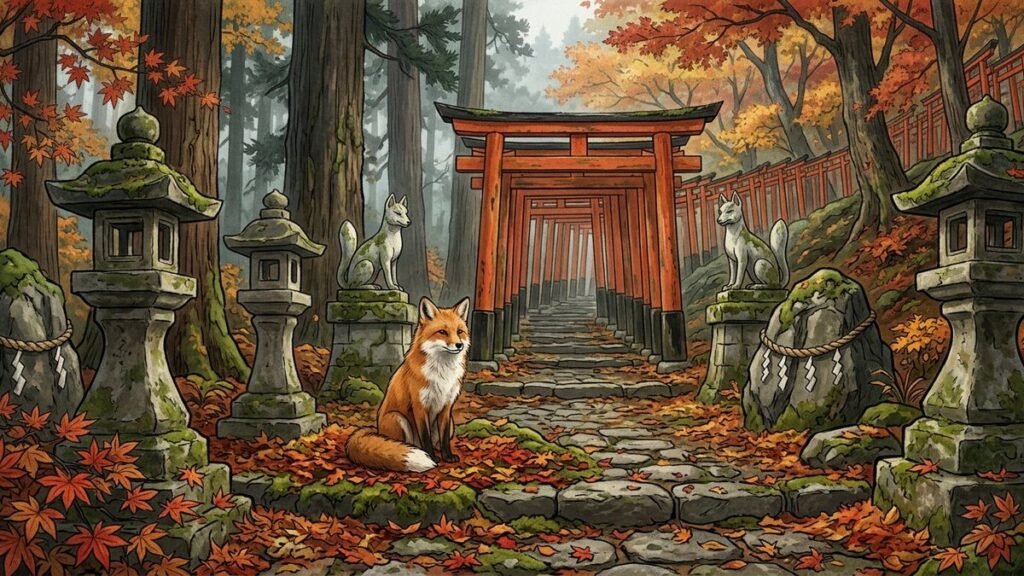
The connected strength in these kitsune clan names fits perfectly when populating your Best Fantasy Town Names and keeps the joyful energy flowing. They honor fox spirit clan names and mythical character naming ideas beautifully. Your groups gain real heritage that readers and players celebrate.
| Clan | Kanji | Meaning | Line |
|---|---|---|---|
| Shinoda no Mori | 信太の森 | the forest of Shinoda in Izumi, where Kuzunoha was found, and so the oldest fox line in the stories | a line that claims Kuzunoha |
| Fushimi | 伏見 | the hill in Kyoto holding the great Inari shrine, with its fox statues at every gate | a shrine-serving line |
| Toyokawa | 豊川 | the temple in Aichi famous for its foxes, which are messengers rather than gods | a temple line |
| Oji-gumi | 王子組 | the gang of Oji, the Tokyo district where the foxes gathered on New Year’s Eve | a city line |
| Inariyama | 稲荷山 | the mountain behind the Fushimi shrine | a mountain line |
| Shiramine | 白峰 | the mountain of the Sutoku legend, tied to the story of the nine-tailed fox | a line with a grudge |
| Yamashiro | 山城 | the old province around Kyoto | a court-connected line |
| Kii | 紀伊 | the province of the Kumano shrines and deep mountains | a pilgrimage line |
| Izumo | 出雲 | the province where the gods gather in the tenth month | a line that travels in autumn |
| Kaga | 加賀 | an old province on the west coast | a coastal line |
| Shinano | 信濃 | the inland mountain province | a highland line |
| Hida | 飛驒 | the far northern mountain province | a snow line |
| Mino | 美濃 | the province of the Sekigahara country | a river line |
| Harima | 播磨 | the western province of open plains | a plains line |
| Echizen | 越前 | the province of cold winters and old paper | a winter line |
| Azuma | 東 | ‘the east’, the old name for everything east of the capital | an eastern line |
| Mikasa | 三笠 | the mountain at Nara, and a crest name | a Nara line |
| Kasuga-ke | 春日家 | the house of Kasuga, the Nara shrine and the family that served it | a noble line |
| Kuzunoha-ke | 葛の葉家 | the house of Kuzunoha, the fox-wife herself | a line of fox-wives |
| Tamamo-ke | 玉藻家 | the house of the nine-tailed court fox | a line that will not stay small |
| Hakuzosu-ke | 白蔵主家 | the house of the fox who took a priest’s shape and is now a noh mask | a line of disguised foxes |
| Yakan-gumi | 野干組 | the wild-fox gang, from an old word for a wild fox | a line that admits its rank |
| Shippo-gumi | 七宝組 | the gang of the seven treasures of Buddhism | a temple-guarding line |
| Yamabushi | 山伏 | the mountain ascetics, whose dress foxes were said to borrow | a wandering line |
| Kuzuryu | 九頭竜 | the nine-headed dragon of a real mountain shrine | a line named against its rival |
A fox clan needs a name the way any other body does, and the same two-word rule runs through the Guild names list.
Kitsune Nicknames
Japanese shortens rather than decorates. Most of these are the first syllable of a rank or a word plus -chan. Shippo is also the fox child in Inuyasha, which is exactly why it works.
| Nickname | From | What it means |
|---|---|---|
| Kon-chan | kon, the fox’s own cry | what a household actually calls a fox |
| Shippo | tail | tail. It is also the name of the fox child in Inuyasha, which is exactly why it works as a nickname |
| Kyu | short for kyubi | used by a fox that expects you to know the rest |
| Zen | short for zenko | for a fox that wants credit for being good |
| Nogi | short for nogitsune | an insult a fox has accepted |
| Tama-chan | from hoshi no tama | for a fox that will not let go of its ball |
| Hoshi | star | same source, shorter |
| Gin-chan | silver | a grey fox |
| Kuro-chan | black | a black fox |
| Shiro-chan | white | a white fox |
| Aka-chan | red | a plain red fox, and also the word for a human baby |
| Yuki-chan | snow | a winter fox |
| Mame-chan | bean | for the smallest one |
| Abura-chan | from aburaage, the fried tofu offering | for a fox that only comes at mealtimes |
| O-Kitsune-sama | the honourific used for a fox deity at a household shrine | formal, and slightly nervous |
| Kitsune-san | polite Mr Fox | used when you are not sure what it wants |
| Yome | bride, from kitsune no yomeiri, the sun shower | for a fox that changes the weather |
| Ten | from tenko | for a fox that thinks it has already made the top rank |
| Kage-chan | shadow | for a fox you keep losing |
| Saki-chan | from blossom | for a spring fox |
| Yoru-chan | night | for a fox that only comes after dark |
| Momo-chan | peach | for a spoiled household fox |
| Tofu-chan | bean curd | same joke as Abura-chan, shorter |
| Chibi-chan | tiny | for a first-tail cub |
| Kitsu | the old short form of kitsune | the shortest version possible |
Kitsune Usernames
Handles want lowercase, no spaces and one lore word people already recognise. Kon kon, hoshi no tama and aburaage are the three that carry without explaining themselves.
| Handle | Meaning | Why it works |
|---|---|---|
| konkon_kitsune | the fox’s own cry, twice | clean, readable, easy to say out loud |
| hoshi_tama_kitsune | the star ball fox | lore-correct and unclaimed-looking |
| nine_tails_only | nine tails and nothing less | works as a flex or a joke |
| aburaage_thief | the fried tofu thief | funny to anyone who knows the offering |
| kuzunoha_kid | child of Kuzunoha | for a half-fox character |
| nogitsune404 | wild fox, not found | the standard joke format |
| byakko_blade | white fox rank plus a weapon | good for a fighter |
| kitsunebi_tv | foxfire | short, works as a channel name |
| yakan_yoru | wild fox night | two real words, no filler |
| fushimi_fox | the shrine hill | place-based, easy to remember |
| oji_gitsune | the New Year gathering of foxes | deep-cut lore |
| tamamo_trouble | the nine-tailed court fox | alliterative and ominous |
| kyubi_kit | nine tails | short and clean |
| shiranui_fox | the unknown fire over the sea | beautiful and unobvious |
| myobu_messenger | the shrine rank | for a zenko character |
| kiko_claw | the middling rank | understated |
| tenko_tale | the celestial fox | for a storyteller account |
| kurogitsune | black fox | one real word, no decoration |
| zenko_mode | good fox mode | plays like a status |
| shippo_shake | tail shake | light and silly |
| inari_offering | what you leave at the shrine | for a support or healer account |
| foxfire_kasumi | foxfire and mist | two lore words in English and Japanese |
| washi_wa_kitsune | ‘I am a fox’ | a whole sentence as a handle |
| yokai_yomeiri | the fox wedding | for a weather-obsessed account |
| kagerou_fox | heat haze | the best word for something almost seen |
A – Z Names for Kitsune
One name per letter with the kanji. Japanese has no L, Q, V or X, so those four rows say what to use instead rather than inventing a spelling.
| Letter | Name | Kanji | Meaning |
|---|---|---|---|
| A | Akatsuki | 暁 | dawn, the hour a fox goes home |
| B | Botan | 牡丹 | peony, the flower of a fox marriage in the old stories |
| C | Chitose | 千歳 | a thousand years, which is what nine tails takes |
| D | Daidai | 橙 | the bitter orange, and a word for generation after generation |
| E | Enoki | 榎 | the hackberry tree, the kind a fox is often said to live under |
| F | Fushimi | 伏見 | the hill of the great Inari shrine |
| G | Gunjo | 群青 | ultramarine, the pigment of deep blue |
| H | Hakuro | 白露 | white dew, an early-autumn term |
| I | Irori | 囲炉裏 | the sunken hearth, the warm centre of an old house |
| J | Jukai | 樹海 | a sea of trees, the name of the forest at Mount Fuji |
| K | Kanzashi | 簪 | the hairpin a fox-woman would wear |
| L | Renge | 蓮華 | lotus blossom. Japanese has no L, so the nearest is R |
| M | Mikazuki | 三日月 | the crescent moon, three days old |
| N | Nadeshiko | 撫子 | the pink flower, and an old word for an ideal woman |
| O | Oborozuki | 朧月 | the hazy moon of spring |
| P | Pon | ぽん | a small soft sound. Japanese has few native P words |
| Q | Kyokko | 極光 | the northern lights. Q does not exist in Japanese, so use the K sound |
| R | Raiju | 雷獣 | the thunder beast that rides in lightning |
| S | Shirayuki | 白雪 | white snow |
| T | Tsurara | 氷柱 | an icicle |
| U | Utsusemi | 空蝉 | the empty shell a cicada leaves, so this fleeting world |
| V | Megitsune | 雌狐 | a female fox. There is no V in Japanese, so V stands for vixen |
| W | Wasurenagusa | 勿忘草 | forget-me-not |
| X | Kurogitsune | 黒狐 | the black fox. X has no Japanese sound, so use the K or S row |
| Y | Yamabiko | 山彦 | the echo spirit of the mountains |
| Z | Zanzo | 残像 | the afterimage left when something has already gone |
Nine-Tailed Fox Names
Nine tails is about a thousand years, and the legend already supplies the epithets. Kinmo Kyubi and Hakumen no Kyubi are the two used for Tamamo-no-Mae; kumiho and huli jing are the same idea in Korea and China.
| Name | Kanji | Meaning | Note |
|---|---|---|---|
| Kyubi no Kitsune | 九尾の狐 | the nine-tailed fox; the plain term for the thing itself | a thousand-year fox |
| Kinmo Kyubi | 金毛九尾 | the golden-furred nine-tailed fox, the epithet used for Tamamo-no-Mae | a gold-coated nine-tail |
| Hakumen no Kyubi | 白面の九尾 | the white-faced nine-tailed fox, the other half of the same epithet | a pale nine-tail |
| Kyubi no Yoko | 九尾の妖狐 | the nine-tailed bewitching fox | a nine-tail that charms first |
| Sennen no Kitsune | 千年の狐 | the thousand-year fox, which is the age the ninth tail arrives at | a fox that has finished growing |
| Kumiho | 구미호 | the Korean nine-tailed fox, which eats hearts rather than serving shrines | a Korean setting |
| Huli jing | 狐狸精 | the Chinese fox spirit, a term that can be an insult or a title | a Chinese setting |
| Jiuweihu | 九尾狐 | the Chinese nine-tailed fox, which appears in the oldest Chinese texts as a good omen | an early-era Chinese fox |
| Kuyo | 九曜 | the nine luminaries, and a real crest of nine circles | a nine-tail worn as a mon |
| Kokin | 黄金 | gold, the metal | a gold nine-tail |
| Tenkyu | 天穹 | the vault of the sky | a celestial nine-tail |
| Shirogane | 白銀 | silver, literally white metal | a silver nine-tail |
| Kinun | 金雲 | a golden cloud | a nine-tail seen overhead |
| Kyusei | 九星 | the nine stars of geomancy | a nine-tail read as an omen |
| Komyo | 光明 | bright light, radiance | a nine-tail at the shrine |
| Kyubi no Tama | 九尾の玉 | the jewel of nine tails. Invented, but built from two real words | a nine-tail’s star ball |
| Sesshoseki no Kage | 殺生石の影 | the shadow of the Killing Stone, where the fox’s spirit was said to be trapped | a vengeful nine-tail |
| Nasuno no Kyubi | 那須野の九尾 | the nine-tail of the Nasuno moor, where the hunt for it happened | a nine-tail with a history |
| Toba | 鳥羽 | the retired emperor whose court the nine-tailed fox entered | the human half of the story |
| Kyuko no Kitsune | 九光の狐 | the fox of nine lights, one per tail. Invented from two real readings | a nine-tail that lights a room |
| Kyubi Zuka | 九尾塚 | the nine-tail mound. Invented, on the pattern of the real kitsune zuka | a buried nine-tail |
| Hakumen Konko | 白面金光 | white face, golden light. A pairing of two real epithets | a nine-tail at full glory |
| Kyubi no Kage | 九尾の影 | the shadow of nine tails | the shape a nine-tail leaves |
| Sennen Hakko | 千年白狐 | the thousand-year white fox. Real words, arranged as a title | a byakko at the ceiling |
| Kyubi Myobu | 九尾命婦 | the nine-tailed shrine fox. Rank plus tail count | a nine-tail that serves Inari |
How to Name a Kitsune
Japanese fox lore already counts things, so let it do the work. Tails count centuries, nine at the ceiling. Colour counts rank: byakko white, genko black, kinko gold, ginko silver. Above the ordinary field fox the ladder runs yako, kiko, kuko, tenko. Put a rank word beside a colour or season word and the name carries information. Kurenai Tenko is a crimson celestial fox, and a reader who knows the lore has just learned the character’s age.
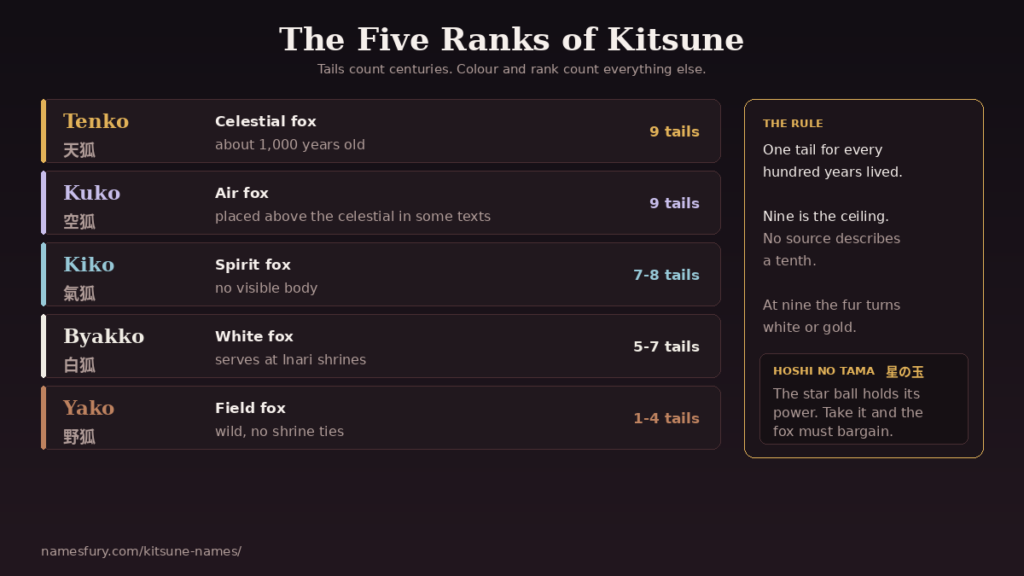
The second method is to name the fox after the thing it cannot lose. Its power sits in the hoshi no tama, the star ball, and a human who holds it can compel the fox. Names built on that idea imply a weakness instead of a boast, which is the harder and better trick.
The third is the one Japanese writers actually use. Pick a real word for something that only exists for a moment. Komorebi is light through leaves. Kagerou is heat haze. Shigure is the cold rain of late autumn. A fox spirit is a thing that is there and then is not, so a word for passing light or weather suits it better than a word for a weapon.
Two checks before you keep a name. Say it at speaking speed, because kyubi and kyuubi are the same word and only one reads cleanly in English. And never treat -chan or -san as part of a name. Those are forms of address. Yuki-chan is Yuki, being spoken to kindly.
Final Word on Kitsune Names
A kitsune name should carry three things: how old it is, what rank it holds, and the one thing it cannot lose. Tails give you the century, colour gives you the rank, and the hoshi no tama gives you the weakness.
Take a real word for something that only lasts a moment, set it beside the fox’s rank, and you have a name a Japanese reader would accept without argument. Every table above is sorted that way.
Frequently Asked Questions
What does kitsune mean?
Kitsune, written 狐, is just the ordinary Japanese word for fox. It is not a special term for a magical one. The distinction comes from what kind of fox you mean: a zenko is a good fox, a yako or nogitsune is a wild one, and a myobu is one in service at an Inari shrine. Japan has over thirty thousand of those shrines, and the stone foxes at their gates are messengers rather than the object of the shrine.
How many tails can a kitsune have?
Nine. No source describes a tenth. A fox grows one tail per hundred years, so the count reads as its age directly. At nine, near a thousand years, its fur turns white or gold and it becomes a tenko, a celestial fox.
What is a hoshi no tama?
The star ball, a small white orb holding a kitsune’s power. The stories agree on what follows: if a human takes it, the fox will promise almost anything to have it back, because without it the fox weakens. Shrine statues often show the orb at the tip of a tail or in the fox’s mouth, alongside the other common object, a key.
Are all kitsune evil?
No, and the split is built into the words. Zenko, the good foxes, include the myobu of the Inari shrines and appear as helpers. Yako and nogitsune are the ones that mislead travellers. Even they are usually mischievous rather than murderous. Tamamo-no-Mae is famous precisely because she is the exception.
Who was Tamamo-no-Mae?
The most famous nine-tailed fox in Japanese legend. She arrived at the court of the retired Emperor Toba in the twelfth century, and he fell ill as she grew closer to him. The diviner Abe no Yasuchika identified her as a fox. She fled to the moor at Nasu, was hunted down, and her spirit was said to pass into the Sessho-seki, the Killing Stone. That stone exists in Tochigi Prefecture, and it split in two in March 2022.
What is kitsunebi?
Foxfire. Kitsunebi are the pale lights sometimes seen moving over fields at night, and folklore puts them down to foxes. A related belief gives Japanese one of its best phrases: rain falling while the sun is out is kitsune no yomeiri, the fox’s wedding.
Can kitsune shapeshift?
Yes, and it comes with age. A fox is usually said to gain human form at about a hundred years, which is when it grows its second tail. The disguise has known weaknesses. Dogs see through it, water can betray it, and the rites of a diviner or a monk can strip it away.
Are kitsune and kumiho the same thing?
The same idea in three cultures rather than the same creature. The Japanese kitsune, the Korean kumiho and the Chinese huli jing are all nine-tailed fox spirits, and the tradition travelled eastward from China. The Japanese version has a whole benevolent branch tied to the Inari shrines, which the kumiho generally does not. Ahri from League of Legends, often called a kitsune, is a gumiho.
What are the ranks of a kitsune?
The ladder runs yako, kiko, kuko and tenko, and colour adds a second set: byakko white, genko black, kinko gold, ginko silver. A fox serving Inari is a myobu, and a wild one with no shrine rank is a nogitsune. Tails mark the age, one per century, with nine at about a thousand years.
What is a good name for a nine-tailed fox?
The legend already supplies two: Kinmo Kyubi, the golden-furred nine-tail, and Hakumen no Kyubi, the white-faced one. Both are epithets for Tamamo-no-Mae. For a new character, Sennen no Kitsune, the thousand-year fox, states the age without boasting.