The word guild has nothing to do with craft, trade or brotherhood. It means payment.
Old English gield meant a service, offering, tribute or compensation, and it comes from Proto-Germanic geldja-, a contribution. The earliest guilds Tacitus describes were sacred banquets that you had to pay into to attend. The word for the subscription became the word for the people who paid it. A guild was never defined by what it made. It was defined by who was paid up.
That single fact fixes most bad guild names, because it tells you what a guild actually is: a body with members, dues, records and a building. Real ones were named accordingly. London’s guilds still use the formula The Worshipful Company of plus the trade, and the order of precedence between them was settled in 1515 and has barely moved since.
Below are 510 names across seventeen categories, covering guilds, clans and factions, and every entry lists the root or the real institution it came from. Use the generator if you want something now.
Guild Name Generator
This guild name generator has three modes, because guilds, clans and factions are not the same kind of thing and should not be named the same way. A guild has members and dues, so its names lean on institutional words such as company, order, hall and charter. Switch to Clan and it becomes a clan name generator instead, building from landforms and kinship the way real Gaelic and Norse clans were named. Switch to Faction and it works as a faction name generator, using the administrative vocabulary of treaties and councils.
Pick a theme as well if you want something narrower, from merchant and mage to thieves, warrior and dark. Every result shows the meaning of the parts it was built from, so you can check that a name says what you think it says. This also works as a fantasy guild name generator for tabletop campaigns. Tap any result to copy it.
Guild, Clan and Faction Name Generator
Three different naming systems, because a guild, a clan and a faction are not the same kind of thing. Every result shows what its parts mean. Tap to copy.
Guild Names
The word guild does not mean craft, trade or brotherhood. It means payment. Old English gield meant a service, offering or tribute, and the earliest guilds were sacred banquets you had to pay into. A guild was never defined by what it made. It was defined by who had paid their dues.
| Name | Meaning and root |
|---|---|
| The Gilded Hand | The hand is the oldest guild symbol: craft guilds were the hand, merchant guilds the purse |
| Order of the Iron Chain | A chain means links of equal strength, the founding idea of every guild charter |
| The Silver Compass | Compasses were the real mark of masons and surveyors |
| The Ashen Circle | A circle implies no head of table, so the name suggests an elected master |
| Hall of the Open Ledger | Guilds were record keepers first; the ledger decided who was a member |
| The Warden's Table | A warden was the genuine second officer of a London livery company |
| The Quiet Covenant | Covenant means a binding agreement, which is what a guild oath was |
| Brotherhood of the Lamp | Lamp guilds met after dark because members worked by day |
| The Crimson Seal | A guild seal made a document legally binding |
| Keepers of the Charter | A royal charter turned a fraternity into a legal body |
| The Grey Fellowship | Fellowship was the ordinary medieval English word for a guild |
| The Bound Hands | Apprentices were bound by indenture for seven years |
| Guild of the Standing Stone | Boundary stones marked a guild's trading monopoly |
| The Last Apprentice | A name that implies the guild is dying out |
| Hearth and Hammer | Two symbols: hearth for the hall, hammer for the trade |
| The Twelfth Company | Precedence numbers were real and fiercely contested |
| Order of the Broken Wheel | A broken wheel suggests a guild that failed and reformed |
| The Vellum Court | Guild courts met to judge their own members' disputes |
| Sons of the Forge | A kinship name for a craft that passed father to son |
| The Tallow Guild | Tallow chandlers were a genuine and powerful London company |
| The Watchful Company | Guilds policed quality and punished shoddy work |
| Fellowship of the Second Key | Guild chests had two locks and two keyholders, a real precaution |
| The Amber League | League implies several towns acting together, like the Hanse |
| Order of the Measured Stone | Masons were paid by measured work, not by the day |
| The Salt Company | Salters ranked ninth among the Great Twelve of London |
| Hollow Hall Company | Named for the building, as most real guilds were |
| The Unbroken Oath | Oath-breaking was the one offence that meant expulsion |
| Guild of the Nine Marks | Makers' marks identified who was responsible for a flaw |
| The Thorn and Thread | Two-object names are the oldest English sign-naming habit |
| Masters of the Low Gate | Guilds often controlled a specific city gate and its tolls |
Cool Guild Names
Cool guild names nearly always do one of two things: they pair a hard noun with a soft one, or they drop the article entirely. Blackvein and Severance both work because nothing in them is decorative. If a name needs the word the to sound right, it is an institution, not a crew.
| Name | Meaning and root |
|---|---|
| Blackvein | A vein of ore, and a vein of blood: deliberate double reading |
| Nightforge | Compound of night and forge, work done out of sight |
| Ironveil | Hard noun plus soft noun, the most reliable cool-name formula |
| Ashfall Syndicate | Syndicate is modern and reads as organised rather than noble |
| The Pale Verdict | Abstract noun names sound colder than object names |
| Stormbreakers | Agent nouns ending in -ers read as a crew, not an institution |
| Grim Accord | Accord means a treaty, so it implies former enemies |
| Severance | One word, no article, which is why it sounds modern |
| Dead Reckoning | A real navigation term for steering without landmarks |
| The Iron Writ | A writ is a legal order, so the name implies enforcement |
| Black Ledger | Ledger plus black suggests the accounts nobody sees |
| Coldiron | Cold iron is the folklore metal that harms fae |
| Ninefold | Numeric names imply a structure the reader cannot see |
| The Last Tally | Tally sticks were real medieval accounting tools |
| Ravenstrike | Verb-noun compounds read as aggressive by default |
| Hollowpoint | A real ammunition term, used here as a guild name |
| The Quiet Edge | Understatement makes a name sound more dangerous, not less |
| Emberlock | Lock implies something sealed that should stay sealed |
| Vantage | A single Latin-rooted noun meaning the high ground |
| Shardbound | Bound as a suffix reads as cursed or sworn |
| The Flint Accord | Flint strikes sparks, so the treaty is unstable |
| Nullvane | Null plus vane: a weathervane pointing nowhere |
| Deadbolt Company | Mechanical nouns sound harder than organic ones |
| The Burnt Charter | Implies the guild operates outside its own founding rules |
| Stonewake | Wake means both a vigil and the trail a ship leaves |
| Harrow | Old English hearg, a heathen shrine, and a field implement |
| The Lean Years | Time-based names imply a shared hardship |
| Ironwake | Compound of a metal and a vigil |
| Blackmarch | A march is a border, and black is who patrols it |
| The Cold Tally | Counting the dead rather than the profit |
Best Guild Names
The best guild names survive three tests: they read clearly in a chat window, they can be said aloud without stumbling, and they still make sense after six months. Every entry here is two or three words, because longer names get abbreviated by members and the abbreviation becomes the real name.
| Name | Meaning and root |
|---|---|
| The Silver Hand | Clean, memorable, and readable at a glance in any chat window |
| Ironclad Covenant | Alliteration plus a legal noun: easy to say, easy to remember |
| Order of the Dawn | The single most reusable guild formula in the genre |
| The Argent Court | Argent is the heraldic word for silver, so it reads as official |
| Sons of the Anvil | Kinship plus tool, the oldest craft-guild naming pattern |
| The Last Bastion | Bastion is a projecting part of a fortress wall |
| Highmark Company | High plus mark: a boundary claimed from a position of strength |
| The Oathsworn | A real Old Norse concept, eidsvarinn, the sworn band |
| Ember and Oak | Pairing a fire word with a wood word is immediately warm |
| The Steadfast | Adjective-as-noun names sound like a title earned in battle |
| Vanguard Company | Vanguard is from Old French avant-garde, the front of an army |
| The Golden Measure | Measure refers to guild quality standards, which were real |
| Stonewatch | Compound of material and duty, short enough for any nameplate |
| The Bright Accord | Positive adjective plus treaty noun: reads as a founding alliance |
| Hearthguard | The genuine Old English heorthweard, the household troop |
| The Keen Edge | Keen is Old English cene, bold or brave, before it meant sharp |
| Ninth Hall | Numbered halls were a real feature of guild quarters |
| The Free Company | A real medieval term for a mercenary band under contract |
| Ironreach | Material plus extent, suggesting territory earned not inherited |
| The Quiet Order | Implies discipline rather than secrecy |
| Aegis Company | Aegis is the shield of Zeus and Athena in Greek myth |
| The Long Table | A long table seats equals, which is the point |
| Brightforge | Forge compounds are the single most durable guild element |
| The Standing Oath | Standing means continuously in force, a genuine legal sense |
| Warden's Rest | A place name used as a guild name, which real guilds did |
| The Copper Crown | Copper is a poor metal, so the crown is an ironic claim |
| Trueborn Company | Trueborn meant legitimate birth, a real guild entry requirement |
| The Open Gate | A guild that takes anyone, which was genuinely unusual |
| Stormhold Company | Weather plus stronghold, the most-used fantasy pairing for a reason |
| The First Measure | First means founding, measure means standard of quality |
Clan Names
Clan comes from Gaelic clann, meaning children or offspring, which is why real clan names are almost always places rather than adjectives. A clan was the people of a glen, not the people who liked a theme. Build yours from a landform and you will be following the genuine pattern.
| Name | Meaning and root |
|---|---|
| Clan Ironhelm | Clan is from Gaelic clann, meaning children or offspring |
| Clan Stormcrag | Weather plus rock, the standard Scottish clan territory pattern |
| Clan Blackmoor | Real Scottish clan names are usually places, not adjectives |
| Clan Ashvale | Ash tree plus valley, a genuine place-name construction |
| Clan Dunbrae | Gaelic dun, hill fort, and brae, a hillside |
| Clan Thornefell | Thorn plus Norse fjall, a bare mountain |
| Clan Rhunmar | Welsh rhun, grand, and Norse marr, sea |
| Clan Greyhollow | Colour plus landform, the most common English pattern |
| Clan Wyrmstone | Old English wyrm, serpent or dragon, plus stone |
| Clan Kaldrek | Norse kaldr, cold, with a hardened ending |
| Clan Duskbarrow | A barrow is a burial mound, so the clan guards its dead |
| Clan Vashkar | Invented but consistent: harsh consonants throughout |
| Clan Oakenshield | A shield of oak, and a byname rather than a place |
| Clan Morwen | Welsh mor, sea, and gwen, white or blessed |
| Clan Brackenridge | Norse brakni, fern, plus ridge |
| Clan Emberhold | Fire plus stronghold, suggesting a forge clan |
| Clan Skarngard | Norse skarn, rubble, and gardr, enclosure |
| Clan Hollowbrook | Two soft landforms, so the clan reads as farming not warring |
| Clan Rhoswen | Welsh rhos, moor, and gwen, fair |
| Clan Dreadmoor | Old English draed, fear, plus moorland |
| Clan Ferrowind | Latin ferrum, iron, plus wind |
| Clan Tarnveil | A tarn is a small mountain lake, from Norse tjorn |
| Clan Highfell | High plus fell, the plainest possible highland name |
| Clan Sablewood | Old French sable, black, plus wood |
| Clan Gorrick | Norse gorr, ready, and rikr, powerful |
| Clan Winterbane | Bane is Old English bana, a slayer |
| Clan Mossgarde | Moss plus gardr, suggesting an old and overgrown hold |
| Clan Varnhal | Invented root with Norse hall, a great room |
| Clan Stonebarrow | Stone plus burial mound, the oldest clan claim to land |
| Clan Elderwyn | Elder tree plus Welsh gwyn, white |
Unique Clan Names
The reason most unique clan names are not unique is that everyone reaches for the same four nouns: blood, storm, shadow, iron. These thirty use real but overlooked vocabulary instead. A windrow is a line of raked hay. A patten was a wooden overshoe. Specific beats dramatic.
| Name | Meaning and root |
|---|---|
| Clan Nettlebind | Nettles were used for cord before flax, so the name is a real craft |
| Clan Saltrow | A row of salt pans, a genuine coastal industry |
| Clan Owlfeather | Animal-part names are rare in English but common in Norse bynames |
| Clan Threnody | A threnody is a lament for the dead |
| Clan Hollowpane | Pane is a section of glass, so the clan are glaziers |
| Clan Quillmarch | Quill plus border: the clan that keeps the records of a frontier |
| Clan Mirefen | Two bog words together, which no one else would claim |
| Clan Tindersworn | Sworn by tinder, meaning sworn by the hearth fire |
| Clan Glasswater | Glass as an adjective meaning perfectly still |
| Clan Rookspire | A rookery plus a spire, so the clan live above a church |
| Clan Windrow | A windrow is a real line of raked hay |
| Clan Brinefast | Brine plus fast, meaning a fortress held against the sea |
| Clan Lanterndeep | Lantern plus deep: miners who name themselves for their light |
| Clan Yarrowbrook | Yarrow is a wound-healing herb, so the clan are healers |
| Clan Cinderquill | Fire plus pen, a clan of scribes who survived a burning |
| Clan Harrowgate | Norse horgr, a heathen shrine, plus gate |
| Clan Slatefall | Slate quarries genuinely collapsed, and clans were named for it |
| Clan Vellumhart | Vellum is calf skin, so the clan are parchment makers |
| Clan Tallowmere | Tallow plus lake: a clan of candle makers by water |
| Clan Beggarsleap | Place names describing an event are common and underused |
| Clan Pitchbrand | Pitch plus burning brand, a clan of torchbearers or arsonists |
| Clan Hookmoor | A hook is a bend in a river, a genuine place element |
| Clan Chaffwind | Chaff is what the wind takes at threshing |
| Clan Grimsteading | A steading is a Norse farm, from stadr, a place |
| Clan Wickerhold | Wicker fortifications were real and genuinely effective |
| Clan Dourlock | Scots dour, stubborn, plus loch |
| Clan Emberwick | Wick is Old English wic, a settlement, not a candle wick |
| Clan Scaldmere | Scald is Norse skald, a poet, plus lake |
| Clan Fallowgate | Fallow is land deliberately left unplanted |
| Clan Rushbarrow | Rushes were floor covering, so the clan supplied halls |
Faction Names
A faction is a political body, so faction names should sound administrative rather than heroic. Accord, concord, pact, writ, mandate, quorum and tribunal all carry the weight of a decision made in a room. That is more threatening than a sword in a title.
| Name | Meaning and root |
|---|---|
| The Covenant of Ash | Faction names work best as a noun of agreement plus a symbol |
| The Iron Concord | Concord means agreement, and iron means it is enforced |
| The Severed Crown | Implies a faction formed by breaking from a monarchy |
| The Grey Parliament | Parliament is from Old French parler, to speak |
| The Unbound | The definite article plus a past participle is the cheapest strong faction name |
| The Writ Eternal | A writ is a formal legal command |
| The Third Banner | Banners counted troops, so the number implies an army's size |
| The Hollow Throne | A throne with no king: the faction rules in a vacuum |
| The Ember Pact | Pact is from Latin pactum, a thing agreed |
| The Salt Treaty | Salt treaties were real: salt was taxed and fought over |
| The Quiet Dominion | Dominion is Latin dominium, lordship over property |
| The Broken Standard | A standard is both a flag and a rule, used here as both |
| The Ninefold Assembly | Assembly implies delegates rather than a single ruler |
| The Crimson Accord | Accord plus a blood colour: a treaty signed after a war |
| The Last Sanction | Sanction means both permission and punishment |
| The Sundered Host | Host is the Old English here, an armed company |
| The Verdant Charter | Charters granted rights; verdant implies a land claim |
| The Obsidian Senate | Senate is Latin senatus, a council of elders |
| The Free Cities League | Leagues of free cities were real across medieval Europe |
| The Ashen Mandate | A mandate is a command that carries authority to act |
| The Iron Quorum | A quorum is the minimum number needed to decide |
| The Thousand Hands | Numeric body names imply mass membership |
| The Silent Tribunal | A tribunal judges; silent means it does not explain |
| The Gilded Consensus | Consensus implies the faction is bought rather than agreed |
| The Shattered Pale | A pale was a fenced boundary of controlled territory |
| The Dawn Compact | Compact is a binding agreement between equals |
| The Red Chancellery | A chancellery is the office that issues official documents |
| The Stonebound Union | Union is the plainest faction word and still works |
| The Vigil Eternal | A vigil is a watch kept through the night |
| The Burnt Petition | A petition refused by fire: the faction formed after rejection |
A faction needs something to be a faction inside, and the realm around it should be named in the same register the kingdom names list covers the crowns and empires these bodies form against.
Adventurer Guild Names
Adventurer guilds are businesses, and medieval businesses named themselves the way inns did: two objects painted on a board, because most customers could not read. Boots and Lanterns works for exactly that reason. These are names a tavern sign painter could actually have drawn.
| Name | Meaning and root |
|---|---|
| The Crossed Blades | Tavern-sign naming: two objects, crossed, painted on a board |
| Boots and Lanterns | The two things every adventuring party actually needs |
| The Open Road Company | Implies contracts taken anywhere rather than one city |
| The Quest Board | Naming the guild after its own noticeboard |
| The Wayfarers Hall | Wayfarer is Old English weg plus faran, to travel |
| The Copper Contract | Copper signals the guild takes small, cheap jobs |
| The Long Walk | Understated, and implies the jobs are far away |
| Hired Steel | Plain and honest about what the guild sells |
| The Second Sword | A second sword is the backup, which is what hirelings were |
| The Broken Compass | Suggests a guild that takes jobs nobody can navigate to |
| The Dust and Coin | Dust from the road, coin at the end of it |
| Lanternlight Company | Lantern guilds genuinely existed for night escorts |
| The Hearthless | Adventurers by definition have no hearth of their own |
| The Kindly Contract | Ironic: the contract is never kind |
| Three Roads Company | Named for a crossroads, as many real inns were |
| The Paid Bold | Bold as a noun, meaning the brave, with a reminder they are paid |
| The Gauntlet Hall | A gauntlet thrown was a formal challenge |
| Rope and Ration | The unglamorous supplies that actually finish a dungeon |
| The Far Errand | Errand is Old English aerende, a message or mission |
| Shieldmarket Company | Named after the street where hirelings waited for work |
| The Willing Few | Implies the guild is small and takes what others refuse |
| Stone and Sellsword | Alliteration plus the real medieval word for a mercenary |
| The Tenth Mile | Distance names imply contracts measured in travel |
| The Honest Blade | Suggests the guild does not take assassination work |
| Mudfoot Company | A self-deprecating name, which real companies genuinely used |
| The Standing Contract | A contract always open, so the guild never refuses |
| Torch and Tally | Light to go in, a count to come out |
| The Reluctant Hand | Implies the guild only fights when paid enough |
| Wandering Hall | A guild with no fixed building, which solves a plot problem |
| The Last Hireling | Suggests a dying profession, useful for a late-era setting |
DnD Guild Names
DnD guild names have one extra job: they have to survive being said out loud at a table, and they have to sound like something a city would actually charter. That means legal nouns over adjectives, which is why The Hollow Quorum lands harder than anything with a dragon in it. Several below use real guild paperwork words such as writ, tally and charter.
| Name | Meaning and root |
|---|---|
| The Adventurers Guild of Neverdeep | The plain in-world name, with an invented city so it drops into any setting |
| The Charter of the Open Door | A charter is the legal grant that turns a party into a recognised body |
| The Silver Flagon Company | Named for the tavern it meets in, which is how most real companies started |
| The Writ of Passage | A writ is a formal command; here it doubles as travel papers |
| The Lantern Charter | Lantern guilds genuinely existed for night escort work |
| Hall of the Fifth Seal | Guild seals made documents binding, so a numbered seal implies a bureaucracy |
| The Broken Shield Company | A broken shield is a mercenary badge of survival, not failure |
| The Dungeoneers Bond | A bond is money lodged against failure, which fits a delving contract |
| The Mithral Compact | Compact is the older English word for a formal agreement |
| The Vault Wardens | Warden is Old French wardein, a guardian with legal authority |
| The Crooked Lantern | A crooked light suggests the guild bends its own rules |
| The Gilded Dice | Dice naming nods to the table itself without breaking the setting |
| The Sable Writ | Sable is heraldic black, so the orders are written but not public |
| The Hollow Crown Company | Hollow crown implies a guild that outlived the king who chartered it |
| The Ninth Lantern | A numbered chapter implies eight others elsewhere, which builds a world |
| The Emberhold Accord | Accord from Old French acorder, to bring hearts into agreement |
| The Trembling Hand | A mercenary company named for the fear of its clients, not its members |
| The Quiet Ledger Guild | Accounting language is more unsettling than weapon language |
| Order of the Spent Coin | A spent coin is a contract already paid, so the debt is owed in blood |
| The Grey Marches Company | Marches were real contested borderlands, perfect for a frontier campaign |
| The Cartographers Fellowship | Fellowship is the ordinary medieval English word for a guild |
| The Hollow Quorum | A quorum is the minimum number needed to make a decision binding, so a hollow one has no authority |
| The Thornwatch Hall | Watch plus a landform is the oldest English naming pattern there is |
| The Candle and Chain | Two objects on a sign, the way illiterate customers were served |
| The Owlwarden Company | Owl for night work, warden for legal authority over it |
| The Last Tally Guild | A tally stick was a real medieval receipt, split between both parties |
| The Scoured Vale Pact | Scoured implies the land was already fought over once |
| The Fletchers Rest | Fletchers made arrows and were the 39th London livery company |
| The Unsworn | Members who refuse the oath, which is a whole campaign hook on its own |
| The Dawnward Mandate | A mandate carries the authority to act; dawnward means facing east |
Thieves and Assassin Guild Names
Thieves guilds name themselves for silence, not theft, and the best ones sound like accounting firms. The Silent Ledger is more unsettling than anything with a dagger in it, because it tells you someone is keeping records. Several names below use genuine thieves cant.
| Name | Meaning and root |
|---|---|
| The Quiet Hand | Thieves guilds name themselves for silence more than theft |
| The Lifted Purse | Lift is genuine thieves cant for steal |
| The Shadowed Tally | Someone is counting, and nobody knows who |
| The Nightwatch Debt | Implies the guild owns the city watch |
| Whisper and Wick | Wick here is the candle: the two things that end a job |
| The Grey Market | Grey market is real commerce that is legal but unofficial |
| The Cutters Court | Cutter is thieves cant for a cutpurse |
| The Ninth Finger | Implies a guild that takes a finger for failure |
| The Silent Ledger | Even thieves guilds kept accounts, which is the joke |
| Ashfall Collective | Collective sounds administrative, which makes it worse |
| The Unseen Writ | A legal order nobody can read or appeal |
| The Keyhole Fellowship | Fellowship is the genuine medieval word for a guild |
| The Soft Step | Understated names are more frightening than loud ones |
| Candlesnuff Company | Snuffing a candle is the oldest euphemism for a killing |
| The Red Accounting | Red ink meant loss, here it means blood |
| The Lockless Door | Suggests no door in the city holds against them |
| The Pale Contract | Pale because the client never sees who signs |
| Thornwhisper | Thorn for harm, whisper for method |
| The Widow's Rate | A price list, named after who ends up paying it |
| The Hollow Oath | An oath sworn knowing it will be broken |
| The Second Shadow | A shadow that is not cast by the body it follows |
| Nightcoin Syndicate | Payment plus darkness, with a modern organising word |
| The Cold Hour | The hour before dawn, when watchmen are weakest |
| The Glass Knife | Glass breaks off in the wound, which is the point |
| The Debt Collectors | Plain modern phrasing used deliberately for menace |
| Blackthread | Thread for the stitch, and for what connects the members |
| The Quiet Tally | Counting the jobs nobody reports |
| The Last Name | A list, and the last name written on it |
| Emberquiet | Contradiction names are hard to do well and strong when they land |
| The Unwritten Rate | No price list, because the price is never money |
Merchant and Trade Guild Names
Real trade guilds used one formula: The Worshipful Company of plus the trade. That prefix is still legally correct in London today, and almost no fantasy list uses it. Several names below are real companies, including the Loriners, who made spurs, and the Horners, who made window panes from horn.
| Name | Meaning and root |
|---|---|
| The Worshipful Company of Saltwrights | Worshipful Company is the genuine London guild prefix |
| The Mercers Rest | Mercers were general merchants and ranked first in London |
| The Vintners Table | Vintners, the wine merchants, ranked eleventh |
| The Weighed Measure | Guilds enforced weights and measures, a real legal duty |
| The Wool Staple | A staple was the town with exclusive rights to trade a commodity |
| The Amber Road Company | The Amber Road was a genuine trade route to the Baltic |
| The Honest Scale | Short weight was the most-punished guild offence |
| Guild of Chandlers and Wax | Chandlers made candles; wax and tallow were separate companies |
| The Bonded Warehouse | Bonded means goods held until duty is paid, a real term |
| The Spice Quarter | Spice merchants in London became the Grocers Company |
| The Fletchers Hall | Fletchers made arrows and ranked thirty-ninth in London |
| The Loriners Yard | Loriners made bits and spurs, a real and obscure company |
| Girdlers and Pursemakers | Girdlers made belts; both are genuine London companies |
| The Pewter Mark | Pewterers struck a mark to guarantee the tin content |
| The Coopers Ring | Coopers made barrels; a ring is the metal hoop |
| The Tanners Reach | Tanneries were placed downstream by law, hence the reach |
| The Haberdashers Row | Haberdashers sold small goods and ranked eighth |
| Guild of the Standing Weight | A standing weight was the master copy kept by the guild |
| The Ironmongers Gate | Ironmongers ranked tenth among the Great Twelve |
| The Dyers Run | Dye runoff coloured rivers, which is why dyers were zoned together |
| The Broderers Thread | Broderers were embroiderers, a genuine livery company |
| The Salt Bond | Salt was taxed everywhere, so salt guilds were political |
| Skinners and Furriers Hall | Skinners ranked seventh and traded furs |
| The Candle Tithe | Guilds paid tithes in candles to their patron church |
| The Horners Yard | Horners worked horn into combs, cups and window panes |
| The Pattenmakers Walk | Pattens were wooden overshoes worn above the mud |
| The Cordwainers Last | A last is the foot-shaped block a shoemaker builds on |
| The Grocers Gross | Grocer comes from French gros, trading in large quantities |
| The Open Market Company | Open market meant anyone could trade, which guilds resisted |
| Guild of the Hundred Tolls | Tolls funded town walls, and guilds collected them |
A smith guild in a dwarven city follows dwarven naming, not English livery naming, so check the dwarf names for your smiths page before mixing the two systems.
Mage Guild Names
Mage guild names work best when they sound like libraries rather than temples. Conclave comes from Latin cum clave, with a key, meaning the doors were locked from outside. Grimoire comes from French grammaire, grammar. Magic and scholarship share the same vocabulary for a reason.
| Name | Meaning and root |
|---|---|
| The Arcanum | Latin arcanum, a secret or mystery |
| The Seventh Circle | Circles of magic imply a graded hierarchy of learning |
| The Vellum Conclave | Conclave is Latin cum clave, with a key, meaning locked in |
| The Astral Chancery | A chancery is the office that issues official documents |
| The Silent Index | An index is a list, and silent means it is forbidden reading |
| The Lamplit Athenaeum | Athenaeum is a genuine word for a scholarly institution |
| Order of the Third Sigil | A sigil is a sign with power, from Latin sigillum, a seal |
| The Glass Observatory | Observatories were the real border between magic and science |
| The Unspoken Syllabary | A syllabary is a writing system of syllables |
| The Ember Codex | A codex is a bound book, as opposed to a scroll |
| The Quiet Scriptorium | A scriptorium is the room where manuscripts were copied |
| The Nine Lecterns | A lectern is a reading stand; nine implies nine disciplines |
| The Widdershins Order | Widdershins is a real word for counter-clockwise, considered unlucky |
| The Salt Circle | Salt circles are genuine European folk protection practice |
| The Mercury Seat | Mercury was the alchemists' most important and most dangerous element |
| The Grey Collegium | Collegium is Latin for a body of colleagues |
| The Last Transcription | Implies a text being copied for the final time |
| The Threefold Key | Three keys for three locks is a real archive security practice |
| The Null Chamber | Null from Latin nullus, none: a room where magic does not work |
| The Candle Register | A register of who studied what and when |
| Order of the Sealed Folio | A folio is a sheet folded once, the largest book format |
| The Hollow Prism | Prisms split light, which is why they became an occult symbol |
| The Quill and Cipher | A cipher is a code, from Arabic sifr, zero |
| The Verdigris Hall | Verdigris is the green corrosion on copper, used in old inks |
| The Twelfth Lesson | Numbering lessons implies a fixed and finite curriculum |
| The Moonless Study | Some workings genuinely required a dark moon in folk practice |
| The Bound Grimoire | Grimoire is from French grammaire, grammar |
| The Alabaster Court | Alabaster is soft stone, easily carved and easily broken |
| The Ashen Lexicon | A lexicon is a word list, which is what a spellbook really is |
| Order of the Open Eye | The open eye is the oldest symbol for knowledge in every tradition |
Warrior Guild Names
Martial orders borrow from two sources: the oath and the formation. Shieldwall was a genuine Anglo-Saxon tactic, scyldweall, and hearthguard, heorthweard, was the household troop sworn to one lord. Both are real words that already mean a group of men who stand together.
| Name | Meaning and root |
|---|---|
| The Shieldwall | A real Anglo-Saxon and Norse formation, the scyldweall |
| Order of the Drawn Sword | Drawn means already committed, with no retreat |
| The Iron Vigil | A vigil is a watch, and iron means it does not end |
| The Hundred Spears | A hundred was a genuine Anglo-Saxon administrative unit |
| The Red Oath | Oaths sworn in blood were real across Germanic cultures |
| Hearthguard Company | Heorthweard, the household troop sworn to one lord |
| The Standing Shield | A shield that does not move is the whole idea of a defence |
| Order of the Broken Lance | A broken lance meant the charge connected |
| The Thane's Company | A thegn was a retainer who held land for service |
| The Grim Muster | A muster is the formal assembly of fighting men |
| Order of the Pale Banner | Pale means both colourless and a fenced boundary |
| The Sworn Edge | Sworn plus a weapon part, the most compact warrior formula |
| The Last Rank | The rear rank is where the steadiest men were placed |
| Order of the Iron Crown | Iron crowns were real coronation objects in Lombardy |
| The Unyielding | Adjective-as-noun names work best when the adjective is long |
| Stormshield Company | Weather plus defence, overused because it genuinely works |
| The Sentinel Order | Sentinel is from Italian sentinella, one who senses |
| Order of the Nine Wounds | Counting wounds is a real hagiographic tradition |
| The Bannerless | A company with no lord, which is a plot in one word |
| The Iron Fast | Fast here means held firmly, not quickly |
| Order of the Dawnward | Facing the dawn means facing east, toward an enemy or a holy site |
| The Hollow Helm | An empty helmet is a memorial for a dead commander |
| The Bloodied Standard | A standard carried through a battle and kept unrepaired |
| Order of the Silent March | Silent marches were genuine tactics before a dawn assault |
| The Iron Levy | A levy is a forced call-up, so the order is not voluntary |
| Shieldbreakers | Agent noun, which reads as offensive rather than defensive |
| Order of the Grey Watch | Grey for the hour, watch for the duty |
| The Final Muster | A muster called when nothing is left to hold back |
| The Warden's Spear | A warden was a genuine border-defence office |
| Order of the Kept Oath | Kept, not sworn: the point is that it has lasted |
Many warrior guilds are religious orders rather than mercenary bands, and those need a different vocabulary again — the paladin names and holy orders list covers the sworn and consecrated side.
Dark Guild Names
Dark guild names fail when the menace is general. The Rotting Charter works because a charter is a specific legal document and rot is a specific process. Naming a real thing and then damaging it is more effective than stacking words like blood, death and shadow.
| Name | Meaning and root |
|---|---|
| The Rotting Charter | A legal founding document, decaying |
| The Carrion Accord | Carrion is from Old French caroigne, dead flesh |
| The Hollow Tithe | A tithe is a tenth paid in tribute, here paid in people |
| The Gravewright Company | A wright is a maker, from Old English wyrhta |
| The Ashen Dominion | Dominion is Latin dominium, ownership of property |
| The Flayed Ledger | Ledger plus flayed: records bound in something unpleasant |
| Order of the Spent Candle | A spent candle marks the end of a vigil or a life |
| The Blackened Writ | A writ is a command, blackened means scorched or corrupt |
| The Maggot Court | Courts judged guild members, so the name is self-aware |
| The Unclean Hands | An inversion of the guild hand symbol |
| The Sunless Concord | Concord means agreement, sunless means it was signed underground |
| The Bone Tally | Tally sticks counted debts, here they count bodies |
| The Cull | A single short noun is harder than a long phrase |
| The Weeping Seal | A seal that leaks is a document that was never valid |
| Order of the Last Breath | The oldest and still the most effective death-cult formula |
| The Grey Rot | Grey rot is a real plant disease, used here as a faction |
| The Silent Harvest | Harvest as a euphemism, which makes it worse |
| The Buried Compact | A compact buried means the terms cannot be checked |
| The Pale Famine | Pale and famine both come from the Book of Revelation |
| Order of the Shut Eye | An inversion of the open eye of knowledge |
| The Worm Court | Old English wyrm meant both worm and dragon |
| The Ninefold Debt | A debt that multiplies is worse than one that is owed |
| The Cindered Oath | An oath burned is an oath nobody can produce in court |
| The Hollow Men | Deliberately plain, which is why it unsettles |
| The Red Quarantine | Quarantine is Italian quaranta giorni, forty days |
| Order of the Spoiled Grain | Ergot in rye caused real mass poisonings in medieval Europe |
| The Marrow Guild | Marrow is the last thing taken from a bone |
| The Lantern of Teeth | Mismatched objects create unease more reliably than gore |
| The Dead Letter | A dead letter is undeliverable post, and a law no longer enforced |
| The Cold Charter | Charter plus cold: a founding document with no mercy in it |
Funny Guild Names
Funny guild names age badly when the joke is a pun on a current patch. The ones that last describe a shared failure instead, which is why Critical Fumble and Pull It Anyway still work years later. Self-deprecation outlives boasting by a wide margin.
| Name | Meaning and root |
|---|---|
| Aggressive Napping | The joke is the mismatch between adjective and activity |
| Sorry For Your Loot | Puns on loss work because every player has had one |
| Critical Fumble | A real tabletop term for the worst possible dice roll |
| We Buff Nothing | Self-deprecation ages better than boasting |
| The Mild Inconvenience | Understatement as a guild name is reliably funny |
| Backup Dancers | Implies the guild exists to support someone else's run |
| Leeroy's Legacy | Refers to the most famous raid failure in gaming history |
| Out of Mana Again | Specific complaints are funnier than general ones |
| Loot Goblins Anonymous | Combining a game term with a support group name |
| The Respawn Society | Treating death as a membership benefit |
| Tank You Very Much | Puns on class roles are the most-used guild joke for a reason |
| Accidental Pacifists | Suggests the guild keeps failing to start fights |
| Mostly Harmless | A Hitchhiker's Guide reference that still reads as a joke alone |
| The Afk Collective | Afk is away from keyboard, so the guild is never present |
| Pull It Anyway | The exact sentence that precedes every wipe |
| Guild Name Pending | Naming the problem instead of solving it |
| Two Healers One Cup | Role humour that stays just on the right side |
| The Aggro Management | Aggro is a real game term for enemy attention |
| Chaotic Mumble | Puns on the alignment system plus the voice chat app |
| Stealth Is A Mindset | Confidence with no competence behind it |
| The Dps Check Bounced | Combining a raid term with a banking term |
| Hired Goons Limited | Adding a corporate suffix to a fantasy job |
| Respec Regret | Respec is reassigning character points, usually badly |
| The Lore Ignorers | Admitting what most players actually do |
| Buffet Raiders | Raid humour that works outside the game too |
| Wipe It Down | A raid wipe plus a household chore |
| Legally Distinct Heroes | A copyright joke that implies the obvious |
| The Side Quest Union | Treating optional content as organised labour |
| Pixels And Poor Choices | Honest summary of the hobby |
| Last Pick Every Time | Schoolyard humour, which lands for everyone |
WoW and MMO Guild Names
MMO guild names signal recruitment terms before anything else. Two Night Guild and Consumables Provided tell a prospective member more than any fantasy phrase could. If your guild has a schedule and a loot system, putting one of them in the name filters applicants for free.
| Name | Meaning and root |
|---|---|
| Server First Attempt | Server first is the real race to clear new content |
| The Progression Curve | Progression is the term for clearing raid content in order |
| Soft Reserve | A genuine loot system where members call one item each |
| The Parse Enjoyers | Parse means a logged damage ranking |
| Mythic Minded | Mythic is the hardest difficulty tier in modern raiding |
| The Reset Crew | Raid lockouts reset weekly, which shapes guild life |
| Pull Timer | The countdown before a boss attempt begins |
| The Loot Council | A real and famously contentious loot distribution method |
| Hardmode Habit | Hardmode is optional extra difficulty for better rewards |
| The Off Night Raid | Off nights are the casual second raid most guilds run |
| Consumables Provided | The single most attractive line in a guild recruitment post |
| The Bench Rotation | Benching is sitting a player out, the hardest social problem in raiding |
| Cutting Edge | The achievement for clearing the hardest tier before it ends |
| The Logs Don't Lie | Combat logs are public, which is the joke and the threat |
| Two Night Guild | A real and highly specific recruitment pitch |
| The Alt Run | Alt runs are second clears with secondary characters |
| Vault Opening | The weekly reward chest, and the ritual around it |
| The Trash Skippers | Trash is the non-boss enemies between fights |
| Prepull Potion | A real optimisation: drinking before the fight starts |
| The Wipe Count | Guilds genuinely track how many attempts a boss took |
| Gearscore Irrelevant | A rejection of the most-argued-about number in MMOs |
| The Addon Dependents | Honest about how much of the UI is player-made |
| Raid Lead Burnout | The most common reason guilds actually dissolve |
| The Sunday Clear | Naming the guild after the night it exists |
| Bis Or Bust | Bis is best in slot, the optimal item for a position |
| The Guild Bank Heist | Guild bank theft is a real and recurring MMO drama |
| Threat Table | The hidden list that decides which player a boss attacks |
| The Soft Enrage | A soft enrage is when a fight gets harder over time |
| Discord Required | The least romantic and most accurate recruitment line |
| The Tier Set Bonus | Tier sets are matched armour pieces with a combined effect |
Real Historical Guild Names
These guilds existed and most still do. London's order of precedence was fixed in 1515 by the Court of Aldermen, and the top twelve are still called the Great Twelve. Take any of these names wholesale, because no invented name will sound more institutional than the real thing.
| Name | Meaning and root |
|---|---|
| The Worshipful Company of Mercers | General merchants, 1394, first in London's order of precedence |
| The Worshipful Company of Grocers | Spice merchants, 1345, named from French gros, in bulk |
| The Worshipful Company of Drapers | Wool and cloth merchants, 1361, third in precedence |
| The Worshipful Company of Fishmongers | Fourth in precedence, and once the richest in the city |
| The Worshipful Company of Goldsmiths | Fifth; it still assays and hallmarks precious metal today |
| The Worshipful Company of Merchant Taylors | Sixth; it alternates rank with the Skinners every year |
| The Worshipful Company of Skinners | Seventh; fur traders, who disputed precedence with the Taylors |
| The Worshipful Company of Haberdashers | Eighth; sellers of small wares, ribbons, pins and caps |
| The Worshipful Company of Salters | Ninth; salt was taxed, so salters were politically powerful |
| The Worshipful Company of Ironmongers | Tenth; iron goods rather than ironworking |
| The Worshipful Company of Vintners | Eleventh; wine merchants with their own river rights |
| The Worshipful Company of Clothworkers | Twelfth and last of the Great Twelve, formed 1528 |
| The Worshipful Company of Dyers | Thirteenth; dye runoff made them unpopular neighbours |
| The Worshipful Company of Brewers | Fourteenth; ale was safer than water, so brewers mattered |
| The Worshipful Company of Pewterers | Sixteenth; pewter marks guaranteed the tin content |
| The Worshipful Company of Bowyers | Thirty-eighth; longbow makers, legally protected by statute |
| The Worshipful Company of Fletchers | Thirty-ninth; arrow makers, separate from the bowyers |
| The Worshipful Company of Coopers | Thirty-sixth; barrel makers, essential to every other trade |
| The Worshipful Company of Loriners | Makers of bits, spurs and stirrups for horses |
| The Worshipful Company of Horners | Worked horn into combs, cups and translucent window panes |
| The Worshipful Company of Pattenmakers | Made pattens, the wooden overshoes worn above street filth |
| The Worshipful Company of Girdlers | Made belts and girdles, with their own hall from 1431 |
| The Worshipful Company of Broderers | Embroiderers, who supplied church and court vestments |
| The Worshipful Company of Curriers | Dressed and finished leather after the tanners had cured it |
| The Hanseatic League | A confederation of merchant guilds across northern Europe |
| Arte della Lana | The Florentine wool guild that funded the city's cathedral dome |
| Arte di Calimala | The Florentine cloth-finishing guild, named after a street |
| The Guild of Saint Luke | The painters' guild across the Low Countries, named for their patron |
| The Meistersinger | German guilds of poet-musicians with formal examined ranks |
| The Honourable Company of Master Mariners | Granted livery in 1932, the first of the modern companies |
Guild members needed names as much as guilds did, and both came from the same word pool in this period, which is why the medieval names list pairs directly with this section.
Free Fire and Mobile Guild Names
Mobile guild tags have different constraints: they must read at small size, survive a non-Latin keyboard, and fit a character limit. Two short words beat one long one every time. These avoid decorative symbols, which break on some devices and cannot be searched for.
| Name | Meaning and root |
|---|---|
| Apex Protocol | Two-word esports names read as organised and serious |
| Zero Recoil | A real shooting term, and short enough for a tag |
| Nightfall Squad | Squad is the standard mobile-game unit word |
| Iron Reign | Short, two syllables each, easy to read on a small screen |
| Phantom Rank | Phantom plus a ladder term |
| Blackout Crew | Blackout is both a power cut and losing consciousness |
| Rogue Protocol | Protocol implies rules the guild then breaks |
| Venom Strike | Aggressive two-word names dominate mobile esports |
| Last Zone | Named for the final safe area in a battle royale |
| Elite Recoil | Pairs a status word with a mechanical one |
| Shadow Rank | Short, searchable, and reads clearly in any font |
| Titan Division | Division is a real military formation above a brigade |
| Red Protocol | Colour plus procedure, the most copied esports formula |
| Frost Legion | Legion was a Roman unit of around five thousand men |
| Kill Order | Blunt, and short enough for a four-letter tag |
| Steel Syndicate | Syndicate implies organised crime rather than sport |
| Ghost Circuit | Circuit refers to a competitive season |
| Alpha Breach | Breach is the real term for forcing an entry point |
| Night Reign | Night plus rule, the most common mobile guild pairing |
| Fatal Lobby | Lobby is where players wait before a match |
| Chrome Legion | Metal plus unit, which scans well in any language |
| Storm Division | Weather plus formation |
| Void Rank | Void is short, dark, and reads in every script |
| Rapid Accord | Speed plus agreement |
| Blaze Order | Fire plus organisation, the most-used mobile pair |
| Obsidian Squad | Obsidian is volcanic glass, black and sharp |
| Final Circle | The last shrinking zone of a battle royale match |
| Toxic Rain | Two common game mechanics used as one name |
| Iron Lobby | Deliberately plain, which stands out among ornate tags |
| Clutch Protocol | Clutch means winning from a losing position |
How to Name a Guild
If nothing above fits, the real naming systems are simple enough to use directly, and there are only three of them.
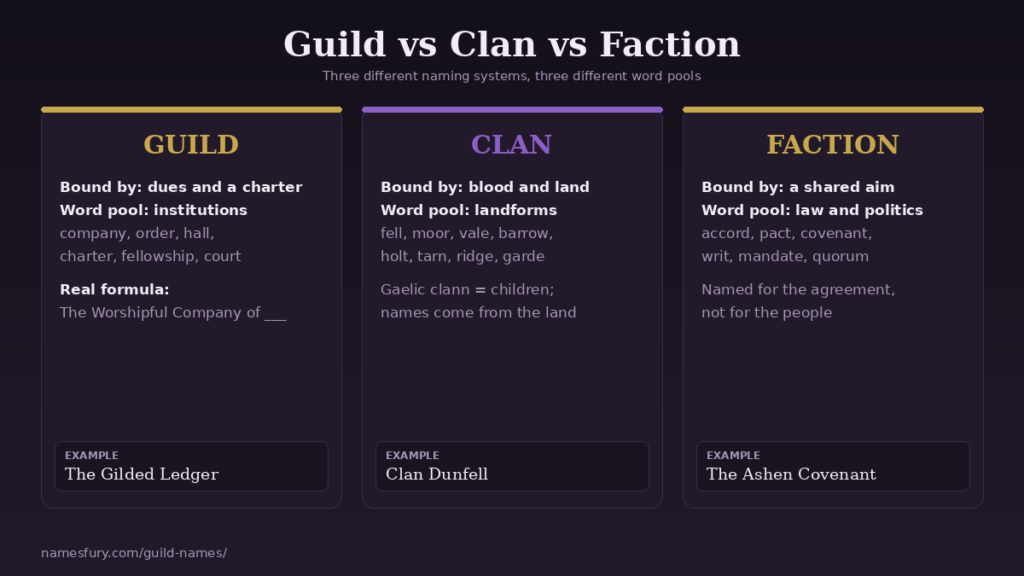
The institutional formula is the one almost nobody borrows and the one that works best. Real guilds were named The Worshipful Company of plus the trade, and that structure is still legally correct in London today. The strength of it is that it sounds like something with a building, a chest with two locks, and a clerk who writes everything down. You can shorten it without losing the effect: The Salters, The Vintners, The Fletchers. Drop the trade and keep the grammar and you get The Worshipful Company of Gravewrights, which sounds older than any invented word could.
The kinship formula is for clans. Clan comes from Gaelic clann, children, and real clan names are overwhelmingly places rather than qualities. A clan was the people of a particular glen, fell or shore, which is why Clan Brackenridge reads as genuine and Clan Bloodfury does not. Take a landform, attach a plant, colour, animal or weather word, and stop. Resist the urge to add a second adjective.
The political formula is for factions, and it runs on legal nouns. Accord, concord, pact, covenant, writ, mandate, quorum, tribunal, dominion and charter all describe a decision taken by a body rather than an act of heroism, which is exactly the flavour a faction needs. Pair one of them with a single concrete image and you have finished: The Ember Pact, The Obsidian Senate, The Burnt Petition.
Whichever system you use, test the abbreviation before you commit. Members will shorten the name within a week, and whatever they shorten it to is the name you actually have. If The Order of the Silver Dawn becomes OSD, or worse, Dawnies, you need to know that now rather than later.
Conclusion
Four hundred and eighty names is more than one campaign or one guild roster needs, so work backwards instead of reading all of it. Decide first whether the thing you are naming has dues, a bloodline or a political position, because that single question tells you which of the three sections to open.
And if you want the shortcut, use the real one. Find a trade that no longer exists, put The Worshipful Company of in front of it, and you will have a guild name that sounds older and more solid than anything you could invent. That is not cheating. It is the formula the actual guilds used, and they used it for six hundred years because it worked.
Frequently Asked Questions
What does the word guild actually mean?
It means payment. Guild comes from Old English gield, meaning a service, offering, tribute or compensation, from Proto-Germanic geldja-, a contribution. The earliest guilds were sacred banquets that members paid into, and the word for the subscription became the word for the group. A guild was defined by its dues and its records, not by its craft.
What is a good guild name?
One that is two or three words, reads clearly at small size, and can be said aloud without stumbling. Longer names get abbreviated by members within days, so decide the abbreviation yourself. Institutional words such as company, order, hall, accord and charter carry more weight than adjectives like dark, blood or shadow, which every other guild has already used.
What is the difference between a guild, a clan and a faction?
A guild has members, dues and a trade, so it takes institutional names. A clan is a kinship group tied to a place, so it takes landform names, which is why real clan names are nearly all geographical. A faction is a political body, so it takes legal and administrative names built on words like accord, mandate and tribunal. Using the wrong system is the most common naming mistake in worldbuilding.
What were the real medieval guilds called?
In London they used, and still use, the formula The Worshipful Company of plus the trade. The twelve most senior, ranked in 1515 by the Court of Aldermen and still known as the Great Twelve, are the Mercers, Grocers, Drapers, Fishmongers, Goldsmiths, Merchant Taylors, Skinners, Haberdashers, Salters, Ironmongers, Vintners and Clothworkers. The Merchant Taylors and Skinners still alternate between sixth and seventh place each year, a compromise reached after a long dispute over precedence.
How do I pick a clan name that does not sound generic?
Stop using blood, storm, shadow and iron. Those four words appear in a large share of every clan list online. Use specific and slightly obscure real vocabulary instead: a tarn is a small mountain lake, a windrow is a line of raked hay, a patten was a wooden overshoe, a steading is a Norse farm. Specific beats dramatic, because specific sounds like somewhere that exists.
What is a good guild name for Free Fire or mobile games?
Two short words, no decorative symbols. Symbols such as the ones most tag generators produce break on some devices, cannot be typed by other players, and cannot be searched for. Something like Zero Recoil or Final Circle reads clearly at small size and survives any keyboard. If you want the stylised unicode look, that is a font tool rather than a naming problem.
Can I use real guild names in my game or book?
Yes. The names of historical guilds are not protected, and most are far better than invented ones because they have had six hundred years to settle. The Loriners made spurs, the Horners made window panes from horn, the Pattenmakers made wooden overshoes. Any of those three would pass as fantasy without a single change.