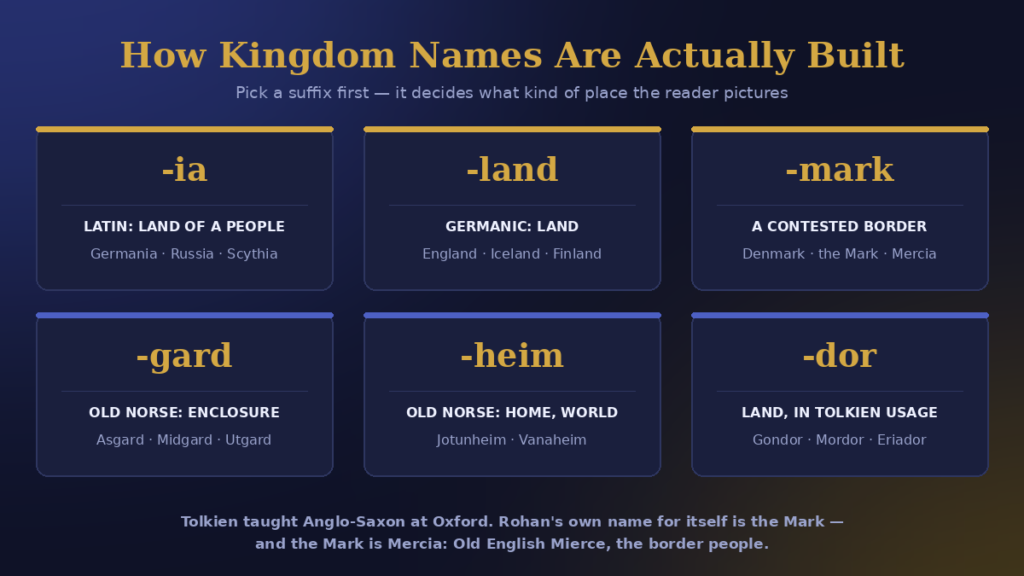
Tolkien taught Anglo-Saxon at Oxford for twenty years, and it shows in one detail most readers never notice. The Rohirrim do not call their country Rohan. That is what Gondor calls it. Among themselves it is the Mark and the Mark is Mercia.
Mercia was a real Anglo-Saxon kingdom covering the English Midlands. Its name is a Latinised form of Old English Mierce, meaning the border people, from mearc, a boundary. Tolkien did not invent a word for Rohan. He took a thousand-year-old English kingdom and translated its name back into the language it came from.
That is the whole method, and it is why some kingdom names land and others sound like a password. A name works when it means something in a real language, even a language your reader has never studied. Below are 480 names across sixteen categories, and every single one lists the actual root it was built from — Latin, Old Norse, Old English, Welsh, Arabic, Sindarin or a genuine historical place name.
Start with the generator if you want something immediately, or scroll to the category you need.
Kingdom Name Generator
This kingdom name generator builds names the way real place names were built, by joining a root to a suffix rather than scrambling letters. Pick a style fantasy, medieval, elven, dwarven, desert, dark, northern or imperial and every result arrives with the meaning of the parts it was made from. Switch the type to Empire and it works as an empire name generator instead, swapping the kingdom endings for the heavier Latin ones that imperial states tend to carry.
There is no limit on how many times you can run it, so treat it as a random kingdom name generator and reroll until something catches. If you are writing something grounded rather than high fantasy, the Medieval setting works as a medieval kingdom name generator, drawing only on Old English, Old Norse and Norman French elements that genuinely appear in European place names. Tap any result to copy it.
Kingdom Name Generator
Every result is a real root joined to a real suffix, and the meaning of both parts is shown underneath. Tap any name to copy it.
Fantasy Kingdom Names
Most fantasy kingdom names that feel right are doing one quiet thing: borrowing a real suffix. The Latin ending -ia originally turned a people into a place, which is how Germani became Germania and Rus became Russia. Attach it to almost any invented root and the ear accepts it as a country. Every name below carries a genuine root, listed beside it.
| Name | Meaning and root |
|---|---|
| Aldoria | Germanic ald, old, plus Latin -ia: the ancient land |
| Eryndor | Welsh eryr, eagle, with -dor, realm: land of eagles |
| Valmoria | Latin vallis, valley, and mor, great: the great valley |
| Caldrath | Latin calidus, warm, with a hard Celtic ending |
| Solvaris | Latin sol, sun, and varius, shifting: land of changing light |
| Dracoris | Latin draco, dragon: the dragon's seat |
| Eldenmar | Old English ælden, fire, and Norse marr, sea |
| Varenthia | Latin varius, varied, in full Latinised form |
| Kaldreth | Old Norse kaldr, cold, with Brythonic -eth |
| Orenhal | Hebrew oren, pine, and Norse hall, great room |
| Sylvenna | Latin silva, forest: the wooded realm |
| Tarnovia | Slavic tarn, thorn, Latinised with -ia |
| Pyrrhane | Greek pyr, fire, with a softening ending |
| Lumendra | Latin lumen, light, with Sanskrit -indra, lord |
| Corvania | Latin corvus, raven: the raven country |
| Ferrowyn | Latin ferrum, iron, and Welsh gwyn, white |
| Ostaria | Latin ostium, river mouth: the delta kingdom |
| Brennhold | Welsh brenin, king, and Norse hold: the king's holding |
| Vesperon | Latin vesper, evening star |
| Malkoria | Semitic malk, king: the king's country |
| Ansgard | Norse áss, god, and garðr, enclosure |
| Durnmere | Old English derne, hidden, and mere, lake |
| Rhosmark | Welsh rhos, moor, and Germanic mark, border |
| Aquilene | Latin aquila, eagle, with a Gallic ending |
| Terravane | Latin terra, earth, and vanus, empty |
| Nocturnia | Latin nox, night: the realm that never sees noon |
| Galdrheim | Norse galdr, spell, and heimr, home |
| Belthoria | Semitic bel, lord, and Greek thorós, leaping |
| Caerwyth | Welsh caer, fortress, and gwyth, anger |
| Mordanel | Latin mordere, to bite, with Elvish-style -el |
Cool Kingdom Names
Cool kingdom names usually trade vowels for consonants. Compare Serenwyn with Vexhold and you can hear the difference: hard stops at the front and back of the word make a realm sound dangerous rather than pleasant. The thirty below lean on Norse and Germanic roots, which is where English keeps most of its blunt sounds.
| Name | Meaning and root |
|---|---|
| Vexhold | Latin vexare, to harass, and Norse hold, stronghold |
| Krenvar | Slavic kren, horseradish root, hardened: the bitter land |
| Dreadmark | Old English dræd, fear, and mearc, boundary |
| Zarnoth | Persian zar, gold, with Norse -noth |
| Blackspire | English compound: the dark tower that names the realm |
| Ironfell | Norse fjall, mountain: the iron mountain |
| Varkoth | Germanic wark, work or fortress, with -oth |
| Stormreach | Old English storm and ræcan, to extend |
| Nyxaria | Greek Nyx, night, Latinised |
| Grimvale | Norse grimmr, fierce, and Old French val, valley |
| Thornegate | Old English thorn and geat, gate |
| Obsidra | Latin obsidianus, volcanic glass |
| Skarnholm | Norse skarn, rubble, and holmr, islet |
| Ravencrest | English compound: the ridge the ravens hold |
| Volkmar | Germanic volk, people, and mar, famous |
| Ashenfang | Old English æscen, of ash, and fang, grasp |
| Draven | Middle English draven, to drive out |
| Korrath | Semitic qor, cold, with Celtic -ath |
| Nightmarch | English: a border region crossed only after dark |
| Vaelspire | Latin valere, to be strong, and spira, coil |
| Strakmoor | Slavic strakh, dread, and English moor |
| Hollowmere | Old English holh, hollow, and mere, lake |
| Jaggard | Middle English jag, notch, and Norse garðr |
| Dusklund | English dusk and Norse lundr, grove |
| Verrick | Latin verus, true, and Norse rik, ruler |
| Scathehall | Norse skaði, harm, and Old English heall |
| Blightmoor | Old English blæce, pallor, and mor, moorland |
| Torvane | Norse torg, market, and vangr, field |
| Emberfall | English compound: the realm founded where the fire died |
| Rhakmar | Sanskrit raksha, protection, and Norse marr, sea |
Good Kingdom Names
If you want a good kingdom name that works immediately and never draws attention to itself, use real English place-name elements. These are the words that built thousands of actual village names: -mere for a lake, -wick for a settlement, -shire for a district. Readers recognise the pattern without knowing why, which is exactly what you want from a background kingdom.
| Name | Meaning and root |
|---|---|
| Arandor | Quenya-style aran, king, and -dor, land: the king's land |
| Highmere | Old English heah, high, and mere, lake |
| Caldonia | Latin Caledonia, the Roman name for Scotland |
| Westmarch | Old English: the western border province |
| Thalendor | Greek thallein, to bloom, with -dor, realm |
| Ambervale | Arabic anbar, amber, and Old French val, valley |
| Rothwell | Old English rod, clearing, and wella, spring |
| Elsmere | Old English els, alder, and mere, lake |
| Norhaven | Norse norðr, north, and English haven, harbour |
| Larkspur | English plant name, used as a realm of open meadow |
| Fenwick | Old English fenn, marsh, and wic, settlement |
| Oakenshire | Old English ac, oak, and scir, administrative district |
| Brightwater | English compound: the kingdom named for its clear river |
| Avonrest | Brythonic afon, river, and English rest |
| Greymarch | English: the disputed grey land between two crowns |
| Stonebridge | English compound: the crossing that made the kingdom rich |
| Wyndholt | Old English wind and holt, wood |
| Marrowdale | Old English mearg, marrow, and Norse dalr, valley |
| Ashbourne | Old English æsc, ash tree, and burna, stream |
| Pellmoor | Latin pellis, hide, and English moor |
| Dunhallow | Gaelic dun, fort, and Old English halig, holy |
| Everwood | English compound: the forest that was never cleared |
| Thornbury | Old English thorn and burh, fortified place |
| Clearhelm | English clear and Old English helm, protection |
| Sablewood | Old French sable, black, and English wood |
| Ridgemont | English ridge and Latin mons, mountain |
| Kingsvale | English compound: the valley the crown kept for itself |
| Harrowgate | Norse hörgr, shrine, and Old English geat, gate |
| Windermar | Norse Vinandr, a personal name, and marr, sea |
| Belfront | Latin bellum, war, and frons, forehead or front line |
Beautiful Kingdom Names
Beautiful kingdom names share a shape: more vowels than consonants, a soft middle, and an ending that trails rather than stops. Liquid sounds such as l, r and n do most of the work, which is why Lirathel feels gentler than Grimvale even though both are invented. These thirty are built on Latin, Greek and Welsh roots.
| Name | Meaning and root |
|---|---|
| Aurelian | Latin aurum, gold: the golden realm |
| Seralune | Latin sera, evening, and luna, moon |
| Elowyn | Welsh eilun, image, and gwyn, fair |
| Lirathel | Greek lyra, lyre, with Elvish-style -thel |
| Silvenmoor | Latin silva, wood, and English moor |
| Caelora | Latin caelum, sky, and ora, shore: the sky's edge |
| Mirabelle | Latin mirabilis, wonderful: the land worth seeing |
| Thessaline | Greek Thessalia, with a softened Latin ending |
| Avanthea | Sanskrit avani, earth, and Greek theia, divine |
| Lysandre | Greek lysis, release, and andros, of man |
| Veloria | Latin velum, veil: the veiled country |
| Orielle | Latin aureolus, golden, by way of Old French |
| Nerida | Greek Nereis, sea nymph |
| Calissa | Greek kallos, beauty, Latinised |
| Elvarin | Old English ælf, elf, and Welsh rhin, secret |
| Serenwyn | Latin serenus, calm, and Welsh gwyn, blessed |
| Allariel | Semitic allah-ri, with Elvish -iel: a deliberate hybrid |
| Fiorenne | Italian fiore, flower, with a Gallic ending |
| Amarine | Latin amare, to love, and marinus, of the sea |
| Lunaveil | Latin luna, moon, and English veil |
| Cythera | Greek Kythera, the island sacred to Aphrodite |
| Ysolde | Germanic is, ice, and hild, battle |
| Elenthia | Greek helene, torch, with -thia |
| Marisol | Latin mare, sea, and sol, sun |
| Vaelora | Latin valere, to flourish, and ora, coast |
| Rosalind | Germanic hros, horse, and lind, soft |
| Celesmere | Latin caelestis, heavenly, and Old English mere, lake |
| Thalienne | Greek thaleia, blooming, with a French ending |
| Ilyaria | Illyria, the classical name of the Adriatic coast |
| Sorellis | Latin soror, sister: the realm of the two sister cities |
Medieval Kingdom Names
Real medieval kingdom names were rarely poetic. They described terrain, ownership or direction, then stuck for eight hundred years. Beaumarch simply means the fair border; Winterbourne is a stream that only runs in winter. Nothing below is grand, and that is the point if you want a world that sounds lived in.
| Name | Meaning and root |
|---|---|
| Beaumarch | Old French beau, fair, and marche, border province |
| Normanby | Norse: the settlement of the Northmen |
| Alderholt | Old English alor, alder, and holt, wood |
| Montclair | Old French mont, hill, and clair, bright |
| Weatherby | Old English wether, ram, and Norse by, village |
| Carlowe | Gaelic ceatharlach, four lakes |
| Dunmorra | Gaelic dun, fort, and mor, great |
| Wexmoor | Old English weax, wax, and mor, moorland |
| Aldermere | Old English ealdor, elder or chief, and mere, lake |
| Ravenstoke | Norse hrafn, raven, and Old English stoc, outlying farm |
| Bellecourt | Old French belle, fair, and cour, court |
| Hartwick | Old English heorot, stag, and wic, settlement |
| Grimsby | Norse: Grim's village, a genuine Danelaw formation |
| Ashcombe | Old English æsc, ash, and cumb, valley |
| Thorncastle | English: the fortress ringed by thorn hedges |
| Sainte-Marre | Old French: the saint's marsh |
| Oldenburg | German alt, old, and burg, fortress |
| Fairholme | English fair and Norse holmr, river island |
| Pevensmoor | Old English Pefen, a personal name, and mor |
| Lutterwell | Old English hlutor, clear, and wella, spring |
| Caen Dreux | Two genuine Norman place elements combined |
| Brackenfell | Norse brakni, fern, and fjall, mountain |
| Stowmarket | Old English stow, holy place, and market |
| Redcliffe | Old English read, red, and clif, cliff |
| Hollingsmere | Old English hole, hollow, and mere, lake |
| Auvergnac | Auvergne, the French province, with a Gallic suffix |
| Winterbourne | Old English: the stream that flows only in winter |
| Maldonbury | Old English mæl, cross, dun, hill, and burh, fort |
| Saxonhold | English: the holding kept by the Saxon line |
| Verdunnais | Verdun, from Gaulish verodunum, strong fort |
[[[ NEECHE WALE PARAGRAPH MEIN LINK LAGANA HAI — tafseel LINKS section mein ]]]
Once the kingdom has a name, its rulers need one too, and the same Anglo-Norman sound pool produces both the medieval names for your rulers list covers the people who would have held these lands.
Mythical Kingdom Names
These are mythical kingdom names drawn from places people genuinely believed existed. Hyperborea was Greek for the land beyond the north wind. Cíbola was one of seven golden cities Spanish expeditions actually marched into the desert to find. Using a real legend gives your kingdom a history before you write a single line of it.
| Name | Meaning and root |
|---|---|
| Avalonis | Welsh afal, apple: the isle of apples, Latinised |
| Hyperborea | Greek: the land beyond the north wind |
| Elysior | Greek Elysion, the blessed fields of the afterlife |
| Thuleheim | Thule, the classical far north, and Norse heimr, home |
| Lemuria | A lost-continent name coined by zoologist Philip Sclater |
| Asgardia | Norse Ásgarðr, the enclosure of the gods, Latinised |
| Shangria | Shangri-La, coined by James Hilton in 1933 |
| Ysbaddon | Welsh Ysbaddaden, the giant king of the Mabinogi |
| Mag Mellia | Irish Mag Mell, the plain of delight |
| Vanaheil | Norse Vanaheimr, home of the Vanir gods |
| Kitezhgrad | Kitezh, the Russian city said to have sunk into a lake |
| Irembar | Iram of the Pillars, the lost city of Arabian tradition |
| Penglaria | Penglai, the immortal mountain-isle of Chinese myth |
| Tirnanog | Irish Tír na nÓg, the land of the young |
| Agarthen | Agartha, the subterranean realm of nineteenth-century legend |
| Zerzuria | Zerzura, the white oasis city of Egyptian desert legend |
| Numenorr | Tolkien's drowned kingdom, from Quenya númen, west |
| Hesperida | Greek Hesperides, the nymphs of the western golden apples |
| Cibolar | Cíbola, one of the seven golden cities Spanish explorers sought |
| Lyonnessa | Lyonesse, the Cornish land said to lie beneath the sea |
| Svarthal | Norse Svartálfaheimr, home of the dark elves |
| Aztlantis | Aztlán, the ancestral homeland of the Mexica |
| Biarmland | Bjarmaland, the half-legendary realm of Norse sagas |
| Ophiria | Ophir, the biblical source of Solomon's gold |
| Mu Kaleth | Mu, the hypothetical Pacific continent of occult writing |
| Dilmunar | Dilmun, the Sumerian paradise-land of the Gulf |
| Jotunhold | Norse Jötunheimr, the realm of giants |
| Khembalar | Khembalung, a hidden valley of Tibetan tradition |
| Antillia | Antillia, the phantom Atlantic island of medieval maps |
| Prester Jhan | Prester John, the legendary Christian king of the East |
Dark Kingdom Names
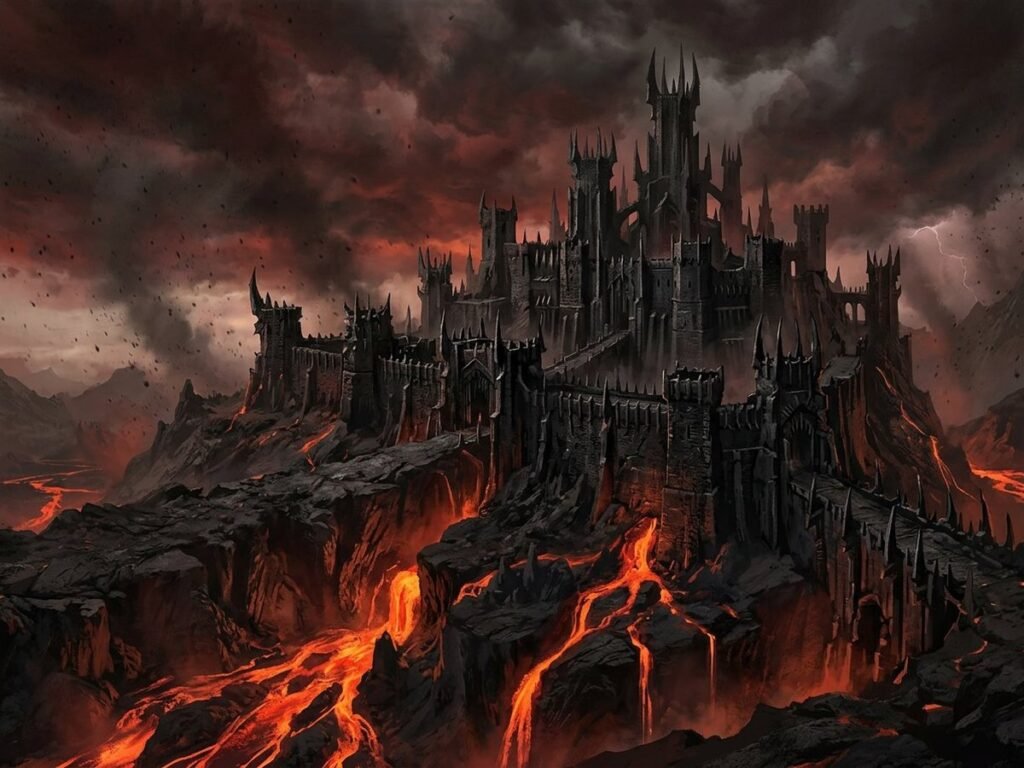
Dark kingdom names work best when the grimness is specific rather than general. Gallowfen names one gallows in one marsh; Cinderwaste tells you something burned and never recovered. Vague menace wears off in a chapter, but a name that implies an event keeps working. These thirty each name a thing that happened.
| Name | Meaning and root |
|---|---|
| Malgrave | Latin malus, evil, and English grave |
| Vorndrath | Germanic vorn, in front, and Celtic drath, betrayal |
| Sablemourn | Old French sable, black, and English mourn |
| Necropolia | Greek nekros, dead, and polis, city |
| Dreadspire | English: the realm known only by its one black tower |
| Carrionvale | Latin caro, flesh, by way of Old French caroigne |
| Ghaulmark | Gaulish gall, stranger, and Germanic mark, border |
| Umbrathis | Latin umbra, shadow, with a Greek ending |
| Ruinhold | English: the stronghold that kept its name after falling |
| Vexmoria | Latin vexare, to torment, and mori, to die |
| Blackmire | English compound: the bog the old road avoided |
| Thanatos Reach | Greek Thanatos, death personified |
| Grimhollow | Norse grimmr, fierce, and Old English holh, hollow |
| Severn Pale | Old English pale, the fenced limit of settled land |
| Nocthaven | Latin nox, night, and English haven |
| Wormwood | Old English wermod, the bitter herb of Revelation |
| Mortaine | Latin mors, death, with a Norman ending |
| Cinderwaste | English compound: the land that burned and stayed burnt |
| Baelgorn | Semitic baal, lord, and Norse gorn, entrails |
| Shriveholm | English shrive, to confess, and Norse holmr, islet |
| Dolorosa | Latin dolor, grief: the sorrowing country |
| Ashkarath | Semitic ashkar, bright, inverted with Celtic -ath |
| Gallowfen | Old English galga, gallows, and fenn, marsh |
| Tenebrion | Latin tenebrae, darkness |
| Sorrowmarch | English: the border province nobody wanted |
| Vaskareth | Slavic vask, wax, with Brythonic -eth |
| Blightholm | Old English blæce, pallor, and Norse holmr |
| Erebusk | Greek Erebos, the primordial darkness |
| Mourncrag | English mourn and Norse kraka, crag |
| Kaldrothia | Norse kaldr, cold, and Celtic roth, wheel |
Elven Kingdom Names
Elven kingdom names follow Tolkien's two invented languages more than anything in folklore. Sindarin favours short, consonant-light roots joined cleanly, so gond plus dor gives Gondor, the land of stone. The thirty below use that same grammar, with the Sindarin or Quenya element named beside each one.
| Name | Meaning and root |
|---|---|
| Lathrielle | Sindarin-style lath, listen, with -rielle, maiden |
| Aerendil | Quenya earen, eagle, and ndil, devoted friend |
| Silmaloth | Quenya silma, silver light, and loth, flower |
| Taurevon | Sindarin taur, forest, and von, of |
| Nimrodiel | Sindarin nim, white, and roch, horse |
| Galadhrim Vale | Sindarin galadh, tree, and rim, host of people |
| Elenduil | Quenya elen, star, and duil, river |
| Mithlorien | Sindarin mith, grey, and lorien, dreamland |
| Faelwen | Sindarin fael, fair-minded, and gwen, maiden |
| Aerinthal | Sindarin aer, sea, and thal, firm |
| Caranthir | Sindarin caran, red, and thir, face |
| Lindoreth | Quenya linde, song, with Brythonic -eth |
| Ithilmoor | Sindarin ithil, moon, with English moor |
| Vaelorien | Latin valere, to flourish, fused to Sindarin lorien |
| Thaliondor | Sindarin thalion, steadfast, and dor, land |
| Eryn Galen | Sindarin: the green wood, Mirkwood's older name |
| Nenuviel | Sindarin nen, water, and uial, twilight |
| Celebmar | Sindarin celeb, silver, and Norse marr, sea |
| Arwenhal | Sindarin ar, noble, wen, maiden, and hal, hall |
| Lossarond | Sindarin loss, snow, and rond, vaulted hall |
| Edhelmire | Sindarin edhel, elf, and English mire |
| Tinuvara | Sindarin tinu, spark, and vara, burning |
| Anorvale | Sindarin anor, sun, with Old French val, valley |
| Mellonir | Sindarin mellon, friend, and nir, tear |
| Glorinthe | Sindarin glor, golden, with a Greek ending |
| Sirithwyn | Sindarin sirith, a flowing, and Welsh gwyn, white |
| Aduialon | Sindarin aduial, evening twilight |
| Haldirane | Sindarin hal, exalted, and dir, man |
| Nimloth Reach | Sindarin: the white blossom, the tree of Numenor |
| Elvandrim | Sindarin elvan, starlike, and rim, host |
Not every elf realm should sound like a garden. For the courts below ground, the dark elf names list uses a harsher register built on the same Sindarin grammar.
Dwarven Kingdom Names
Dwarven kingdom names are almost always compounds of a material and a structure. That is a real linguistic habit, not a fantasy invention: Old Norse built place names the same way, stacking fjall for mountain or garðr for enclosure onto whatever was there. Hard consonant clusters do the rest of the work.
| Name | Meaning and root |
|---|---|
| Khazad Durum | Khuzdul-style khazad, dwarves, and durum, hard |
| Ironforge Deep | English compound: the forge-city beneath the mountain |
| Stonehelm | Old English stan, stone, and helm, protection |
| Grimbrak | Norse grimmr, fierce, and brak, crash |
| Durinhold | Norse Durinn, a dwarf of the Völuspá, and hold |
| Anvilgard | English anvil and Norse garðr, enclosure |
| Baraz Thrund | Khuzdul-style baraz, red, with a guttural ending |
| Deepdelve | Old English delfan, to dig: the kingdom that dug too far |
| Hammerfast | English compound: the hold that never fell |
| Thrainmor | Norse Þráinn, a dwarf name, and mor, great |
| Granitfell | Latin granum, grain, and Norse fjall, mountain |
| Orethrone | English ore and Greek thronos, seat |
| Kazrik Vault | Semitic kazr, palace, with Norse rik, ruler |
| Coalspire | English compound: the chimney-tower of the deep forges |
| Brondhal | Welsh brwnt, rough, and Norse hall |
| Steelmarch | English: the armoured border of the under-kingdom |
| Nargun Deep | Norse Nár, a dwarf of the Völuspá, and gunnr, battle |
| Mithralhold | Sindarin mithril, grey brilliance, and English hold |
| Boragrim | Norse Bávorr, a dwarf name, and grimmr, fierce |
| Emberforge | English compound: the kingdom built around one furnace |
| Dolgrund | Welsh dol, meadow, and German grund, ground |
| Stonebeard Hold | English: named for its first king, not its geography |
| Vargrim Deep | Norse vargr, wolf, and grimmr, fierce |
| Goldvein | English compound: the seam that founded the kingdom |
| Tharkun Barad | Sindarin barad, tower, with a Khuzdul-style prefix |
| Rockmantle | English: the stone roof the dwarves live beneath |
| Fjallgard | Norse fjall, mountain, and garðr, enclosure |
| Undergarde | Middle English under and Norse garðr |
| Bronzegate | English compound: the door that has never been forced |
| Skarnvald | Norse skarn, rubble, and valdr, ruler |
Clan naming and hold naming are the same system in dwarf culture, since a hold is simply the clan that dug it — the dwarf names and clan naming page covers the personal side of it.
Desert Kingdom Names
Good desert kingdom names come from Arabic, Persian and Berber roots, because those languages have precise words for things English does not. Wadi is a riverbed that is dry most of the year. Qasr is a fortified desert palace. Several entries below are real kingdoms, including Nabataea, which carved Petra out of a cliff.
| Name | Meaning and root |
|---|---|
| Al Zhareen | Arabic al, the, and zahr, blossom |
| Qasr Nahal | Arabic qasr, palace, and nakhl, palm trees |
| Sahrabad | Arabic sahra, desert, and Persian abad, settled place |
| Khoremid | Persian khor, sun, and mid, middle |
| Tamarkesh | Arabic tamr, dates, and Berber kesh, fortified town |
| Zerafshan | Persian zarafshan, scatterer of gold, a real river name |
| Marrakhan | Berber amur n akush, land of God, with Mongol khan |
| Bahr Sulim | Arabic bahr, sea, and salim, whole |
| Nefertara | Egyptian nefer, beautiful, and ta, land |
| Ozmandria | Ozymandias, the Greek rendering of Ramesses' throne name |
| Harsamun | Egyptian hor, Horus, and amun, the hidden one |
| Djedkara | Egyptian djed, stability, a genuine royal name element |
| Sirocco Reach | Arabic sharq, east, the name of the desert wind |
| Kerman Vash | Kerman, a real Persian province, and vash, like |
| Ammonaris | Ammon, the Siwa oracle the Greeks consulted |
| Rub al Khala | Arabic: the empty quarter, the real Arabian desert |
| Tuaregath | Tuareg, the Saharan people, with Celtic -ath |
| Shamshara | Akkadian shamash, sun god, and shar, king |
| Ghadames | A genuine Libyan oasis town of the caravan routes |
| Palmyris | Palmyra, the Syrian caravan city of Queen Zenobia |
| Nabatheon | Nabataea, the real Arab kingdom that carved Petra |
| Himyarun | Himyar, the kingdom that ruled Yemen before Islam |
| Sabakhan | Saba, the kingdom the Bible calls Sheba |
| Thamudis | Thamud, the Arabian people named in the Qur'an |
| Azrakeel | Arabic azraq, blue, with a Hebrew -el ending |
| Wadi Suran | Arabic wadi, dry riverbed, and sur, rampart |
| Garamantis | Garamantes, the Saharan kingdom Herodotus described |
| Ifriqana | Ifriqiya, the Arabic name for the old Roman province |
| Dahkarim | Arabic dahk, laughter, and karim, generous |
| Sandravar | English sand and Persian var, fortified |
Island and Sea Kingdom Names
Island and sea kingdoms are named for what sailors noticed first. Norse sker gives Skerryvore, a rock that wrecks ships; holmr gives every -holm in the North Sea. Sea kingdom names built from these elements sound authentic because the elements themselves were coined by people who had to navigate by them.
| Name | Meaning and root |
|---|---|
| Thalassor | Greek thalassa, sea, with an agent ending |
| Saltmere | Old English sealt, salt, and mere, lake |
| Coralhaven | Greek korallion, coral, and English haven |
| Nerethys | Greek Nereus, the old man of the sea |
| Tidecrown | English compound: the ring of islets at high water |
| Marindor | Latin marinus, of the sea, and -dor, realm |
| Orkneyar | Orkney, from Norse orkn, seal, and ey, island |
| Brinehold | Old English bryne, brine, and hold, stronghold |
| Pelagara | Greek pelagos, open sea, with -ara |
| Skerryvore | Norse sker, sea rock, and Gaelic mor, great |
| Aquilonia | Latin aquilo, the north wind: the windward isles |
| Stormfathom | English: a sea depth no ship has ever sounded |
| Vanholm | Norse vangr, field, and holmr, islet |
| Meridara | Latin meridies, midday or south |
| Kelpmarch | English kelp and Germanic mark, border |
| Caladrea | Greek kalos, beautiful, and hydor, water |
| Seawatch | English compound: the kingdom that exists to look outward |
| Lyrenne Isles | Greek lyra, lyre, with a French ending |
| Driftmoor | English drift and moor: the floating bog kingdom |
| Nautilia | Greek nautilos, sailor, Latinised |
| Fjordhelm | Norse fjörðr, inlet, and hjalmr, helm |
| Sirenvale | Greek seiren, the singing sea spirit |
| Gullcrest | English compound: the cliff the colony built below |
| Tortugara | Spanish tortuga, turtle, with a Latin ending |
| Haldarmer | Norse hald, holding, and marr, sea |
| Reefholt | English reef and Old English holt, wood |
| Oceanus Pale | Greek Okeanos, the river encircling the world |
| Windward Thane | English windward and Old English thegn, retainer |
| Selkiemoor | Orcadian selkie, seal-person, and English moor |
| Maristella | Latin: star of the sea, a genuine medieval epithet |
Ice and Northern Kingdom Names
Northern realms get their sound from Old Norse, which had more words for cold terrain than English has ever needed. Jökull is a glacier, fjall a bare mountain, íss simply ice. Fimbulhold below refers to the Fimbulwinter, the three-year winter Norse myth placed immediately before Ragnarok.
| Name | Meaning and root |
|---|---|
| Frosthelm | English frost and Old English helm, protection |
| Vetrgard | Norse vetr, winter, and garðr, enclosure |
| Nivalis | Latin nivalis, snowy |
| Rimehold | Old English hrim, hoarfrost, and hold, stronghold |
| Jokulheim | Icelandic jökull, glacier, and Norse heimr, home |
| Bjornmark | Norse björn, bear, and mark, border |
| Whitereach | English compound: the province beyond the tree line |
| Kaldafjell | Norse kaldr, cold, and fjall, mountain |
| Isgard | Norse íss, ice, and garðr, enclosure |
| Nordhaven | Norse norðr, north, and English haven |
| Glacimar | Latin glacies, ice, and mare, sea |
| Skaldmoor | Norse skáld, poet, and English moor |
| Hvitland | Norse hvítr, white, and land |
| Thulemarch | Thule, the classical far north, and march, border |
| Vargholm | Norse vargr, wolf, and holmr, islet |
| Snowthane | English snow and Old English thegn, lord's retainer |
| Eiswald | German eis, ice, and wald, forest |
| Boreasind | Greek Boreas, the north wind |
| Fimbulhold | Norse fimbulvetr, the great winter before Ragnarok |
| Drifthollow | English compound: the valley the snow fills first |
| Sturmfell | German sturm, storm, and Norse fjall, mountain |
| Lappmarken | Lappmarken, the genuine old name for Swedish Lapland |
| Hjaltvik | Norse Hjaltland, the old name for Shetland, and vik, bay |
| Pallarost | Latin pallidus, pale, and German frost |
| Grimfrost | Norse grimmr, fierce, and English frost |
| Ninglor Pale | Sindarin ninglor, golden water-flower, and English pale |
| Austrvegr | Norse: the eastern way, the real Viking name for the Baltic route |
| Hoarmoor | Old English har, grey with age, and mor, moorland |
| Svalbrand | Norse svalr, cool, and brandr, sword blade |
| Winterthrone | English compound: the seat that is only occupied in winter |
Empire Names
An empire name has to sound larger than a kingdom, and the trick is usually Latin. Endings such as -ium, -ar and -ian were how Rome labelled territory it had absorbed, so they carry the weight of administration rather than inheritance. Pair one with a harsh root and you get a state that conquered rather than grew.
| Name | Meaning and root |
|---|---|
| Valcoran Empire | Latin valere, to be strong, and cor, heart |
| Astarion Dominion | Greek aster, star, with a Latin ending |
| Kharzadi Empire | Persian khwarazm, a real Central Asian empire, reshaped |
| Solveran Imperium | Latin sol, sun, and verus, true |
| Thorasian Empire | Greek thorax, breastplate, with -ian |
| Draconar Imperium | Latin draco, dragon, and ara, altar |
| Velmaris Dominion | Latin velum, sail, and maris, of the sea |
| Orthandia | Greek orthos, straight, and andros, of man |
| Serathine Empire | Hebrew seraph, burning one, with a Latin ending |
| Caldaran Imperium | Latin calidus, hot, and ara, altar |
| Tyrannos Reach | Greek tyrannos, a ruler who seized power |
| Mordavian Empire | Latin mordere, to bite, with a Slavic ending |
| Aurethia | Latin aurum, gold, with a Greek -thia |
| Vharnak Dominion | Slavic vran, raven, hardened with -ak |
| Luminar Imperium | Latin lumen, light, and ara, altar |
| Sanguinar Empire | Latin sanguis, blood |
| Khyberan Dominion | Khyber, the real pass between Afghanistan and India |
| Palatine Reach | Latin palatium, the imperial hill of Rome |
| Ferrathia | Latin ferrum, iron, with -thia |
| Nyxandros Empire | Greek Nyx, night, and andros, of man |
| Castrovar | Latin castrum, fortified camp, and Persian var |
| Obsidian Throne | Latin obsidianus, the black volcanic glass |
| Terravane Imperium | Latin terra, earth, and vanus, empty |
| Harkonar Dominion | Germanic hark, to listen, with -onar |
| Imperium Solara | Latin: the empire of the sun, in correct Latin word order |
| Zarandel Empire | Persian zar, gold, with a Hebrew -el ending |
| Brachionis | Greek brachion, arm: the empire's reach |
| Volkmaran Empire | Germanic volk, people, and mar, famous |
| Eterium | Greek aither, the upper air, Latinised |
| Magnarion | Latin magnus, great, with a Greek ending |
Fairytale Kingdom Names
Fairytale kingdom names are deliberately small. A realm called Peppercorn Vale cannot be threatening, and that is the function. Peppercorn is a genuine feudal term: a nominal rent of one peppercorn a year kept a lease legally alive. Several names below are real historical words wearing a storybook coat.
| Name | Meaning and root |
|---|---|
| Rosenhollow | German rosen, roses, and English hollow |
| Glimmervale | English glimmer and Old French val, valley |
| Thistledown | English: the seed that drifts, used as a soft realm name |
| Moonbarrow | English moon and Old English beorg, mound |
| Pennywhistle | English: a kingdom named after its smallest instrument |
| Everbloom | English compound: the land where the orchards never rest |
| Candlewick | English candle and Old English wic, settlement |
| Hazelmere | Old English hæsel, hazel, and mere, lake |
| Sugarbrook | English compound: the stream the children were told of |
| Willowgate | Old English welig, willow, and geat, gate |
| Brambleshire | Old English bremel, bramble, and scir, district |
| Lullaby Reach | English: the province named for a song, not a battle |
| Honeyfold | Old English hunig, honey, and fald, enclosure |
| Starlingwood | English starling and wood |
| Peppercorn Vale | English: the rent of one peppercorn, a real feudal term |
| Dandelion Pale | English dandelion, from French dent de lion, lion's tooth |
| Gingerholt | English ginger and Old English holt, wood |
| Marzipania | Italian marzapane, the almond sweet, Latinised |
| Clovermoor | Old English clafre, clover, and mor, moorland |
| Buttercross | English: the market cross where butter was sold |
| Pipkin Hollow | English pipkin, a small earthen pot |
| Thimbleford | English thimble and Old English ford, river crossing |
| Nutmeg Reach | English, from Old French nois muguete, musky nut |
| Lavendell | Latin lavare, to wash, the root of lavender |
| Pumpkinshire | English pumpkin and Old English scir, district |
| Teacup Dale | English teacup and Norse dalr, valley |
| Cobblewick | English cobble and Old English wic, settlement |
| Fableholm | Latin fabula, story, and Norse holmr, islet |
| Mistletoe Court | Old English mistiltan, the plant of winter custom |
| Snowdrop Glen | English snowdrop and Gaelic gleann, narrow valley |
Real Historical Kingdom Names
These kingdoms all existed. Their names are better than most invented ones because they had centuries to wear smooth, and because each one encodes a fact. Lotharingia is named after a man called Lothair and survives today as Lorraine. Urartu is where the word Ararat comes from. Take any of them wholesale.
| Name | Meaning and root |
|---|---|
| Mercia | Old English Mierce, border people, from mearc, boundary |
| Wessex | Old English: the kingdom of the West Saxons |
| Northumbria | Old English: the land north of the River Humber |
| Dalriada | The Gaelic kingdom spanning Argyll and northern Ireland |
| Gwynedd | The north Welsh kingdom, from a tribal name |
| Powys | Welsh, from Latin pagenses, the country dwellers |
| Strathclyde | Brythonic: the valley of the River Clyde |
| Rheged | A northern Brythonic kingdom whose capital is still unlocated |
| Elmet | The last Brythonic kingdom inside modern Yorkshire |
| Aquitaine | Latin Aquitania, the land of waters |
| Austrasia | Latin: the eastern lands of the Frankish realm |
| Neustria | Latin: the new western lands of the Franks |
| Lotharingia | Named for Lothair II, and the root of the word Lorraine |
| Burgundy | From the Burgundians, a people originally from Bornholm |
| Septimania | Latin: the land of the seventh legion's veterans |
| Asturias | The Iberian kingdom that outlasted the Umayyad conquest |
| Navarre | Basque nabar, brown or ploughland |
| Aragon | Named for the River Aragón in the Pyrenees |
| Bohemia | Latin Boiohaemum, the home of the Boii, a Celtic people |
| Moravia | Named for the River Morava |
| Urartu | The Assyrian name for the Armenian highland kingdom; the root of Ararat |
| Lydia | The Anatolian kingdom that minted the world's first coins |
| Bactria | The Greek kingdom founded in Afghanistan after Alexander |
| Sogdiana | The Silk Road kingdom whose merchants carried its language to China |
| Axum | The Ethiopian empire that minted its own coinage from the third century |
| Kush | The Nubian kingdom that ruled Egypt as its twenty-fifth dynasty |
| Nri | The Igbo kingdom whose ruler held ritual rather than military power |
| Majapahit | The Javanese empire named after a bitter fruit |
| Srivijaya | Sanskrit sri, radiant, and vijaya, victory |
| Goguryeo | The northernmost of Korea's Three Kingdoms, the root of the name Korea |
Fictional Kingdom Names from Books, Films and Games
Here is what the famous invented kingdoms actually mean, which is more useful than another list of made-up words. Narnia was lifted from Narni, a real town in Umbria that Lewis found in a classical atlas. Oz reportedly came from a filing cabinet drawer labelled O to Z. Pattern-spotting beats brainstorming.
| Name | Meaning and root |
|---|---|
| Gondor | Sindarin gond, stone, and dor, land: the land of stone |
| Rohan | Sindarin for horse country; its own people call it the Mark |
| Arnor | Sindarin ara, royal, and nor, land: the royal land |
| Numenor | Quenya númen, west, and nórë, land |
| Narnia | Taken from Narni, a real town in Umbria, found in an atlas |
| Archenland | Lewis's southern neighbour to Narnia |
| Calormen | Lewis's southern empire, from Latin calor, heat |
| Dorne | The southernmost of the Seven Kingdoms in Westeros |
| The Reach | Martin's fertile south-west, named for its open land |
| The Vale of Arryn | Martin's mountain kingdom, shut by snow half the year |
| Hyrule | The kingdom of The Legend of Zelda, ruled by its royal family |
| Ferelden | The Dragon Age kingdom modelled on early medieval England |
| Orlais | Dragon Age's courtly empire, built on a French template |
| Tevinter | Dragon Age's mage-ruled imperium |
| Skyrim | The Elder Scrolls province of the Nords, formerly Mereth |
| Cyrodiil | The Elder Scrolls imperial province at the heart of Tamriel |
| Hammerfell | The Elder Scrolls home of the Redguards |
| Morrowind | The Elder Scrolls province of the Dunmer |
| Lordaeron | The fallen human kingdom of Warcraft's Eastern Kingdoms |
| Stormwind | Warcraft's surviving human capital and realm |
| Quel'Thalas | Warcraft's high elf kingdom, from a constructed Thalassian |
| Gilneas | Warcraft's walled kingdom that cut itself off entirely |
| Genovia | The small European kingdom of The Princess Diaries |
| Wakanda | The Marvel kingdom built on a fictional meteor metal |
| Latveria | Marvel's Eastern European state ruled by Doctor Doom |
| Ruritania | Anthony Hope's 1894 kingdom, which named a whole genre |
| Florin | The kingdom of The Princess Bride, named after a coin |
| Guilder | Florin's rival in The Princess Bride, also named after a coin |
| Freedonia | The Marx Brothers' kingdom in Duck Soup, 1933 |
| Oz | Baum's land, said to come from a filing drawer marked O to Z |
How to Name a Kingdom
If none of the 480 fit, build your own. The method is simple enough to do in your head once you know the parts, because real place names are almost always a root plus a suffix, and the suffix is doing the heavy lifting.
Start with the suffix, because it decides what kind of place the reader pictures. The Latin -ia turns a people into a territory, which is how Germani became Germania and Rus became Russia; attach it to anything and you get a country. Germanic -land does the same job more plainly. Norse -gard means an enclosure, so Asgard is literally the gods' enclosed yard, and it suggests a defended realm rather than an open one. -heim is a home or world. -mark is a border province, which is why Denmark is the Danes' march and why a kingdom called anything-mark sounds contested. -dor reads as land to anyone who has read Tolkien, so it is instantly fantasy rather than historical.
Then pick a root that describes something physically true about the place. This is what real settlers did, and it is why so many English place names are boring on purpose. Old English gives you mere for a lake, holt for a wood, burh for a fortified place, ford for a river crossing, dun for a hill and wic for a trading settlement. Old Norse adds fjall for a bare mountain, dalr for a valley, holmr for a river island and sker for a ship-wrecking rock. Welsh contributes caer for a fortress and afon for a river. Join any one of these to a colour, a tree, an animal or a founder's name and you have produced something indistinguishable from a real entry on a map.
The last step is the one most people skip: say it out loud, then imagine a character saying it angrily in dialogue. Names that look elegant on a page often collapse in speech. Four syllables is usually the ceiling for a kingdom you will mention fifty times, and if the name has two possible stress patterns, your reader will pick the wrong one and stay annoyed for the whole book.
One kingdom is rarely enough. Once the realm has a name, the places inside it need names in the same register, and a mismatch there is more noticeable than a weak kingdom name — the fantasy town names list covers the cities and trade hubs, and the fantasy village names list handles the smaller settlements that fill the space between them.
Conclusion
Four hundred and eighty names is more than any one story needs, so do not read the whole page. Find the register you want — grand, grim, gentle or historically plausible — and take three from that section, then say each one aloud before you choose. The one that survives being spoken in anger is the one to keep.
And if you are still stuck, go back to the Mercia trick. Find a real kingdom that collapsed a thousand years ago, look up what its name meant, and translate that meaning into whatever language your world runs on. That is not borrowing. That is the same thing every mapmaker in history did, including the ones who named the country you live in.
Frequently Asked Questions
What is a good kingdom name?
A good kingdom name is short, pronounceable on first sight, and means something in a real language. Aldoria works because ald is Germanic for old and -ia is the Latin suffix that turns a people into a territory. Four syllables is the practical limit for a name you will repeat throughout a story. If a reader has to pause to work out the stress, the name is too clever.
What are the best fantasy kingdom names with meaning?
The strongest ones borrow genuine roots rather than inventing sounds. Eryndor joins Welsh eryr, eagle, to the fantasy ending -dor, land. Galdrheim joins Old Norse galdr, a spell, to heimr, home. Every name on this page lists its root in the second column, so you can check that a name means what you want before you commit to it.
How do I come up with fake kingdom names that sound real?
Take a real suffix and attach it to a real root. The suffix tells the reader what kind of place it is: -ia for a country, -mark for a border province, -gard for a walled stronghold, -heim for a homeland. The root should describe terrain, a tree, a colour, an animal or a founder. This is how almost every genuine European place name was formed, which is why the result does not read as invented.
What were the real medieval kingdoms of England?
Before unification there were seven, collectively called the Heptarchy: Northumbria, Mercia, East Anglia, Essex, Kent, Sussex and Wessex. Three of those names are simply compass directions attached to a people — Wessex is the West Saxons, Essex the East Saxons, Sussex the South Saxons. Mercia means the border people. Even real kingdoms were named with very little ceremony.
What is the difference between a kingdom name and an empire name?
Mostly sound and ending. Kingdoms tend to take Germanic or Celtic endings that imply inheritance and land: -land, -mark, -shire, -gard. Empires take Latin administrative endings that imply conquest and bureaucracy: -ium, -ia, -ar, -ian. Rome labelled absorbed territory this way, so the sound carries the weight of a governing office rather than a family line.
Why do so many fantasy kingdoms end in -ia?
Because Latin and Greek used -ia to form abstract nouns, including the names of territories. The land of the Germani was Germania, the land of the Rus was Russia, the land of the Scythians was Scythia. Classical scholars and later colonial mapmakers applied the pattern worldwide, so English speakers have been trained since childhood to hear anything ending in -ia as a country.