There was never a halfling. There was a hobbit, and then there was a letter from a lawyer.
The original 1974 edition of Dungeons & Dragons called this species hobbits. In 1977 the holders of the Tolkien rights sent a cease and desist, and TSR quietly rewrote its books: hobbit became halfling, ent became treant, and balrog became a Type VI demon. The joke is that halfling is also Tolkien’s word. He used it throughout The Lord of the Rings to translate the Westron banakil. The game escaped one Tolkien word by hiding inside another.
That history matters for naming, because it means halfling names are pulling in two directions at once. One half is Tolkien’s rural England: Proudfoot, Bracegirdle, Marigold, Hamfast. The other half is the rulebook’s own invention: Kithri, Paela, Vani, names with no root behind them at all, whatever other lists tell you they mean.
Below are 515 names across seventeen sections, every one with its actual root listed beside it. The official 5e names are marked as official, the invented ones are marked as invented, and one section is built from the genuine Westron vocabulary Tolkien recorded. Use the generator if you want a name right now.
Halfling Name Generator
This halfling name generator builds a given name and a surname separately, because that is how the species is actually named. Set the style to Classic for the soft rural sound, to Pathfinder for harder consonants that do not read as hobbit, or to Westron for names assembled from the real root words Tolkien recorded in Appendix F. You can also set it to surnames only, which makes it a halfling surname generator for a whole family at once.
Pick male, female or either, choose how many you want, and every result shows what its parts mean so you can check the name says what you think it says. Tap any result to copy it.
🌿 Halfling Name Generator
Generate 10 classic, female, surname, DnD or Westron halfling names instantly.
Halfling Names
Halfling names work because they sound like they belong to people who have never left the valley. The pattern is simple and genuinely old: a soft English given name, then a surname made of two ordinary words that describe land, food or a job. Every halfling name below follows it, and the root of each one is listed beside it.
| Name | Meaning and root |
|---|---|
| Bodo Thistledown | Bodo is a real Old English name from bod, a messenger; thistledown is what blows over a field |
| Hamfast Rootwell | Hamfast is Old English ham-fæst, stay-at-home; Tolkien used it for Sam's father |
| Tilly Marchbrook | Tilly from Matilda, battle-strength, worn soft; March is Old English mearc, a boundary |
| Orgo Cobbleway | Orgo follows the hobbit pattern of a short name ending in -o; cobble is a rounded stone |
| Nib Ashcroft | Nib is the point of a pen, used as a nickname for a clerk; croft is a smallholding |
| Dory Pennywhistle | Dory from Dorothea; a pennywhistle was the cheapest instrument a village could buy |
| Wilcome Brandyfoot | Wilcome is the older spelling of welcome and a genuine medieval English given name |
| Posy Overhill | Posy is a bunch of flowers, from poesy; over the hill is where the next farm is |
| Tobold Hayward | Tobold is Tolkien's own hobbit name; a hayward was the real officer who guarded hedges |
| Myrtle Dunnock | Myrtle is an evergreen shrub; a dunnock is the small brown hedge sparrow |
| Griffo Barleymow | Griffo from griffon, used ironically for a very small person; a mow is a stack of grain |
| Pansy Longholes | Pansy is from French pensée, a thought; holes refers to hobbit-style burrow homes |
| Odo Swiftbarrow | Odo is a genuine Norman name meaning wealth; a barrow here is the wheelbarrow, not the grave |
| Hilda Nettlebed | Hilda is Old Norse hildr, battle; Nettlebed is a real Oxfordshire village name |
| Marroc Fenwick | Marroc is a Breton form of Mark; a wick is a dairy farm, so Fenwick is the marsh farm |
| Lila Brambleditch | Lila from lilac, by way of Persian nil, blue; a brambleditch is a hedged boundary |
| Carl Loamhedge | Carl is Old Norse karl, a free man of low rank; loam is the richest growing soil |
| Rufa Quickset | Rufa is Latin rufus, red-haired; a quickset is a hedge grown from living cuttings |
| Ponto Sandyman | Ponto follows the Tolkien -o pattern; Sandyman is a real occupational surname for a miller |
| Daisy Hornblower | Daisy is Old English daeges eage, day's eye, because it opens at dawn |
| Beroc Oatfield | Beroc is Old English beorc, the birch tree and the rune for it |
| Wren Tallowmere | Wren is the smallest common British bird; tallow is rendered fat used for candles |
| Gorbo Ryeshore | Gorbo is one of Tolkien's own hobbit forms; rye grows where wheat will not |
| Salvia Pipewood | Salvia is the botanical name for sage, from Latin salvus, healthy |
| Hob Thrushmoor | Hob is a real English nickname for Robert and also the shelf beside a fireplace |
| Rosamunda Bolger | Rosamunda is a genuine medieval name, horse-protection in Old German |
| Toli Clayburn | Toli is a shortening of Bartholomew used in rural England; a burn is a stream |
| Berylla Mugwort | Berylla from the gemstone beryl; mugwort is a real hedgerow herb used in brewing |
| Fastolph Greenhollow | Fastolph is a real medieval English name, firm wolf, borne by a Norfolk knight |
| Linnet Applecross | A linnet is a small finch; Applecross is a genuine Scottish place name |
Male Halfling Names
Male halfling names in the published material are almost all real English names worn soft, which is why Milo, Reed and Garret sound invented but are not. The ones that end in -o are Tolkien's own habit, taken from the Westron masculine ending he recorded in Appendix F.
| Name | Meaning and root |
|---|---|
| Dudo Harrowfield | Dudo is a recorded Norman name; a harrow is the frame that breaks clods after ploughing |
| Milo Pennyfeather | Milo is a genuine Latin name from Old German mild; feather-light is the halfling joke |
| Fosco Tunneller | Fosco is Italian for dark, and matches Tolkien's hobbit sound exactly |
| Jago Nutcombe | Jago is the Cornish form of James; a combe is a short steep valley |
| Wilibald Oxgate | Wilibald is a real Old German name, bold in will; an oxgate was a unit of ploughland |
| Bramblin Hayrick | Bramblin from bramble, the blackberry thorn; a hayrick is a stack of hay |
| Rorimac Took | Rorimac is Tolkien's own, built on Gaelic Ruaidhri, red king |
| Cob Wheelwright | Cob is a small sturdy horse and the word for clay-and-straw walling |
| Halfred Marshwell | Halfred is Old Norse Hallfreðr, rock-peace; the marsh is where no one else will farm |
| Tanto Burrowes | Tanto fits the hobbit -o pattern; Burrowes is a genuine English surname from burh, a fort |
| Dinodas Netherby | Dinodas is one of Tolkien's Brandybuck names; nether simply means lower |
| Remmy Larkspur | Remmy from Remigius, a real medieval English name; larkspur is a blue meadow flower |
| Orlo Puddifoot | Orlo is a real if rare English name; Puddifoot is a recorded Surrey surname |
| Bungo Thatcher | Bungo is Bilbo's father in Tolkien; thatching was the standard village roof trade |
| Ned Rushworth | Ned is the ordinary English short form of Edward; a worth is an enclosed farmstead |
| Marmadas Coppice | Marmadas is Tolkien's Brandybuck name; a coppice is woodland cut on rotation for poles |
| Sage Underhedge | Sage is both the kitchen herb and the word for wise, from Latin sapius |
| Folco Winterbourne | Folco is a real Old German name, from folk; a winterbourne is a stream that runs only in winter |
| Tully Breadfield | Tully is from Gaelic tulach, a small hill, and is also a real surname |
| Oswin Ferncastle | Oswin is a genuine Old English name; the castle is a joke because it is a rabbit warren |
| Pim Ruddleway | Pim is a real Dutch and English short form; ruddle is the red ochre used to mark sheep |
| Hending Barrowden | Hending is Old Norse for a chief or leader, shortened in use |
| Cotman Smallburrow | Cotman is Tolkien's own Westron rendering, the keeper of a cot or cottage |
| Wick Chaffinch | A wick is a dairy farm; the chaffinch is named for feeding on chaff at threshing |
| Rolf Candlewood | Rolf is Old Norse Hrolfr, famous wolf; candlewood is resinous wood burned for light |
| Bolger Hogpen | Bolger is Tolkien's own hobbit family name; a hogpen is exactly what it says |
| Adelard Thistlewaite | Adelard is a real Norman name, noble and hardy; a thwaite is a Norse clearing |
| Tomba Greatdelving | Tomba is Tolkien's recorded Westron form behind the English Tom |
| Erling Bytheford | Erling is Old Norse, son of a nobleman; by-the-ford names are genuine English surnames |
| Gaffer Brockhouse | Gaffer is a real English word for an old man, worn down from godfather; a brock is a badger |
Female Halfling Names
Female halfling names lean on flowers, herbs and worn-down medieval forms, and that is not a modern stereotype. Primula, Marigold and Lobelia are Tolkien's own choices, and all three are real plants. Nell, Maud and Tilda are what English villagers actually called each other for six hundred years.
| Name | Meaning and root |
|---|---|
| Primula Riverbank | Primula is the primrose, Latin for first little one, the earliest spring flower |
| Esmeralda Marish | Esmeralda is Spanish for emerald; marish is the older English form of marsh |
| Peony Goodchild | Peony is from Greek Paion, a healer's plant; Goodchild is a genuine English surname |
| Amaranth Bywater | Amaranth is Greek amarantos, unfading, a flower that keeps its colour when dried |
| Belba Thornbury | Belba is Tolkien's own hobbit name, built on Latin bella |
| Nell Oatcake | Nell is the ordinary English short form of Eleanor; an oatcake is the cheapest bread there is |
| Gilly Mossbank | Gilly is from gillyflower, the clove-scented pink of cottage gardens |
| Tansy Honeywell | Tansy is a real bitter herb, from Greek athanasia, and was used in Easter cakes |
| Prisca Woodhollow | Prisca is a genuine Roman name meaning ancient, used in medieval England |
| Rowan Softstep | Rowan is the mountain ash, from Old Norse reynir, planted by doors for luck |
| Maribel Cheeseman | Maribel is a real compound name; Cheeseman is a recorded English occupational surname |
| Lobelia Sackville | Lobelia is Tolkien's own, named after the real flowering plant |
| Jessamine Pintuck | Jessamine is jasmine by way of Persian yasamin; a pintuck is a narrow fold in cloth |
| Camellia Haygate | Camellia is named after the botanist Camellus; a haygate controls stock between fields |
| Bell Goodbody | Bell is a real medieval English given name from French belle |
| Honoria Tiptree | Honoria is a genuine Roman name from honor; Tiptree is a real Essex village |
| Flora Barrowlane | Flora is Latin for flower and was a very common rural English name by 1800 |
| Winnow Applethwaite | To winnow is to separate grain from chaff in the wind, a real harvest word |
| Dilly Cressbrook | Dilly is from dill, the kitchen herb; cress grows in clean running water |
| Nesta Thornbrake | Nesta is the Welsh form of Agnes and a real medieval name |
| Clover Dewfoot | Clover is Old English clafre and is what every grazing field is sown with |
| Marigold Cotton | Marigold is Tolkien's own hobbit name; Cotton is his rendering of Westron Hlothran |
| Sorrel Pennycress | Sorrel is a sharp-tasting leaf, from Old French surele, sour |
| Tilda Longburrow | Tilda is the common short form of Matilda, mighty in battle |
| Hazel Crookhorn | Hazel is Old English haesel, the tree whose rods made every hurdle and fence |
| Petronella Sweetwater | Petronella is a genuine medieval English name, the feminine of Peter |
| Fern Hobbleshaw | Fern is Old English fearn; a shaw is a small strip of woodland |
| Rue Barleycorn | Rue is a real bitter garden herb and also the word for regret |
| Marcho Greenhill | Marcho is Tolkien's own name for one of the founders of the Shire |
| Quilla Downsfoot | Quilla is from quill, the flight feather used as a pen |
Halfling Last Names and Surnames
Halfling last names are the best part of the whole species, because they are built like real English surnames: a place, a job or a nickname that stuck. The ten official ones from the 5e Player's Handbook are marked below, and the rest are built with the same two-word rule.
| Name | Meaning and root |
|---|---|
| Brushgather | Official 5e family name; brush is the cut scrub a tenant was allowed to gather for fuel |
| Goodbarrel | Official 5e family name; a barrel-maker who never let a cask leak |
| Greenbottle | Official 5e family name; green glass was the cheap glass, so the family is comfortable but not rich |
| High-hill | Official 5e family name, and the single commonest surname pattern in real England |
| Hilltopple | Official 5e family name; a topple is a fall, so the name records an accident |
| Leagallow | Official 5e family name; a lea is open grassland and gallow is a gallows or a pole |
| Tealeaf | Official 5e family name, and a pun, since tea leaf is Cockney rhyming slang for thief |
| Thorngage | Official 5e family name; a gage is a pledge, so the family pledged on thorns |
| Tosscobble | Official 5e family name; cobbles were tossed at a target in a real village game |
| Underbough | Official 5e family name; under the bough means the house is built beneath an old tree |
| Proudfoot | Tolkien's own, and the Proudfoots insisted the plural was Proudfeet |
| Bracegirdle | Tolkien's own; a girdle was the belt, so the name is a polite joke about weight |
| Noakes | A real English surname worn down from atten oakes, at the oaks |
| Chubb | A genuine English surname from the chub, a thick river fish, used for a plump person |
| Grubb | A real surname from Middle English grubbe, a short person, and the root of grub, to dig |
| Hornblower | Tolkien's rendering of Westron Raspuuta; the horn was blown to call in the fields |
| Oldbuck | Tolkien's rendering of Westron Zaragamba, zara meaning old |
| Tunnelly | Built on tunnel, from Old French tonel, a cask, because early tunnels were barrel-shaped |
| Bunce | A real English surname and still slang for unexpected profit |
| Twofoot | Tolkien's own; it names a family by the one measurement everyone can check |
| Puddlemere | A puddle plus a mere, a lake, so the name shrinks a grand thing into a small one |
| Sandheaver | Built like a real occupational surname, one who shifts sand for mortar |
| Burrowdown | Two burrow words stacked, which is how real place-name surnames actually form |
| Mugglewort | Mugwort is a real brewing herb; the extra syllable is pure village mispronunciation |
| Hayseed | A real English word for a country person, and an honest farming family name |
| Pennywise | Careful with small money, from the proverb penny wise and pound foolish |
| Crumbhollow | A hollow full of crumbs, which is the whole halfling joke in one word |
| Stoutfoot | Stout meant strong long before it meant fat, and halflings are a stout folk |
| Fallowfield | Fallow land is rested land, and Fallowfield is a real Manchester district |
| Weatherbury | Thomas Hardy's invented Wessex village, and a perfect rural surname |
DnD Halfling Names (Official 5e Lists)
These are the actual halfling names printed in the 5e Player's Handbook, with their real roots rather than invented ones. Several of them, including Kithri, Paela and Vani, were made up for the game and have no etymology at all, which most DnD halfling names lists will not tell you. The ten official family names are in the surname section above.
| Name | Meaning and root |
|---|---|
| Alton | Official 5e name, and a real English place name from eald tun, the old farmstead |
| Ander | Official 5e name; a short form of Andrew, Greek andreios, manly |
| Cade | Official 5e name, and a real English surname from a cask or a hand-reared lamb |
| Corrin | Official 5e name; invented for the game, though it echoes Gaelic Corran |
| Eldon | Official 5e name, and a real Durham place name from Ella's hill |
| Errich | Official 5e name; invented for the game, built to echo Eric |
| Finnan | Official 5e name; matches Gaelic Fionn, fair, as in Finnan haddie |
| Garret | Official 5e name; Germanic Gerard, spear-brave, and also a top-floor room |
| Lindal | Official 5e name; a real Cumbrian place name, the valley of lime trees |
| Lyle | Official 5e name; Norman French de l'isle, of the island |
| Merric | Official 5e name; a reshaping of Welsh Meurig, itself from Latin Mauricius |
| Milo | Official 5e name; a genuine Latin name recorded in England from the Conquest on |
| Osborn | Official 5e name; Old Norse Asbjorn, carried to England by Danish settlers |
| Perrin | Official 5e name; a real medieval English diminutive of Peter, from Greek petros, rock |
| Reed | Official 5e name; Old English read, red, a nickname for red hair |
| Roscoe | Official 5e name; Old Norse ra-skogr, roe-deer wood, and a real Lancashire place |
| Wellby | Official 5e name; a by is a Norse settlement, so this is the village by the spring |
| Andry | Official 5e name; a feminine form built on Andrew |
| Bree | Official 5e name; also Tolkien's village, from Welsh bre, a hill |
| Callie | Official 5e name; a short form of Caroline, not Greek kallos, whatever other lists say |
| Cora | Official 5e name; from Greek kore, maiden, popularised by a novel in 1826 |
| Euphemia | Official 5e name; Greek euphemia, fair speech, and a real medieval Scottish name |
| Jillian | Official 5e name; an English form of Juliana, so ultimately from Julius |
| Kithri | Official 5e name; invented for the game. It has no real-world etymology, whatever other lists claim |
| Lavinia | Official 5e name; a Latin name from Virgil, and a genuine English name since the 1600s |
| Lidda | Official 5e name; invented for the game, and the name of the iconic 3e halfling rogue |
| Merla | Official 5e name; matches Latin merula, the blackbird |
| Nedda | Official 5e name; a feminine built on Ned, the English short form of Edward |
| Paela | Official 5e name; invented for the game. No real root exists for it |
| Portia | Official 5e name; from the Roman family name Porcius, and Shakespeare's heroine |
| Seraphina | Official 5e name; from Hebrew saraph, to burn, by way of a long European naming tradition |
| Shaena | Official 5e name; a respelling of Irish Sheena, itself a form of Jane |
| Trym | Official 5e name; Old English trymman, to strengthen, and the root of trim |
| Vani | Official 5e name; invented for the game, though it coincides with a Sanskrit word for speech |
| Verna | Official 5e name; Latin vernus, of the spring |
Good Halfling Names
Good halfling names tend to make a quiet promise about the family. English surnames genuinely did this, which is why Goodchild, Trueman and Fairweather are all real names on real census records. Each name below pairs a verified given name with a surname built on honest work.
| Name | Meaning and root |
|---|---|
| Bodwin Fairfurrow | Bodwin pairs a real Old English root with a fair, straight ploughed line |
| Anselm Trueweight | Anselm is a genuine medieval name; true weight is what an honest market trader gives |
| Merry Kindlestone | Merry is Old English myrige, pleasant; a kindlestone is the flint that starts the fire |
| Wilda Openlatch | Wilda is Old English wilde; an open latch means the door is never barred |
| Thom Mildmay | Mildmay is a genuine English surname and reads as a blessing on the month of May |
| Lettice Warmhearth | Lettice is the real medieval English form of Laetitia, gladness |
| Garvin Steadyhand | Garvin is Old English gar-wine, spear-friend, and a recorded surname |
| Bess Plumtree | Bess is the ordinary short form of Elizabeth; a plum tree outlives the person who plants it |
| Oswald Longmercy | Oswald is a genuine Old English name still in use; mercy is from Latin merces, a reward |
| Dilys Brightbrook | Dilys is a real Welsh name meaning genuine or steadfast |
| Corben Goodhay | Corben is from French corbin, a raven; good hay decides whether the stock survive winter |
| Marta Evenshare | Marta is the plain continental form of Martha; an even share is the oldest village law |
| Rowley Fairweather | Rowley is a real English place name, the rough clearing |
| Senna Quietwater | Senna is a real medicinal plant, from Arabic sana |
| Edric Freegift | Edric is Old English ead-ric, rich and powerful, and a recorded pre-Conquest name |
| Nance Hopefield | Nance is the old English short form of Agnes, not Ann, despite the obvious guess |
| Bramwell Cleanslate | Bramwell is a real English surname, the spring by the brambles |
| Ivy Softcandle | Ivy is Old English ifig, and the plant that keeps a cottage warm and damp at once |
| Alfric Trusthold | Alfric is a genuine Old English name borne by an archbishop |
| Pernel Welcombe | Pernel is the real medieval English worn-down form of Petronella |
| Otto Mendwell | Otto is a genuine Old German name from aud, wealth; to mend well is a craftsman's whole reputation |
| Avice Hearthlight | Avice is a real Norman name used in England for six hundred years |
| Robin Gladmoor | Robin is the medieval English diminutive of Robert and the name of the bird |
| Ellen Comfrey | Comfrey is a real healing herb, from Latin conferva, to knit together |
| Thurstan Keepfaith | Thurstan is Old Norse Thorsteinn, a name recorded across the English Danelaw |
| Juno Calmbarrow | Juno here is used as the plain Latin word it is, and the calm barrow is simply a quiet hill |
| Fenwick Trueash | A true ash is timber with no twist in the grain, which is what a bowyer wants |
| Maud Honeysett | Maud is the real worn-down English form of Matilda, used for centuries |
| Colwyn Rightway | Colwyn is a genuine Welsh place and river name |
| Perry Mellowfield | Perry is both a pear-tree surname and the cider made from pears |
Cool Halfling Names
Cool halfling names have to fight the species' own reputation, and the trick is sound rather than meaning. Hard consonants, short vowels and no -o ending will do most of the work, which is why Jett Stormhedge reads very differently from Bungo Thistledown while using the same two-word rule.
| Name | Meaning and root |
|---|---|
| Kez Nightfurrow | Kez is a clipped modern-sounding name; a night furrow is ploughing done unseen |
| Vale Ashencoat | Vale is Old French val, a valley; ashen means grey, not made of ash |
| Brix Ironclover | Brix reads hard because of the x, which almost no halfling name uses |
| Sable Quickthorn | Sable is heraldic black; quickthorn is the real name for hawthorn grown as hedging |
| Dask Hollowpike | Dask is invented to sound like dusk and task at once; a pike is both a pole-arm and a hill |
| Wren Blackbarrow | Wren is the smallest British bird and also the boldest-sounding short name available |
| Corvin Slatefall | Corvin is from Latin corvus, raven; slate falls off a roof in one sheet |
| Nix Greyhollow | Nix is a real English word for nothing, from German nichts |
| Tamsin Coldmire | Tamsin is the genuine Cornish feminine of Thomas, used since the 1500s |
| Drix Emberlane | Drix is invented; the double consonant does the work that halfling names usually avoid |
| Auburn Reedstrike | Auburn is from Latin alburnus, whitish, which later flipped to mean reddish brown |
| Kessa Flintrow | Kessa is built on the real surname Kess; a flint row is a wall of knapped stone |
| Marrow Dunwick | Marrow is the inside of the bone and an old English word for a close companion |
| Jett Stormhedge | Jett is the black fossil wood from Whitby that was carved for Victorian mourning |
| Perrin Darkwater | Perrin is an official halfling name; dark water is the pool that does not reflect |
| Thistle Vane | A vane is the arrow on a church roof, from Old English fana, a flag |
| Lyra Greyoat | Lyra is the constellation of the lyre, and a real name since the 1800s |
| Rook Underash | A rook is the crow that nests in colonies above English villages |
| Sel Winterhollow | Sel is a real Old Norse word for a hill pasture hut |
| Bram Coalfinch | Bram is the standard Dutch and English short form of Abraham |
| Vesper Longshadow | Vesper is Latin for the evening star, and the name of the evening prayer hour |
| Rune Ashmoor | Rune is Old Norse run, a secret, before it ever meant a letter |
| Cass Thornvale | Cass is a short form of Cassandra used in England since the 1500s |
| Pike Hollowbrand | A brand is a burning stick, and the root of brand-new, meaning fresh from the fire |
| Noor Blackbarley | Noor is a short, clean sound that works in any setting |
| Fenn Shadowcart | Fenn is a fen, the drained marshland of eastern England |
| Talia Coldpenny | Talia is from Hebrew tal, dew, and is a genuine name in several languages |
| Grey Mosswright | A wright is a maker, as in wheelwright and shipwright, from Old English wyrhta |
| Oryn Nightbarrel | Oryn is invented to pair an open vowel with a hard r |
| Veda Ironcress | Veda is a short name that reads clean; cress is the sharp green that grows in cold water |
Funny Halfling Names
Funny halfling names land when the joke is a real word rather than a made-up one. Tolkien knew this: his own comic hobbit names use Bracegirdle and Proudfoot, both of which are genuine English surnames. Several below use real dialect words such as gaffer, bodger and noggin.
| Name | Meaning and root |
|---|---|
| Bungo Secondbreakfast | The joke is that the surname is a meal, and halflings eat it every day |
| Dimble Wobblecask | A dimble is a real dialect word for a wooded dell, which makes the wobble funnier |
| Tubs Overpocket | Overpocket means he has more pockets than he can account for |
| Pippa Burntscone | Burnt scone is a family name earned once and never lived down |
| Fatty Bolger | Tolkien's own joke name, and Fredegar Bolger really is called Fatty in the book |
| Gammer Trippingstone | Gammer is the real female counterpart of gaffer, worn down from godmother |
| Noggin Halfpint | A noggin is a genuine measure of liquor, a quarter pint, and also slang for the head |
| Wimbly Sausagegate | Sausagegate implies a village scandal that was entirely about sausages |
| Tuck Thricefed | Thrice fed is a boast in a culture that counts meals |
| Possum Cheesewright | A cheesewright really is the medieval word for a cheese maker |
| Bodger Loosebutton | A bodger was a real itinerant chair-leg turner, and the root of to bodge |
| Flossy Puddlejump | Flossy is from floss silk and means showy, which is the opposite of halfling |
| Nubbin Hardtack | Hardtack is the ship's biscuit that could break a tooth, so the name is a complaint |
| Gurt Smallbritches | Gurt is genuine West Country dialect for great, so the name contradicts itself twice |
| Pimple Honeyhand | Honey hand means he cannot keep his fingers out of the pot |
| Dolly Tiptoe | Tiptoe is the entire halfling adventuring strategy in one word |
| Snod Mumblecrust | Mumblecrust is a real character name from a Tudor comedy, Ralph Roister Doister |
| Barmy Oatpocket | Barmy comes from barm, the froth on fermenting beer, so it meant frothy before it meant mad |
| Tilly Trousersnatch | Reads as a village incident nobody has forgotten |
| Cribbage Nettlebottom | Cribbage is a genuine English card game invented in the 1600s |
| Widget Backfire | Widget is a twentieth-century word for a small unnamed thing, which is the joke |
| Hogweed Fairlywell | Fairly well is the most halfling answer to how are you that exists |
| Squib Underfoot | A squib is a small firework that often fails, which is the root of damp squib |
| Mungo Napsalot | Mungo is a real name, borne by the patron saint of Glasgow |
| Prudence Pickpocket | The name and the surname argue with each other, which is the entire joke |
| Tatty Breadbasket | Breadbasket is Victorian boxing slang for the stomach |
| Wobble Grimsbottom | Grimsbottom pairs a fierce Norse root with the mildest possible landform |
| Hopper Twicebaked | Twice baked is literally what biscuit means, from Latin bis coctus |
| Nim Jamfingers | Nim is a genuine Old English verb meaning to take, and the old word for stealing |
| Pudding Longwinded | Long-winded is a fair complaint about anyone who tells a story at a halfling table |
Unique Halfling Names
Unique halfling names avoid the obvious pool by going to real British place names and plant names nobody has used yet. Zennor, Jarrow and Brannock are all genuine places, and windlestraw and teasel are real words, so the names stay grounded even when they sound invented.
| Name | Meaning and root |
|---|---|
| Yarrow Spindlewick | Yarrow is a real battlefield wound herb, Achillea, named after Achilles |
| Isold Fernrattle | Isold is the genuine medieval English spelling of Iseult |
| Quern Hallowfield | A quern is the hand mill every village house once owned, from Old English cweorn |
| Mabon Tiddlebrook | Mabon is a real Welsh name meaning son, attested in the Mabinogion |
| Brisket Ravenswold | A wold is high open ground, from Old English weald, and survives in Cotswold |
| Senna Flaxenhurst | A hurst is a wooded hill, and one of the commonest endings in English place names |
| Ulla Birchenshaw | Ulla is a genuine Scandinavian name, a short form of Ulrika |
| Pettifer Longmoss | Pettifer is a real English surname from French pied de fer, iron foot |
| Zennor Saltcombe | Zennor is a real Cornish village with a famous mermaid legend |
| Hollis Glimmerfen | Hollis is from Old English holegn, holly, and means dweller by the hollies |
| Tamar Oakenpenny | Tamar is the real river dividing Devon from Cornwall |
| Oriel Windlestraw | Windlestraw is a genuine old word for a dry stalk of grass |
| Jarrow Mistlethorn | Jarrow is a real Northumbrian place, home of the Venerable Bede |
| Cressida Barleymere | Cressida comes from Chaucer and Shakespeare rather than from history |
| Nollie Fetherstone | Fetherstone is a real English surname from a feather-stone, a standing stone |
| Brannock Tidewell | Brannock is a real Devon river and saint's name |
| Ysella Grainsmith | Ysella is a genuine Cornish name meaning modest |
| Dunmore Pippinhale | A hale is a nook or corner, from Old English healh, common in field names |
| Rosamund Widdershins | Widdershins is a real word for counter-clockwise, from Middle Low German |
| Teasel Hobbyhorse | Teasel is the spiked seed head that was used to raise the nap on woollen cloth |
| Garlon Mellowstock | Mellowstock is Thomas Hardy's invented Dorset village in Under the Greenwood Tree |
| Petra Lathwaite | A lath is the thin strip of wood under plaster, and the root of lathe |
| Odile Barrowgrange | A grange was the outlying farm of a monastery, from Latin granum, grain |
| Hollow Keverne | Keverne is a real Cornish saint and village name, as in St Keverne |
| Linnaeus Pottleby | A pottle was a real measure, two quarts, so a pottle-sized halfling is small indeed |
| Vervain Oakshott | Vervain is a real herb long used in folk medicine, from Latin verbena |
| Melwas Cradlestone | Melwas is a genuine figure from early Welsh Arthurian tales |
| Elowen Thrushwick | Elowen is a modern Cornish name meaning elm, now in real use |
| Barnaby Quillfeather | Barnaby is the genuine English form of Barnabas, used since the Middle Ages |
| Sabra Winnowfield | Sabra is a real name in several languages and reads clean against a rural surname |
Halfling Bard Names
Halfling bard names work best when the surname names an instrument or a part of one, because that is exactly how real musician surnames formed. Harper, Piper and Crowther are all genuine English surnames taken from instruments, and a crowd really is the old English word for the Welsh crwth.
| Name | Meaning and root |
|---|---|
| Pippin Ryesong | Pippin is a real variety of small apple, and Tolkien chose it to translate Westron razar |
| Lark Tunewright | A tunewright would be the exact English word for a composer if we had kept building words that way |
| Merla Threestring | Merla is an official 5e name; three strings is all a rebec ever had |
| Fiddick Greenlute | Fiddick is built on fiddle, from Medieval Latin vitula |
| Carol Hazelpipe | Carol originally meant a ring dance with singing, from Old French carole |
| Tabor Oatfield | A tabor is a real small drum played with one hand while the other works a pipe |
| Linnet Goldenreed | The reed is the part of a pipe that actually makes the sound |
| Bray Chantwell | To bray is to crush in a mortar and also the donkey's call, which is a bard's joke |
| Sonnet Mossgather | A sonnet is a little sound, from Italian sonetto |
| Dowland Fairpluck | John Dowland was the greatest English lutenist, and to pluck is what you do to a lute |
| Rill Silverstave | A rill is a small stream; a stave is both a line of music and a barrel plank |
| Marrow Tabretune | A tabret is a real small tambourine mentioned in older English |
| Quaver Bellhollow | A quaver is an eighth note and also means to tremble, which is where the name came from |
| Jess Hornwhistle | Jess is a real falconry word for the strap on a hawk's leg |
| Rondel Appleyard | A rondel is a genuine medieval verse form built on a repeating refrain |
| Minny Gleewood | Glee is Old English gleo, music and entertainment, long before it meant happiness |
| Carrow Lightfinger | Carrow is a real Norfolk place name, and light fingers are useful to both trades |
| Ballad Underbough | A ballad was originally a dance song, from Late Latin ballare, to dance |
| Treble Nutbrown | Treble is from Latin triplum, the third voice added above a medieval duet |
| Hollis Shawmwright | A shawm is a real medieval double-reed instrument and the ancestor of the oboe |
| Fable Pennywhistle | Fable is Latin fabula, a told thing, from fari, to speak |
| Wrennet Drumfield | Built as a diminutive of wren, the way real English names add -et |
| Lyrre Barleystring | Lyrre is a soft reshaping of lyre, Greek lyra |
| Chant Oakenhorn | Chant is Latin cantare, to sing, and the root of enchant, to sing a spell over someone |
| Pibbin Reedrow | Pib is the genuine Welsh word for a pipe, as in pibgorn |
| Jig Ashmeadow | A jig is a real dance in six-eight time, recorded in England from the 1500s |
| Sorrel Gleeman | A gleeman is the actual Old English word for a professional entertainer |
| Tilda Crowdwell | A crowd is the real English name for the crwth, an early bowed Welsh instrument |
| Verse Hollybrook | Verse is Latin versus, a turning, from the plough turning at the end of a furrow |
| Pim Tabornay | Built from tabor plus a place ending, the way English surnames genuinely form |
Halfling Rogue Names
Halfling rogue names should sound harmless, which is the whole advantage. Several below use genuine thieves cant recorded in the 1500s and 1600s, including filch, crib and pilfer, and nim is the real Old English verb for taking that gave us the slang in the first place.
| Name | Meaning and root |
|---|---|
| Lidda Shadowhand | Lidda is the official iconic halfling rogue of third edition D&D |
| Nim Quietlatch | Nim is the real Old English verb for to take, and the old cant word for stealing |
| Pilfer Greencloak | Pilfer is from Old French pelfre, booty, and the root of pelf, money |
| Sly Underhedge | Sly is Old Norse slaegr, clever, and originally carried no insult at all |
| Keziah Nightlatch | Keziah is a genuine English Puritan name taken from the Book of Job |
| Fingers Mallow | Mallow is a soft hedgerow plant, which is exactly how a rogue wants to be described |
| Dodge Pennybright | Dodge is a real medieval English pet form of Roger, as in the surname Dodgson |
| Wisp Lockley | A wisp is a twist of straw, and a lock-ley would be the field by the lock |
| Tally Darkbarrow | A tally stick was a real receipt split in two, so a rogue named Tally keeps records |
| Snick Hollowpurse | Snick is a genuine English word for a small cut, as in snicker-snee |
| Mira Softshoe | Mira is Latin for wonderful and a real name across southern Europe |
| Grig Blackthistle | A grig is a real English word for a cricket and for a lively small person |
| Pell Shuttergrey | A pell is a skin or hide, from Latin pellis, and the root of pelt |
| Nix Coppercatch | Nix is from German nichts, nothing, which is what the watch will find |
| Tetchy Lightpocket | Tetchy is a real sixteenth-century word for easily irritated |
| Cosh Ferngate | A cosh is a short weighted stick, and the word is genuinely English slang from the 1860s |
| Wren Slipgate | A slip gate is a real field gate that lifts out of its posts instead of swinging |
| Finch Dimmerhollow | The finch was the bird most often kept in cages, so the name is a quiet joke about jails |
| Bodkin Quickstep | A bodkin is a real blunt needle and also a small dagger, which is the point |
| Hush Barleylock | Hush is imitative, and the only word in the language that sounds like what it means |
| Pate Coldfinger | Pate is a real English word for the top of the head, used since the 1300s |
| Sable Nettlerun | A nettle run is the path nobody else will take, which is how a rogue gets in |
| Twig Marrowby | To twig is genuine slang for to understand, recorded from the 1760s |
| Dusk Hollowkey | A hollow key is a skeleton key, and the term is real locksmith vocabulary |
| Crib Underwick | To crib is real slang for to steal, and a crib was the house being robbed |
| Pernel Greyboot | Pernel is the genuine worn-down medieval English form of Petronella |
| Scrim Fallowgate | Scrim is the thin open-weave cloth you can see through from one side only |
| Hob Nightfurrow | Hob is a real nickname for Robert and the root of hobgoblin |
| Gill Thinwater | A gill is both a narrow ravine and a quarter-pint measure, so it is doubly small |
| Filch Oakencorner | Filch is genuine thieves cant from the 1500s, long before it meant petty theft |
Rogues rarely work alone, and the organisation needs naming too, which is what the guild names list is for.
Halfling Fighter and Barbarian Names
Halfling fighter names have to solve one problem: the weapon has to fit. The quarterstaff, the billhook and the short spear are all real and all usable at three feet, while the pike is only useful in a block. Each surname below names something a small fighter could actually carry.
| Name | Meaning and root |
|---|---|
| Trym Ironfurrow | Trym is an official 5e name, from Old English trymman, to make strong |
| Bodo Shieldwall | The shield wall was the actual Anglo-Saxon battle formation at Hastings |
| Garret Hardhedge | Garret is an official 5e name from Germanic Gerard, spear-brave |
| Dunstan Thickboot | Dunstan is a genuine Old English name borne by an archbishop of Canterbury |
| Marrow Billhook | A billhook is a real hedging tool, and it was pressed into service as a weapon for centuries |
| Alda Stonebarrow | Alda is a real Germanic name from ald, old, used as a feminine in England |
| Ketil Shortspear | Ketil is Old Norse for a cauldron or helmet, and a very common Viking name |
| Hilda Flailhand | Hilda is Old Norse hildr, battle, and the name of a famous Whitby abbess |
| Brand Oxgoad | An ox goad is a real pointed stick, and in old accounts a working weapon |
| Rolf Kneecapper | Rolf is Old Norse Hrolfr, and the joke is that a halfling fights at that height |
| Sela Quarterstaff | The quarterstaff is a genuine English weapon, and a short fighter can use one well |
| Osric Boarsbane | Osric is a real Old English royal name from Northumbria |
| Tyg Hammerfell | Tyg is a real English word for a many-handled drinking cup |
| Wulfa Bramblewall | Wulfa is built on Old English wulf, which appears in dozens of real Anglo-Saxon names |
| Corrin Lowguard | Corrin is an official 5e name; low guard is a real fencing position |
| Edda Scythehand | Edda is a genuine Old Norse word for the collections of Icelandic poetry |
| Finnan Pikebearer | Finnan is an official 5e name; a pike is the long infantry spear |
| Mabb Grimstead | Mabb is a real English surname from Mabel, and Mab is the fairy queen |
| Thurkell Smallshield | Thurkell is a genuine Norse-English name, Thorketill, recorded in the Danelaw |
| Peg Boarspit | Peg is the ordinary English short form of Margaret, by way of Meg |
| Harrow Steadfoot | A harrow is the heavy frame dragged over broken ground, so the name is about weight |
| Oda Clubroot | Oda is a real Old English archbishop's name, and clubroot is a genuine crop disease |
| Wellby Lastrank | Wellby is an official 5e name; the last rank is where the smallest fighters stood |
| Siggy Axefield | Siggy is built on Old Norse sigr, victory, which starts dozens of real names |
| Ruddock Highguard | A ruddock is the genuine old English name for the robin, the most aggressive garden bird |
| Brida Hornbreak | Brida is a real Old English and Norse feminine name |
| Cuthred Longhaft | Cuthred is a genuine Old English royal name, famous and counsel |
| Nell Warhammer | Nell is the plain short form of Eleanor, which makes the surname land harder |
| Hake Thornshield | Hake is a real English surname from Old Norse haki, a hook |
| Milo Standfast | Milo is an official 5e name, and stand fast is the oldest order in any infantry line |
Halfling Druid and Ranger Names
Halfling druid and ranger names come from the hedgerow rather than the forest, and that is the more accurate choice. Osier, teasel, bracken and sloe are all real working plants from British farmland, and each one below is listed with what it was actually used for.
| Name | Meaning and root |
|---|---|
| Elder Brookmantle | Elder is the hedgerow tree, Old English ellaern, and also the word for an older person |
| Tansy Greenwarden | A warden is a keeper, from Old French wardein, and the root of warder and guardian |
| Bracken Lowfern | Bracken is Old Norse brakni, and the fern that takes over any field left alone |
| Wyn Mothergrove | Wyn is Old English for joy and also the name of a rune |
| Sorrel Thornhedge | Sorrel is a sharp wild leaf and also the reddish-brown colour of a horse |
| Alder Riversedge | Alder is the one British tree whose timber does not rot under water |
| Fallow Deerpath | Fallow describes both rested land and the pale brown of the fallow deer |
| Marish Reedwalker | Marish is the genuine older English spelling of marsh, used by Tolkien |
| Hawthorn Quickset | A quickset hedge is one grown from living hawthorn cuttings, which is literal quick, alive |
| Burr Nettlecroft | A burr is the hooked seed head that invented the idea behind hook-and-loop fastening |
| Linden Softbark | Linden is the lime tree, Old English lind, and the wood every shield was made from |
| Pell Mosswater | Pell is Latin pellis, a skin, and a real word in old English accounts |
| Rowan Stagwatch | Rowan is the mountain ash, Old Norse reynir, planted by doors against bad luck |
| Sedge Fenwalker | Sedge is Old English secg, the grass that cuts, and also meant a sword |
| Osier Willowbind | An osier is the flexible willow rod that every real basket was woven from |
| Heath Longmeadow | A heath is open uncultivated land, Old English haeth, and the root of heathen |
| Crowan Mireside | Crowan is a real Cornish parish name |
| Teasel Hedgeward | Teasel is the spiked head used to comb wool, from Old English taesan, to pluck |
| Sloe Blackbriar | The sloe is the bitter fruit of the blackthorn, and what gin is flavoured with |
| Thrift Cliffmoss | Thrift is the pink sea flower and also the virtue, because it thrives on nothing |
| Vetch Lowhollow | Vetch is a real climbing legume grown as fodder, from Latin vicia |
| Coppice Stoneford | A coppice is woodland cut on rotation, from Old French couper, to cut |
| Hazel Beckstride | A beck is a northern English stream, from Old Norse bekkr |
| Dell Harefoot | A dell is a small wooded hollow, Old English dell, and Harefoot was a real English king's byname |
| Mallow Greenshank | A greenshank is a real wading bird of the northern marshes |
| Spindle Oakenroot | The spindle tree is real, and its hard wood was turned for spindles |
| Wold Farwatcher | A wold is high open ground, Old English weald, as in Cotswold and Wolds |
| Yarrow Bramblewood | Yarrow was packed into wounds for centuries, which is why it is called soldier's woundwort |
| Fennel Stormhedge | Fennel is Latin faeniculum, little hay, and a genuine medieval kitchen herb |
| Carrick Deepfurrow | Carrick is Gaelic carraig, a rock, and a real place name in Scotland and Ireland |
Rangers and druids share a word pool with the class that owns it outright, and the druid names list goes deeper into the plant and weather vocabulary.
Halfling Wizard and Sorcerer Names
Halfling wizard names work best when they come from the workshop rather than the cosmos, because the real vocabulary of books is strange enough on its own. Grimoire is just the French word for grammar, vellum is calf skin, and oak gall was the main ingredient of ink for a thousand years.
| Name | Meaning and root |
|---|---|
| Grimoire Pennyquill | A grimoire is simply French grammaire, grammar, because reading itself looked like magic |
| Vellum Ashmote | Vellum is calf skin, from Old French velin, veal, and what real manuscripts were written on |
| Cipher Oakenfold | Cipher is Arabic sifr, zero, and the same root as the word zero itself |
| Inkwell Smallhand | An inkwell is literal, and small hand is the honest description of halfling handwriting |
| Mabon Starreader | Mabon is a genuine Welsh name attested in the Mabinogion |
| Sable Candlewick | A candlewick is the thread that burns, and the whole reason a scholar can work at night |
| Quire Underpage | A quire is a real bookbinding unit, from Latin quaterni, four sheets folded together |
| Perrin Glasswright | Perrin is an official 5e name; a glasswright would be the maker of a lens |
| Alum Saltmarsh | Alum is a real mineral used to fix dye and to make ink bite into parchment |
| Rubric Thinleaf | A rubric is the heading written in red, from Latin ruber, red |
| Tincture Orrelby | A tincture is a real alcoholic extract, from Latin tingere, to dye |
| Ember Longreckoning | To reckon is Old English gerecenian, to explain, and the root of reckoning |
| Gall Hollywrite | Oak gall was the actual main ingredient of European ink for a thousand years |
| Lodestone Marrow | A lodestone is naturally magnetic rock, and lode means a way, as in lodestar |
| Pumice Fairhand | Pumice was used to smooth parchment before writing, which is a real scribe's step |
| Zeno Whitbarrow | Zeno is a genuine Greek name, and Zeno's paradoxes are about halving distances |
| Verso Quillmere | Verso is the left-hand page of an open book, from Latin for turned |
| Minim Thistlebrook | A minim is the smallest unit in several real systems, and a single pen stroke |
| Orrery Dunwell | An orrery is the real clockwork model of the heavens, named for the Earl of Orrery |
| Sigil Ashenquire | A sigil is Latin sigillum, a little seal, the same root as seal itself |
| Nedda Lampreader | Nedda is an official 5e name; reading by lamp is what every scholar paid for in oil |
| Codex Barleyfold | A codex is a bound book as opposed to a scroll, from Latin caudex, a tree trunk |
| Flux Greyhollow | Flux is the substance that makes metal flow together, from Latin fluere |
| Argent Smalltype | Argent is the heraldic word for silver, from Latin argentum |
| Tally Starcount | A tally is a notched stick used for counting, from Latin talea, a cut twig |
| Crucible Pennington | A crucible is the vessel that survives the fire, from Medieval Latin crucibulum |
| Lune Thornwick | Lune is the French word for moon and the root of lunatic and lunar |
| Mordant Hollowpen | A mordant is the chemical that bites dye into cloth, from Latin mordere, to bite |
| Vane Quietquire | A vane turns to show the wind, from Old English fana, a flag or banner |
| Scriven Oatlock | A scrivener was the real professional copyist, from Latin scribere, to write |
Pathfinder Halfling Names
Pathfinder halflings are not hobbits, and their names should not sound like them. The published style uses harder consonants, doubled letters and surnames that read as family names rather than jokes, so the list below drops the two-word rural compound almost entirely.
| Name | Meaning and root |
|---|---|
| Bellis Varn | Bellis is the botanical name of the daisy, and reads well in a non-Tolkien setting |
| Corwin Thale | Thale is a real plant name, thale cress, used in laboratories to this day |
| Dessa Aldreth | Aldreth is a genuine Cambridgeshire place name, and it reads as a surname at once |
| Eldric Vossel | Built with a double consonant, which is how Pathfinder names avoid sounding like hobbits |
| Fennis Carrow | Carrow is a real Norfolk place name, so the surname stays grounded |
| Garrin Ulmas | Ulmas is built on Latin ulmus, the elm tree |
| Halva Prennick | Halva is a real word for a sweet, from Arabic halwa |
| Idris Caldmere | Idris is a genuine Welsh name and a mountain, Cadair Idris |
| Jessa Morrow | Morrow is Middle English morwe, the next day, and a real English surname |
| Kessel Bryne | Bryne is Old English for a burning, and a real Scandinavian place name |
| Lussa Fennwright | Built as a plausible Varisian-sounding feminine with an occupational surname |
| Maerith Dunlow | Maerith blends Old English maere, famous, with a soft ending |
| Nessin Harrowgate | Harrowgate is the older spelling of the real Yorkshire spa town |
| Orren Valk | Valk is from Dutch valk, a falcon, and short enough to carry weight |
| Pella Rookhurst | Pella is a genuine ancient Macedonian city name |
| Quill Antry | Antry is built on antre, an old English word for a cave, used by Shakespeare |
| Rhessa Varrow | The double r and double s keep this away from the soft English hobbit sound |
| Sidra Colm | Sidra is a real name in several languages; Colm is Irish for dove |
| Talvin Okeshott | Okeshott is a real English surname, the oak corner of land |
| Ulric Maravel | Ulric is Old English Wulfric, wolf-power, a genuine pre-Conquest name |
| Veska Dunbrae | A brae is the Scots word for a steep bank or hillside |
| Wendel Cressing | Cressing is a real Essex village with a surviving medieval barn |
| Yorrick Palebrook | Yorrick comes to English through Shakespeare, from a Danish form of George |
| Zelda Harrowmere | Zelda is from Griselda, a genuine medieval name from Boccaccio and Chaucer |
| Brannis Teel | Teal is a real small duck and the colour named after the stripe on its head |
| Calla Westmire | Calla is a real genus of lilies, from Greek kallos, beauty |
| Derrin Vaile | Vaile is a genuine English surname spelling of vale, a valley |
| Esmin Rookwater | Rookwater reads like a real English place because rook plus water is a true pattern |
| Fira Alderkeep | Fira is short and hard-edged, which Pathfinder halfling names tend to be |
| Golen Tarnbury | A tarn is a small mountain lake, from Old Norse tjorn |
Westron Style Halfling Names (Tolkien's Real Method)
This section is the one no other halfling list has. Tolkien recorded a small vocabulary of genuine Westron, and the first eleven names below are his own, taken from Appendix F and from his notes in The Peoples of Middle-earth. The rest are built from the same recorded roots, so they are the closest thing to authentic halfling names that exists.
| Name | Meaning and root |
|---|---|
| Banazir Galbasi | Tolkien's recorded Westron for Samwise Gamgee; banazir means half-wise or simple |
| Maura Labingi | Tolkien's recorded Westron for Frodo Baggins; laban means bag, so Labingi is Baggins |
| Kalimac Brandagamba | Tolkien's recorded Westron for Meriadoc Brandybuck; kali means merry or jolly |
| Razanur Tuk | Tolkien's recorded Westron for Peregrin Took; razar is a small red apple, hence Pippin |
| Bilba Labingi | Tolkien's recorded Westron for Bilbo Baggins, with the -a ending he changed to -o in English |
| Ranugad Galbasi | Tolkien's recorded Westron for Hamfast Gamgee; ranugad means stay-at-home |
| Zaragamba | Tolkien's recorded Westron behind Oldbuck, from zara, old |
| Raspuuta | Tolkien's recorded Westron behind the surname Hornblower, from ras, a horn |
| Hlothran | Tolkien's recorded Westron behind the surname Cotton |
| Trahald | Tolkien's recorded name behind Smeagol; it means burrowing or worming in |
| Nahald | Tolkien's recorded name behind Deagol; it means secret |
| Tolma Zilbirapha | Tolma is a recorded Westron name; zilib means butter, so the surname is Butterburr |
| Banazir Suzat | Built from banazir, half-wise, and Suza, the Westron name of the Shire |
| Maura Tapuci | Built from maura, wise, and tapuc, the Westron word for a rabbit |
| Kali Nindor | Built from kali, merry, and nin, water, the way Tolkien built his own compounds |
| Razan Kuduk | Built from razan, foreign, and kuduk, the hobbits' own name for themselves |
| Zirana Labingi | Built from zir, wise, with a feminine ending, attached to the Baggins family name |
| Bana Trahanin | Built from bana, half, and trahan, the Rohirric word behind smial, a burrow |
| Rapha Sovalin | Built from rapha, the burr element in Zilbirapha, and soval, common |
| Tudna Phurun | Built from tudnas, a body of guards, and the delving element in Phurunargian |
| Luthra Galbasi | Built from luthur, down or fluff, with the real Gamgee family name |
| Karnin Labingas | Built from the karnin element in Karningul, Rivendell, and the Baggins root |
| Ribadyan Tuk | Ribadyan is Tolkien's recorded Westron for a person celebrating a birthday |
| Kastu Brandagamb | Built from kast, the Westron word behind mathom, an old kept thing |
| Nasa Zilbir | Built from nas, people, and zilib, butter, a plausible dairy family |
| Baran Kuduki | Built from bara, quick, and the hobbit self-name kuduk |
| Zirak Nindori | Built from zir, wise, and nin, water, so a family of wise well-keepers |
| Maurin Suzagamba | Built from maur, wise, Suza, the Shire, and the gamba element in Brandagamba |
| Labin Rasputa | Built from laban, bag, and ras, horn, which is how real compound surnames form |
| Galba Trahaldin | Built from the Galbasi family root and trahald, burrowing |
Halfling Nicknames
Halfling nicknames are not shortened given names. In the 5e material they are separate, and family names are described as nicknames that stuck so hard they were passed down. Every nickname below is a real English word, with the thing it actually refers to listed beside it.
| Name | Meaning and root |
|---|---|
| Nubs | Short for nubbin, a real word for a small lump or stub |
| Pockets | Earned once, and after that nobody asks where anything went |
| Second | Short for second breakfast, and used for someone who never misses it |
| Tuppence | A real coin worth two pence, used for a person of small but genuine value |
| Gaffer | The real English word for an old man, worn down from godfather |
| Barmy | From barm, the froth on fermenting ale, so it meant frothy before it meant foolish |
| Thimble | A real sewing cap for the finger, from Old English thymel, thumb |
| Crumb | A fragment of bread, Old English cruma, and an obvious halfling nickname |
| Tick | The small insect, and also the credit a village shop extends, as in on tick |
| Sprat | A genuine small sea fish, and English slang for a small child since the 1600s |
| Bodger | A real itinerant woodturner who made chair legs in the woods |
| Mite | Both a tiny creature and the smallest coin, as in the widow's mite |
| Pip | The seed of an apple, and the root of pipsqueak |
| Slip | A slip is a cutting taken from a plant, and a slip of a thing is a small person |
| Noggin | A real liquid measure, a quarter of a pint, and also slang for the head |
| Tatters | Describes the coat rather than the halfling, which is how real nicknames work |
| Dustup | A real English word for a brief fight, and clearly earned |
| Whistle | Imitative, and the root of to wet your whistle, meaning the throat |
| Bramble | The blackberry thorn, and a name for someone easier to start than to finish with |
| Scrap | Old Norse skrap, scraps, and also a small fight |
| Ladle | The deep spoon, from Old English hlaedel, to load |
| Knacker | A knacker bought worn-out horses, and the root of knackered, exhausted |
| Tinder | The dry stuff that catches first, Old English tynder, and a name for a quick temper |
| Puddle | A small pool, and a name earned by one memorable fall |
| Skiff | A small light boat, from Italian schifo |
| Tod | The genuine English dialect word for a fox, as in Tod Hunter, Todhunter |
| Dimmer | Earned by someone who keeps turning the lamp down to save oil |
| Rasher | A single slice of bacon, and the whole personality in one word |
| Clink | Imitative of coins, and real English slang for a prison since the 1500s |
| Shanks | The legs, Old English scanca, and the root of shanks's pony, meaning on foot |
How to Name a Halfling
Tolkien left behind the only complete halfling naming method anyone has ever written down, and almost nobody uses it. In Appendix F he explains that The Lord of the Rings is presented as a translation out of Westron, and that he translated the names along with everything else. He did not transliterate them. He translated what they meant.
Samwise is the clearest case. The hobbit's real name was Banazir, which Tolkien glosses as half-wise or simple. He needed an English name that carried the same sense, so he reached for the Old English samwis, half-wise, and got Samwise. Hamfast is the same trick: the Westron was Ranugad, stay-at-home, and Old English hamfaest means exactly that. Meriadoc exists so the short form could be Merry, because the Westron Kali meant jolly. Peregrin exists so the short form could be Pippin, because Razar was a small red apple. Frodo's Maura carried a sense of wisdom, so Tolkien picked a genuine old Germanic name meaning the same thing.
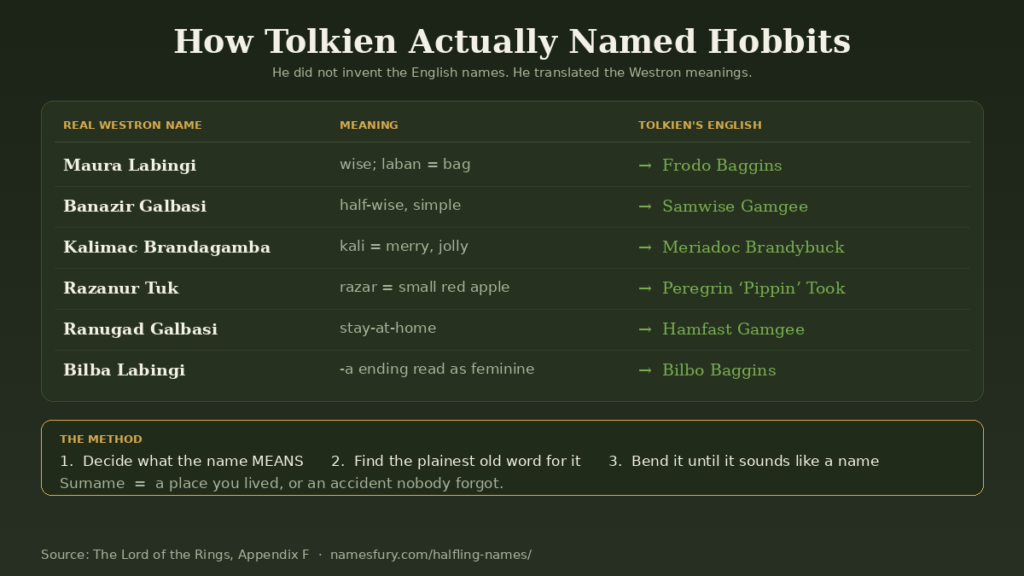
So the method is three steps, and it works in any setting. Decide what the name means first. Pick a trait, a habit, a job or a single memorable incident. Then find the plainest, oldest word in your own language for it. Not the grand word. Hamfast, not Sedentarius. Then bend it until it sounds like a name rather than a description. That last step is the whole craft, and it is why Banazir became Samwise rather than Halfwise.
Surnames follow a separate and much simpler rule, and it is a real one. English surnames came from four places: where you lived, what you did, who your father was, and what people teased you about. Halfling family names use the first and the fourth almost exclusively. High-hill and Underbough are locations. Tealeaf, Hilltopple and Tosscobble are incidents that stuck. The 5e Player's Handbook says this outright, that family names are nicknames so tenacious they were passed down, which means every halfling surname is supposed to be a story about an ancestor who did something embarrassing.
A few practical checks before you commit. Say the full name out loud at speaking speed, because a halfling name is said far more often than it is read. Avoid giving a given name and a surname the same number of syllables, since two plus two sounds mechanical and two plus three does not. Decide early whether your setting is rural or not, because if it is a Pathfinder-style city the two-word compound surname will read as a joke whether you intended one or not. And if you are naming a whole family, build the surname first and hang everyone off it, which is the order real villages did it in.
Conclusion
Halfling naming has a method, and it is a better one than most fantasy species get, because Tolkien wrote it down. Translate a meaning into the plainest old word you have, then bend it until it sounds like a person. Build the surname out of a place or an accident. Say it out loud before you keep it.
Everything above lists its own root, which means you can check any of it and change any of it. If a name is marked as invented, it is invented, and you are free to decide what it means in your own setting. If it is marked as official, it came out of the Player's Handbook. Run the generator for a quick option, or build one yourself using the method and keep the story behind it.
Frequently Asked Questions
What is a halfling called in Lord of the Rings?
A hobbit. Halfling is a word Tolkien used too, but it is what the big folk call them, not what they call themselves. In Appendix F he records the Westron term banakil, halfling, used by Men, while the hobbits' own word for themselves was kuduk, worn down from the older kud-dukan, hole-dweller. Dungeons & Dragons only adopted halfling in 1977, after the holders of the Tolkien rights objected to the game using the word hobbit.
Why did D&D change hobbits to halflings?
Legal pressure. The original 1974 Dungeons & Dragons used hobbit, ent and balrog openly. In 1977 TSR received a cease and desist from representatives holding the Tolkien rights, and the terms were changed: hobbit became halfling, ent became treant, and balrog became a Type VI demon, later balor. Halfling was judged safe because it is used generically rather than as a coined name. The species was also redesigned over later editions, which is why 5e halflings do not have hairy feet.
Do halflings have last names in D&D?
Yes, and the rules are specific about where they come from. A halfling has a given name, a family name, and often a nickname, and the family names are described as nicknames that stuck so firmly that they were handed down through generations. The ten official examples in the 5e Player's Handbook are Brushgather, Goodbarrel, Greenbottle, High-hill, Hilltopple, Leagallow, Tealeaf, Thorngage, Tosscobble and Underbough.
What do the official halfling names mean?
Some have real roots and some have none at all. Alton, Eldon, Lindal, Roscoe and Wellby are genuine English place names. Perrin, Merric, Milo, Osborn and Garret are real medieval given names. But Kithri, Paela, Vani, Corrin and Errich were invented for the game and have no etymology whatever, even though many name lists confidently assign them meanings. Every entry in the lists above states which case it is.
What are good halfling bard names?
Name the instrument, not the music. Real English surnames did this already, which is where Harper, Piper and Crowther come from, a crowther being someone who played the crwth. A tabor is a small drum played one-handed, a shawm is the ancestor of the oboe, and a gleeman is the actual Old English word for a professional entertainer. Pippin Ryesong and Tilda Crowdwell both use this rule.
Are halfling and hobbit names the same?
They overlap but they are not interchangeable. Hobbit names are Tolkien's, and they are tightly controlled: rural English given names, two-word surnames, and the masculine -o ending he carried over from Westron. Halfling names in D&D and Pathfinder started there and then drifted, picking up invented forms and, in Pathfinder, harder consonants that deliberately do not sound like the Shire. If you want Shire names specifically, use the hobbit list rather than this one.
How do I make a halfling name sound serious instead of comic?
Change the sound before you change the meaning. Drop the -o ending, which is the single strongest comic signal. Use a one-syllable given name with a hard consonant, such as Jett, Rook, Brix or Pike. Then pick a surname whose two words are both grim rather than both domestic: Stormhedge works, Honeysett does not. The Cool and Pathfinder sections above are built entirely on this principle.