
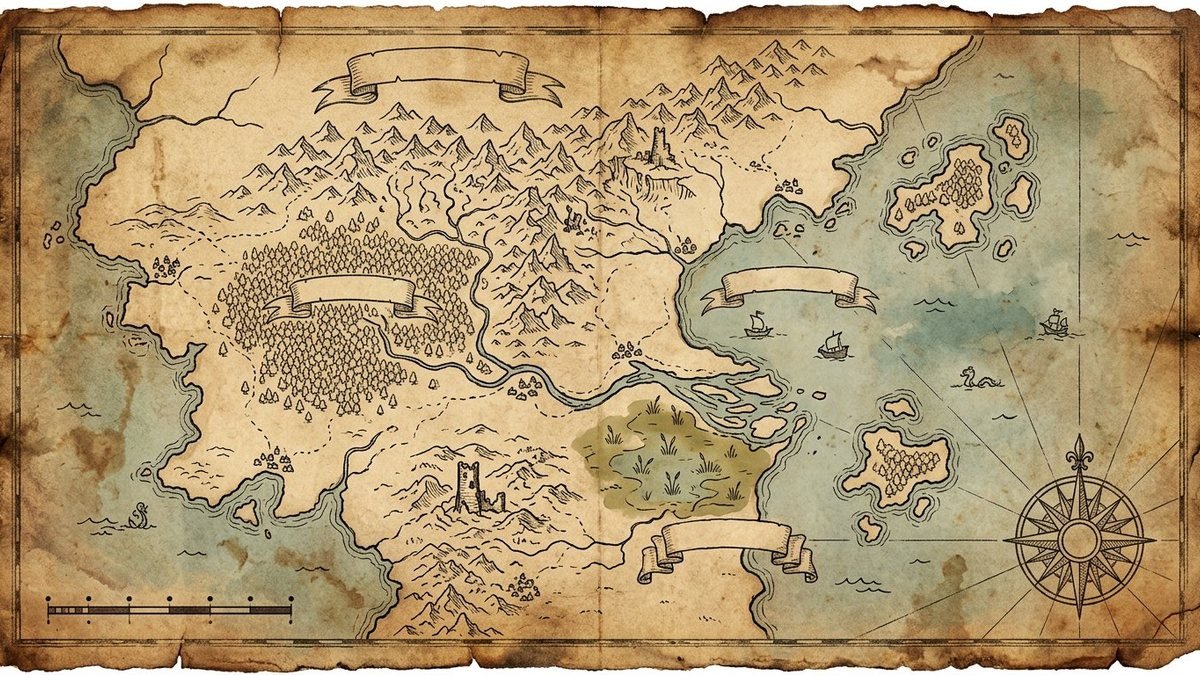
Every map needs more than towns. It needs the river the towns are built on, the wood nobody walks through after dark, the pass that closes in winter and the inn at the bottom of it. Those names are harder to invent than character names, because a place name has to sound like it was given by people who lived there and then worn down by four hundred years of being said out loud.
The place name generator below does that first part for you, and the 520 names under it cover everything a settlement list leaves out. Mountains, rivers, lakes, forests, islands, deserts, swamps, caves, ruins, valleys, coasts and taverns, each one with a short note on what it means or where it came from.
One rule runs through all of it. Real place names are almost never decorative. They are descriptions that stopped being understood. Oxford is the ford where the oxen crossed. Honolulu means sheltered bay. Copenhagen was the merchants’ harbour. If you want an invented place to feel old, do not make the name beautiful. Make it practical, and then let it sound beautiful by accident.
Place Name Generator
Pick a landscape and the generator gives you ten names at once. It will not give you the same ten twice in a row, so hit the same button again if the first set does not fit.
The four categories are deliberately broad. Highlands covers peaks, ridges and passes. Wilds handles forests, moors and valleys. Waters does rivers, lakes, coasts and islands. Ruins covers caves, barrows, abandoned holds and the places people avoid. Most maps need a handful from each.
🗺️ Place Name Generator
Pick highlands, wilds, waters or ruins and get ten place names at once.
Fantasy Place Names
Good fantasy place names tend to be two short pieces joined, with one piece describing the land and the other describing what sits on it. The forty below follow that rule, which is why they can be dropped onto a map without any explanation and still read as though someone has lived there for generations.
- Eldenmoor – Old open ground, long since grazed bare.
- Thrennvale – A valley named for the three rivers that meet in it.
- Caer Dunnoch – A hill fort. The hill outlasted the fort.
- The Pale March – Border country where the soil runs chalky and thin.
- Varrowind – A gap in the hills that funnels the weather.
- Seldath – So old that nobody local agrees what it meant.
- Highfallow – Upland fields left unplanted a year at a time.
- Ormskeep – A watchtower raised after something came out of the fen.
- The Amber Downs – Rolling chalk that turns gold in late summer.
- Ashenmoor – Burnt over so often the heather never fully returns.
- Dunhollow – A dip under a brown hill, sheltered from every wind but one.
- Vireth – A single word on the oldest surviving map of the region.
- The Glass Marches – Flatland that floods and then freezes solid.
- Karrowfen – Wet ground beside a line of old burial mounds.
- Belhaven Reach – A long straight stretch of navigable water.
- Stormcleave – A split in the cliffs where the gales come through.
- The Sunder – Whatever happened here, the name is all that is left of it.
- Thalvane – A weather vane on a church became the name of the parish.
- Greywater March – Borderland along a river that never runs clear.
- Ennismoor – An island of dry ground in the middle of wet country.
- The Hollow Shires – Three counties that emptied after a bad century.
- Rathgard – An earthwork ring, still visible from the air.
- Velmoor – High ground that holds mist until nearly midday.
- The Emberlands – Volcanic soil, excellent for vines and nothing else.
- Duskwatch – A beacon site. The fires were lit at sundown.
- Fennimore – Marsh and moor in the same breath, which is accurate.
- The Silver Hundreds – Administrative districts named for a mint.
- Caldhollow – A cold hollow. Frost sits in it until April.
- Marrowfell – A bare hill where the bedrock shows through.
- The Winterward Downs – Hills that take the north wind for everyone else.
- Oriend – The eastern edge of an older kingdom's claim.
- The Thornmarch – A border held by hedges rather than walls.
- Hallowmere – A lake that was treated as a boundary and still is.
- Scaldcross – A crossroads near a hot spring.
- The Quiet Shires – Farming country with no strategic value whatsoever.
- Vennorhal – A great hall that is now a field with a name.
- Drakemoor – Named for a legend. No bones have ever been found.
- The Low Country – Everything below the flood line, and it knows it.
- Amberfast – A stronghold built on a resin trade.
- Rookhollow – A dip in the land where the birds have always nested.
Fantasy Location Names
A location is wider than a place. These are the names you put on the regions, provinces and stretches of frontier that hold the smaller places together, which is why so many of them begin with the and describe a direction, an edge or a count of something.
- The Marches – Any contested border, in every real medieval kingdom.
- The Westrun – The long road west, and the country either side of it.
- The Rimlands – Everything past the last properly mapped river.
- The Free Shores – Coast that pays tax to nobody and says so often.
- The Outer Hundreds – Districts too far out to govern closely.
- The Middle Country – Neither coast nor mountain. Rich, flat and dull.
- The Border Fells – High moorland claimed by two crowns at once.
- The Cold Provinces – Administered from far away, reluctantly.
- The Sundered Coast – Shoreline broken into a hundred small inlets.
- The Nine Holds – A federation that has not had nine members in years.
- Ardenne Reach – A forested stretch under one family's control.
- Corvane Reach – Named for the crows, which are genuinely a problem.
- Varnhold Reach – The land a single fortress can realistically protect.
- Kaldrath – A cold country with a hard name to match.
- Vantor – A frontier province, perpetually under-funded.
- Hadris – An old imperial name that survived the empire.
- Belmaur – Rolling farmland with a reputation for good horses.
- Tyrr – One syllable, which usually means the name is very old.
- Eshmar – A trade province where three languages are spoken daily.
- Ilvane – Named after a river that has since changed course.
- Oslen – A duchy that has changed hands eleven times.
- Mordric – Hill country with a long memory and a short temper.
- Avalhein – An old royal hunting reserve, now mostly farmland.
- Sarnmoor – Stony upland. The name means exactly that.
- Theskar – Mining country, named for the shafts rather than the ore.
- Dunmara – Brown sea, which is what the estuary looks like.
- Cael Varr – A narrows. Whoever holds it taxes everything passing.
- Ostreach – The eastern limit of an old survey.
- Lunvar – Low ground that floods on a spring tide.
- Pellanor – A province named after the family that no longer rules it.
Mountain and Peak Names
Mountains almost never get poetic names from the people who live under them. They get body parts, animals, weather and warnings, because those are the things that matter when you have to cross one. Keep mountain names blunt and they will sound real.
- Karrock Spire – A rock pinnacle visible from two days' walk away.
- Greyhorn – Bare stone above the tree line, grey in every season.
- Thunderstep – A broad shoulder of rock that echoes in a storm.
- Anvil Rise – Flat-topped, with sheer sides. The shape named it.
- Coldfang – A single sharp peak that holds snow longest.
- The Widow's Tooth – More men have died on it than anyone counts.
- Stormcrown Peak – Cloud sits on the summit most of the year.
- Ironcrest – A ridge with ore in it, worked and then abandoned.
- Mournhollow Ridge – A long ridge with a notorious corrie beneath it.
- Highreach – The tallest thing for sixty miles and nothing else to say.
- Skarnfell – Broken scree on every approach.
- Bleakspire – Exposed, windburnt and completely treeless.
- The Hunter's Shoulder – A gentle route up used by everyone who knows it.
- Frostmantle – The snowline on it is unusually low.
- Dunrock – Brown stone. Not every mountain earns a better name.
- Emberhorn – Red rock that catches the last light.
- Sablecrag – Dark cliffs with a colony of birds on them.
- Winter's Back – The range that stops the weather, mostly.
- Hollowpeak – Caves underneath, known about and largely unexplored.
- Gravenspire – Carvings at the base, much older than the nearest village.
- Red Wether – Named for the sheep that graze its lower slopes.
- Stonewake – A rockfall every spring, reliably.
- Eagle's Lectern – A flat ledge near the summit with a famous view.
- Thornfell – Gorse to the waist on the whole southern face.
- Cairnhead – A pile of stones at the top, added to by every traveller.
- Pale Horn – Quartz in the summit rock makes it shine after rain.
- The Sleeping Giant – The profile from the west. Everyone sees it.
- Ashenfell – Volcanic, and the soil below it is the best in the region.
- Sentinel Rock – Used as a beacon site for four hundred years.
- Drumlanrig Rise – A long whaleback hill left by old ice.
River Names
River names are the oldest words on most maps, because rivers were named before the people who named them built anything permanent. That is why so many real river names simply mean water, dark water or fast water in a language nobody speaks any more.
- Blackwater Run – Peat upstream stains it the whole year.
- Sellen – An old word for a slow current, kept long after the word died.
- Mirecourse – It wanders. The channel has moved twice in living memory.
- The Slow Meira – Navigable, barely, by flat-bottomed boats.
- Tarnbeck – A stream that drains a hill lake.
- Gildenflow – Gold was panned here once. It has not been for centuries.
- Hollow Dyke – Half river, half drainage ditch, entirely man-made.
- Rushmoor Water – Reed-choked and shallow for most of its length.
- The Crookwater – Three right-angle bends in less than a mile.
- Silverbourne – A clear chalk stream, cold even in August.
- Dreyvan – The border between two counties for nine hundred years.
- Whitewash – White water the entire way down from the pass.
- The Long Idle – Falls four feet over thirty miles.
- Aldermere Flow – The outflow of a lake, named for the trees on its banks.
- Scaldwater – Fed by hot springs. It steams on a cold morning.
- Coldbourne – Snowmelt. Nobody swims in it twice.
- The Nettle – Impossible to walk the bank in summer.
- Dunbeck – Brown stream. Plain, accurate and very old.
- Morrow Water – Flooded the valley overnight, once, and got remembered.
- The Thiefstream – It takes a field's worth of soil every winter.
- Kelsing – Named for the fish run that used to feed three villages.
- Greenrace – A mill race, green with weed along both walls.
- Ferrymile – The exact distance between the two crossings.
- Brackenflow – Rises in high moorland under deep fern.
- The Quiet Isen – Deep, wide and almost silent. Drownings are common.
- Stonewash – Carries gravel. The bed shifts after every storm.
- Lammerbeck – Lambs are washed in it each spring, by tradition.
- Dark Ouse – Ouse is a genuine old river word simply meaning water.
- Threadwater – Splits into a dozen channels across the flats.
- Winterflood – Harmless for eight months and dangerous for four.
Lake Names
Lakes get named for what is in them, what was lost in them or what they look like at dawn. Real lake names often carry a drowning story, because still water with a cold bottom has always frightened people and the fear stays in the name.
- Mere of Ash – Ringed by ash trees that were planted deliberately.
- Lake Verelin – Deep, narrow and carved by ice.
- The Drowned Bell – A church tower is said to lie under the north end.
- Still Tarn – No inflow, no outflow, no wind. It never moves.
- Glasswater Mere – Shallow and clear enough to count stones in.
- Lake Oriend – The eastern of a pair. The western one has no name.
- Black Tarn – A peat bottom makes the water look bottomless.
- The Sunken Hall – Timbers show above the surface in a dry summer.
- Merrowmere – Named for a story that the locals tell carefully.
- Lake Ithuan – Fed by nine streams and emptied by one.
- Coldmirror – Freezes first and thaws last of every lake in the valley.
- The Weeping Pool – Water seeps from the rock face above it constantly.
- Lake Saphren – A blue so unlikely that visitors assume it is dyed.
- Dunmere – Brown water over a brown bed. Good fishing, poor swimming.
- Loch Varrow – Long, thin and with a famously bad crossing wind.
- Tarn Hollow – A small lake in a rock bowl high on the fell.
- Lake Belisand – Pale sand beaches, which are rare inland.
- The Kingfisher – Named for the bird, which is still there.
- Greymere – Reflects nothing but weather for most of the year.
- Lake Ennow – A reservoir old enough that nobody calls it one.
- The Quiet Fathom – Soundings have never found the floor.
- Silvermere – Shoals of small fish turn the surface metallic at dusk.
- Lake Thrall – A prison island sat in the middle for two centuries.
- Owl's Mere – The woods around it are loud at night.
- The Blind Pool – Overgrown to the point of invisibility from the path.
- Lake Corvane – Crows roost on the island in their thousands.
- Mistmere – Fog lifts off it at sunrise almost every day of the year.
- The Lantern Water – Boats cross at night, and they carry lights.
- Deeptarn – Small on the surface, alarming underneath.
- Hundred Isles Water – There are about forty. Nobody has recounted.
Forest and Woodland Names
A forest name usually records either the trees in it or the trouble in it. Keep forest names concrete, name an actual species or an actual event, and the wood will feel like somewhere a character could genuinely get lost.
- Thornhallow – Blackthorn so dense the deer paths are the only way in.
- The Elderwood – Old growth, never cleared, with no straight lines in it.
- Greyholt – A single species of tree, which is what holt means.
- Wraithwood – Mist pools in the hollows and moves when it should not.
- Sablegrove – Dark-barked trees and almost no undergrowth.
- The Hanging Pines – They lean. The soil underneath is slipping.
- Mirkholt – Little light reaches the floor even at midday.
- Fenwood – Wet woodland on the edge of marsh, alder and willow.
- The Owl's Quarter – A section of a larger forest, named by foresters.
- Brackenholt – Fern to shoulder height between the trunks.
- Ashenshaw – A shaw is a strip of woodland along a field edge.
- The Long Coppice – Cut on rotation for eight hundred years.
- Wyrmwood – A legend, a very good one, and no evidence at all.
- Hollowbough – Rot has taken the hearts of the oldest trees.
- The Wardenwood – Royal forest, with forest law and a resented warden.
- Sedgeholt – Trees give way to sedge at the southern end.
- Ravensgrove – A roost used continuously for longer than the village.
- The Quiet Shaw – No birds. Nobody has a convincing explanation.
- Ironbark – Timber so hard it blunts an axe. Used for keels.
- Yewhallow – Yews outside a churchyard, which is unusual and old.
- The Charcoal Wood – Burners worked here. The clearings are still bare.
- Thistlegrove – Cleared, abandoned, and losing the argument with weeds.
- Alderhaunt – Alder on wet ground, and a story attached to each pool.
- The Kingswood – Hunting ground. Poaching cost a hand once.
- Briarholt – The edge is impassable. The centre is open and pleasant.
- Mosswood Deep – Everything is green, including the light.
- The Lost Coppice – Marked on an old map and not found since.
- Rowanshade – Rowans planted along the boundary for luck.
- Blackstump – A single burnt tree that became the landmark.
- The Weeping Birches – Sap runs in spring and the whole stand drips.
Island Names
Island names are given by sailors, not by the people living on them, which is why so many real ones are warnings or landmarks. Useful island names tell a passing ship what to expect: deep water, a wreck, a colony of birds or nothing at all.
- Skellig Vane – A bare rock stack with a single landing place.
- The Mariner's Grave – A reef that shows only at the lowest tides.
- Ostholm – Holm is a genuine Norse word for a small island.
- Grey Fast – A fortified rock, held and then forgotten.
- The Ninefingers – A line of nine stacks running out from the headland.
- Corrant Isle – A tide race on both sides makes the crossing hard.
- Saltholm – Salt was panned here when the trade was worth it.
- The Lesser Hook – A curved island, smaller than the Greater Hook.
- Dunnock Isle – Named for a small brown bird and nothing more.
- Verrow – One farm, four people and a boat.
- The Bellrock – A bell was hung on it after the third wreck.
- Thrushholm – Migrating birds stop here in such numbers it is loud.
- Cape Idle – Not a cape and not idle. Charts make mistakes.
- The Sister Stones – Two islands of almost identical size and shape.
- Ilsavar – The old name survived three separate occupations.
- The Drowned Crown – A ring of rocks that is only an island at low water.
- Fennick Isle – Marsh at one end, cliffs at the other.
- Harrowholm – Ploughed to the last inch, because there is so little of it.
- The Gannetry – Birds, guano and an unbelievable smell.
- Ormsay – Say is Norse for island. Orm was a person or a serpent.
- The Wrecker's Shelf – A reputation the islanders deny energetically.
- Caldun – Cold, windward and treeless.
- The Blind Isles – Fog-bound for a third of the year.
- Storholm – The big island of a group, which is all the name means.
- Petrel Rock – Seabirds nest here and nothing else can.
- The Widow Isles – A fishing fleet was lost between them in one night.
- Narn – A single syllable on the chart and nothing underneath it.
- Sealholm – A breeding colony, protected by custom rather than law.
- The Crooked Key – A low sandy island that shifts shape every decade.
- Barrowholm – Burial mounds on an island, which was a deliberate choice.
Desert and Wasteland Names
Deserts are named by the people crossing them, so the names are about water, distance and survival. The strongest desert names are the ones that sound like a complaint, because that is what they usually were.
- The Ashen Reach – Volcanic grit that gets into everything.
- Kharath Waste – Named by a kingdom that tried to cross it and failed.
- The Salt Mirror – A dry lake bed, blinding at midday.
- Dunmarch – A frontier of moving sand that advances a yard a year.
- The Burning Flat – No shade for forty miles in any direction.
- Serrak – Three letters on the map and two weeks on foot.
- The Bone Road – A caravan route marked by what did not make it.
- Pale Erg – An erg is a genuine term for a sea of dunes.
- The Thirst – The only name anyone has ever needed for it.
- Ammakhar – A trading language word for the empty place.
- The Glass Plain – Fused sand, and the usual arguments about why.
- Suneater Waste – Heat haze swallows the horizon by nine in the morning.
- The Long Nothing – Flat, featureless and navigationally terrifying.
- Verruk Flats – Cracked clay that turns to glue in the rare rain.
- The Kiln – A basin below sea level that holds heat all night.
- Hadran Waste – Named after the general who marched an army into it.
- The Scoured Lands – Wind has taken the topsoil down to bedrock.
- Sand's End – The last dune before the scrub starts. A real relief.
- The Copper Pan – Mineral staining turns the ground green and orange.
- Ikhra – Pronounced in two syllables and said with respect.
- The Whistling Flats – Wind through rock formations, audible for miles.
- Dry Marches – Border country where the border is simply where water stops.
- The Last Well – There are no wells after it. The name is a warning.
- Tazrak – A rock plateau, not a sand desert, and far worse to cross.
- The Hollow Dunes – Sand over old ruins, which collapse underfoot.
- Sunfell Waste – Everything here faces away from the light or dies.
- The Grit – Coarse, grey and unpleasant to walk on for any distance.
- Oumara – An oasis name that came to mean the whole region.
- The Red Carry – Iron in the dust. Clothes never come clean.
- Ashmarch – A border of volcanic ash where nothing has grown yet.
Swamp and Marsh Names
Wetland names are the most honest on any map. Marshes were useless for farming and dangerous to cross, so nobody bothered making the names pleasant. Blunt, damp and slightly disgusting is the correct register for swamp names.
- Sedgefen – Sedge to the horizon, cut for thatch once a year.
- The Mire of Owls – Hunting ground for every owl in the county.
- Blackbog – Peat, deep, and it has given up two preserved bodies.
- Weeping Fen – Water seeps out of the ground rather than flowing in.
- The Drowned Acre – A field that was reclaimed and then lost again.
- Quagmarsh – The ground looks solid. It is not.
- Hollowfen – A basin with no drainage and very old flood defences.
- The Sucking Ground – Entirely descriptive, and locals do not joke about it.
- Reedmarch – A reed bed harvested commercially for centuries.
- Mournmire – A funeral party was lost here. The route was changed.
- The Rotten Carr – Carr is wet woodland. This one is dying.
- Sallowfen – Sallow willow grows thick enough to hide a horse.
- The Leech Flats – Avoided in summer for reasons that are obvious.
- Bitterbog – The water is drinkable. Barely, and nobody enjoys it.
- Carrion Marsh – Downwind of it on a warm day is memorable.
- The Slow Water – Movement is measured in inches per hour.
- Grimfen – A hard name for ground that has earned it.
- The Peat Kings – Three bog bodies, all found within one mile.
- Mossmire – Sphagnum moss, floating, with nothing underneath.
- The Lantern Fen – Marsh gas, misread for centuries as something else.
- Eelbog – An eel fishery that supported two villages.
- Withered Marsh – Drained badly, so it is now neither wet nor dry.
- The Boghold – Someone built a fortress here. It worked, defensively.
- Sinkfen – Objects left overnight are not there in the morning.
- The Toadstool Reach – Fungi in quantities that are genuinely unsettling.
- Duskmire – The light goes early because of the trees along the edge.
- Fenhollow – A dry rise in the middle of wet ground, so people live on it.
- The Mud Chapel – A ruined building, slowly going under.
Cave and Underground Place Names
Underground places are named by the people who go into them, so the vocabulary is anatomical and claustrophobic. Mouths, throats, guts and galleries. That instinct is real, and it makes cave names land immediately.
- The Gullet – A narrow entrance that widens unpleasantly.
- Deepmaw – The shaft drops ninety feet before the first ledge.
- Hollow Delve – A mine that hit a natural cavern and stopped work.
- The Whisper Shaft – Airflow makes a noise that nobody likes.
- Blackdelve – Coal, worked out and left open.
- The Hundred Steps – Cut by hand. There are a hundred and six.
- Gravenhollow – Carvings on the walls, predating the nearest settlement.
- The Cold Throat – A constant draught at exactly the wrong temperature.
- Drownward – Floods completely on a high spring tide.
- The Lantern Deep – Mineral surfaces that throw light a long way.
- Stonegullet – A squeeze that has killed people larger than it allows.
- The Mouth – Visible from the valley floor, which is how it was found.
- Ironvault – A natural chamber used as a strongroom for two centuries.
- The Sleeping Mine – Not worked, not collapsed, not quite abandoned.
- Carrowdelve – Next to a barrow field, and almost certainly connected.
- The Long Descent – Four hours down, six hours back.
- Nethervault – The lowest chamber anyone has reached and returned from.
- The Dripping Hall – Constant water and extraordinary acoustics.
- Boneshaft – Animal remains at the bottom, washed in over millennia.
- The Blind Gallery – A side passage that goes nowhere at all.
- Umberdeep – Ochre pigment was dug here in prehistory.
- The Silent Seam – A dead end that absorbs sound strangely.
- Hagsmouth – A low arched entrance with a reputation to match.
- The Guttering Lamp – A hook where cavers leave a light on the way in.
- Rookdelve – Birds nest in the entrance chamber.
- The Cathedral – A single chamber large enough to justify the name.
- Mirthless Deep – Named by a survey team having a very bad week.
- The Underwater – A flooded passage with a known safe line through it.
Ruined and Abandoned Place Names
Ruins carry two names: the one they had and the one they got afterwards. The second is usually better. These abandoned place names work best when they imply a specific loss rather than a general sense of decay.
- Old Varn – There is a New Varn. It is smaller and less interesting.
- The Broken Crown – A royal seat, sacked and never reoccupied.
- Ashfall – A town that burned in a single night.
- Hollowgate – The gatehouse stands. Nothing behind it does.
- The Empty Quarter – A whole district of a living city, left to rot.
- Carrowfast – A fortress on a barrow, which was always a bad idea.
- The Sundered Hall – Split in two by subsidence rather than war.
- Dunmarrow – Brown earth and bones, and nobody digs here.
- The Weeping Arch – Groundwater runs down the last standing stonework.
- Vel Antar – The name is in a dead language and means "the second city".
- The Toppled Spire – It fell in a gale and was left where it lay.
- Greyfast – Garrisoned for three hundred years and besieged once.
- The Nameless Court – The records burned. Nobody knows who lived here.
- Thornfast – Walls intact, interior entirely overgrown.
- The Salt Palace – Built on a salt fortune and abandoned with it.
- Ruin of Keth – Keth was a person. That is all anyone is sure of.
- The Kings' Ash – A burial site rather than a settlement.
- Oldwall – Four miles of it, running through farmland, going nowhere.
- The Shattered Bridge – Two stumps and a very long drop.
- Marrowhold – Starved out during a siege and never resettled.
- The Ninth Gate – Eight were found. The ninth is a local obsession.
- Ancarrow – A monastery, dissolved, quarried and now foundations.
- The Burnt Library – A genuine tragedy, still talked about.
- Stonefast Ruin – Robbed for building material by every nearby village.
- The Quiet Forum – A market square with grass growing through it.
- Vaelthorn – Abandoned after a plague, and avoided for a century after.
- The Last Garrison – They were never relieved and never ordered to leave.
- Drowned Cairn – A reservoir covered it. It shows in a dry year.
- The Hollow Keep – Looks complete from outside. There is no roof.
- Caerveth – A hill fort reused by three cultures and dropped by all of them.
Valley, Pass and Canyon Names
A pass is a chokepoint, and chokepoints get named for what happens in them. Weather, tolls, ambushes and the state of the road. Strong valley names sound like directions given by somebody who has made the crossing.
- The Sorrow – A valley with one bad event attached to every mile.
- Windgate Pass – Open at both ends, which is the whole problem.
- Thornvale – Scrub has closed the old road almost completely.
- The Narrow Mile – Two carts cannot pass. One has to reverse.
- Coldcleave – North-facing, so the ice stays until May.
- Dunglen – A brown glen with good grazing and bad drainage.
- The Devil's Stair – Forty switchbacks, and a name that stuck.
- Mournvale – A battlefield, and the valley is named for the aftermath.
- The Long Dale – Eighteen miles of the same view.
- Skarngap – A scree-filled notch, crossable only in late summer.
- The Cleft – So narrow the sun reaches the floor for one hour a day.
- Hollowdale – Steep sides and a flat bottom, carved by ice.
- The Shepherd's Pass – Known to drovers long before it was on a map.
- Greyglen – Limestone, grey in all weather, with no trees at all.
- The Stone Stair – Steps cut into rock by an engineer nobody remembers.
- Ironcleave – A mining valley. The spoil heaps are now hills.
- The Pinch – Where the two ridges almost meet. Tolls were collected here.
- Bramblevale – Fertile, sheltered and completely overrun.
- The Widow's Walk – A high path with no shelter and a long fall.
- Fellgate – The only way through the range for ninety miles.
- The Drovers' Road – Wide, grassy and worn a foot below the fields.
- Ashglen – Ash woodland on both slopes, coppiced for charcoal.
- The Cradle – A rounded valley head that holds mist and sheep.
- Sedgevale – Wet underfoot the entire length, despite the slope.
- The Broken Stair – A rockfall took out the middle section years ago.
- Rookgap – Crows gather in the pass before bad weather, reliably.
- The Lost Mile – A stretch where the path disappears in cloud.
- Winterglen – Closed by snow from November. The village plans around it.
Sea, Bay and Coast Names
Coastal names are navigation notes. They record depth, shelter, hazard and the single most useful fact about a stretch of water. Treat sea names as instructions and they will sound like they came off a real chart.
- The Grey Fathoms – Deep water close inshore, which is unusual.
- Saltmarch – A coastal strip of salt marsh, grazed and tidal.
- The Mariner's Teeth – A rock line that has taken dozens of hulls.
- Coldharbour – A genuine old term for an anchorage with no facilities.
- The Shivering Sea – A short, steep chop that ruins everyone's day.
- Wreckstrand – The beach where everything lost offshore comes ashore.
- The Hungry Shallows – Sandbanks that move between surveys.
- Gullcliff – A seabird colony loud enough to navigate by in fog.
- The Long Roads – A sheltered stretch where a fleet can lie at anchor.
- Brinehaven – A harbour built on salt and still smelling of it.
- The Sunken Mile – A drowned forest. Stumps show at low spring tide.
- Stormstrand – Faces the prevailing weather with nothing in the way.
- The Deepening – Where the shelf drops away and the colour changes.
- Harrowstrand – Ploughed fields run right to the cliff edge.
- The Pilot's Bay – Where local pilots board ships for the river passage.
- Netherdeep – A trench offshore that nobody has properly sounded.
- The Glass Sea – Calm for weeks, then not, with very little warning.
- Fairwinds Bay – Optimistically named, and the name has caused deaths.
- The Last Sounding – The final point where the lead line finds bottom.
- Cragmouth – A river mouth between two headlands, hard to enter.
- The Mourning Tide – A spring tide that reliably floods the lower town.
- Saltgate – A customs point for the salt trade, fortified.
- The Widening – An estuary that goes from river to sea over four miles.
- Shellstrand – A beach of crushed shell rather than sand.
- The Pirate's Comfort – A deep cove invisible from the main channel.
- Blackstrand – Volcanic sand, and it gets painfully hot.
- The Narrow Sound – A channel with a three-knot tide running through it.
- Tidefast – A fort on a tidal island, cut off twice a day.
- The Breaking Ground – Surf that never stops, in any weather.
- Lanternbay – A light has been kept burning here since the first wreck.
Tavern and Inn Names
Inn names came from signs, and signs came from a time when most customers could not read. That is why real ones are concrete pictures: an animal, an object, or two things that make no sense together. Good tavern names should be paintable in one image.
- The Drowned Rat – Named after a flood, and the sign shows it.
- The Gilded Hog – Expensive, and it knows exactly how expensive it is.
- The Last Lamp – The final lit building before the moor road.
- The Broken Oar – A retired boatman's place, with the oar above the bar.
- The Quiet Crow – Backs onto a rookery, which rather undercuts the name.
- The Tinker's Rest – A yard big enough for a cart and a mule.
- The Bent Nail – A carpenter built it badly and owned it proudly.
- The Hound and Harp – Two unrelated things, which is how heraldry works.
- The Salted Sparrow – A kitchen joke that outlived the cook.
- The Sleeping Bear – A real bear, a long time ago, and a famous story.
- The Copper Kettle – Respectable, clean and extremely dull.
- The Wayward Goose – The sign shows a goose walking off the edge of it.
- The Hanged Man's Hat – Next to the old gallows field. Business is good.
- The Green Flagon – Brews its own, and the ale is genuinely green.
- The Stone Boot – A mounting block outside, worn into the shape of one.
- The Mermaid's Debt – A sailors' inn with a long and complicated tab.
- The Honest Thief – Run by a man everyone watches carefully.
- The Weary Pilgrim – On an old route, with beds in the loft.
- The Rook and Ruin – Built against a ruined wall, with birds in it.
- The Fat Candle – Stays open later than anywhere else in the district.
- The Crossed Spoons – Known for food rather than drink, unusually.
- The Silver Sow – A pig farmer made a fortune and built this.
- The Lame Horse – Beside a smithy, which is either a joke or a warning.
- The Barrel and Bell – Opposite a church tower, and the two compete.
- The Winter Hearth – A fire that is never allowed to go out.
- The Laughing Mule – The sign is genuinely funny and everyone stops.
- The Cracked Tankard – Cheap, loud and surprisingly well run.
- The Ferryman's Coin – At the crossing, and it takes the same toll.
- The Old Sword – A blade over the fireplace with a disputed history.
- The Nine Geese – There were nine. There are now about forty.
Dark and Cursed Place Names
A frightening place name should never say it is frightening. It should state a flat fact that the reader finishes themselves. The best cursed place names are the ones that sound administrative until you think about them.
- Gallowfield – A field, with a specific and well-recorded use.
- The Hollowing – A process, not a place. The name implies it is ongoing.
- Mourneholt – A wood where funerals went and sometimes stopped.
- The Black Assize – A court sat here once and the whole room died after.
- Wraithmoor – Fog, distance and a long history of people misjudging both.
- The Unquiet Ground – A burial site that the parish gave up maintaining.
- Grimhallow – A hollow with a reputation older than the village beside it.
- The Flayed Hill – Topsoil stripped by a landslip, and the shape is wrong.
- Sorrowgate – The gate a condemned prisoner was taken through.
- The Red Furrow – One ploughed line that never grows anything.
- Bleakhallow – Exposed, treeless and avoided after dark by habit.
- Carrionfield – Crows gather here out of all proportion to the food.
- The Starving Mile – A stretch of road where a column once died.
- Nightwake – A village custom of staying up, for reasons nobody repeats.
- The Ash Pit – Something was burned here in quantity and buried.
- Gravenmoor – Standing stones, cup marks and a very strong local silence.
- The Weeping Stones – Condensation, probably. The explanation is new.
- Duskfell – The light fails here before it fails anywhere nearby.
- The Barrow Line – Eleven mounds in a row, aligned on nothing obvious.
- Hushfield – Sound does not carry across it. This is measurable.
- The Unlucky Acre – Four owners in thirty years. None will discuss it.
- Blightmoor – Crops fail in a band half a mile wide, consistently.
- The Cold Company – A name given to the place, not to any people.
- Ravensgallow – A crossroads, a post, and the birds that learned the habit.
- The Silent Row – Eleven cottages, all empty, all still furnished.
- Witherfield – The hedge around it died first, then everything inside.
- The Marked Ground – Boundary stones, moved, and then moved back.
- Dreadhollow – An honest name from people who did not exaggerate.
- The Last Mile – The final stretch before the old prison gate.
- Hagsend – Where the track stops, and a name that discourages questions.
Magical Place Names
Magical places need restraint. One strange detail beats five, because the reader supplies the rest. These magical place names each contain exactly one thing that should not be possible, and nothing else.
- Aurelmere – A lake that holds the last of the light long after sunset.
- The Singing Stones – Wind through a stone circle, at one pitch.
- Lumengrove – The leaves hold a faint glow for an hour after dusk.
- The Hour Garden – Flowers here open and close an hour out of step.
- Starfall Reach – Meteorite iron in the soil, and everyone knows it.
- The Mirror March – Flat wet ground that doubles the sky exactly.
- Veilhollow – Mist that arrives at the same time every single day.
- The Tilted Wood – Every tree leans the same way, against the wind.
- Shimmerfen – Marsh light that moves with purpose rather than drift.
- The Borrowed Country – Travellers describe it differently every time.
- Everbloom – Nothing here has flowered out of season. It just never stops.
- The Leyfast – A fortress built where three old straight tracks cross.
- Moonmarch – Border country surveyed, by tradition, only at night.
- The Soft Hours – A valley where the afternoon appears to last longer.
- Glimmergate – A gateway with nothing behind it and a faint shine.
- The Threadways – Paths that are shorter walked than they are measured.
- Silverwake – A river that leaves a pale trail behind a moving boat.
- The Longest Garden – Walled, and larger inside than the wall allows.
- Dawnhollow – Sunrise reaches the floor of it before the hilltops.
- The Folded Hill – Walk around it and you arrive where you started early.
- Emberlight – A hearth in a ruin that is warm and has no fire.
- The Wandering Mile – A milestone that has been found in four places.
- Nightglass – Black sand that reflects stars but not the moon.
- The Candle Fields – Lights appear at harvest. The cause is disputed.
- Highveil – Cloud sits at a fixed height and never rises or falls.
- The Quiet Door – A stone doorway in open country, leading nowhere.
- Thistledown Reach – Seed heads drift upstream here, against the current.
- The Glass Orchard – Frost on the branches that does not melt by noon.
- Wyrdmere – A lake that is said to show weather rather than reflections.
- The Second Country – The same landscape, reported by too many people.
Realistic Place Names for Historical Settings
If your story is grounded rather than high fantasy, invented names should follow the grammar of real ones. Each realistic place name below is built from genuine Old English or Old Norse elements, joined the way the map actually does it.
- Oakhurst – Hurst means a wooded hill. Oaks on a rise.
- Netherby – Nether is lower, by is a Norse settlement. The lower village.
- Stanthorpe – Stan is stone, thorpe is an outlying farm.
- Cheverley – A leah is a woodland clearing. This one kept goats.
- Wycombe Magna – Magna marks the larger of two places with one name.
- Ashwick – A wic was a specialised farm. This one worked ash timber.
- Thornbury Parva – Parva is the smaller twin. A fortified thorn enclosure.
- Draycott – Drag plus cott, where boats were hauled past a shallow.
- Ravensthorpe – A Norse outlying farm, with the usual birds.
- Felsham – Field plus ham, a homestead on open ground.
- Burnthwaite – A thwaite is a Norse clearing. This one was cleared by fire.
- Little Grimsby – Grim was a person. By was his settlement.
- Harewood – Grey wood, or possibly boundary wood. Both are attested.
- Sutton Cleeve – South farmstead, under a cliff.
- Appleby Dene – Apple settlement in a valley. Dene is a wooded valley.
- Crowmarsh – Marsh with crows. Not every name is complicated.
- Stowford – A stow was a holy or assembly place, beside a crossing.
- Nether Hallam – The lower part of a place name ending in ham.
- Kirkbeck – Kirk is a Norse church, beck is a Norse stream.
- Bramshaw – Bramble plus shaw, a strip of woodland.
- Great Welford – A ford by a spring. Wella is Old English for a spring.
- Ulverton – Ulf's farmstead, a Norse name on an English ending.
- Mossgill – A gill is a steep narrow ravine, this one boggy at the top.
- Easthorpe – The eastern of a pair of outlying farms.
- Winterbourne Magna – A stream that only runs in winter.
- Hinton Wold – High farmstead on open upland. Wold means unwooded hill.
- Claverham – Clover homestead, which tells you about the soil.
- Dunsley – Dun's clearing, or possibly the clearing on the brown hill.
- Barrowfield – A field with a burial mound still standing in it.
- Pendlebury – Pen is a Celtic hill word, with an English fort ending.
How Real Place Names Are Built
Almost every place name on a real map is two pieces joined. The second piece says what kind of place it is. The first piece says whose it was, what grew there, or what the land looked like. Once you can hear the join, invented names stop sounding invented.
Oxford is the ford where oxen crossed. Swinton is the pig farm. Chiswick was a cheese farm and Gatwick was a goat farm. None of these are romantic. All of them are a thousand years old and nobody questions them.
Settlement endings
| Ending | From | Means | Real example |
|---|---|---|---|
| -ton | Old English tūn | Farmstead, enclosure | Swinton, "pig farm" |
| -ham | Old English hām | Homestead, village | Tottenham, "Totta's homestead" |
| -wick | Old English wīc | Specialised farm or trading place | Chiswick, "cheese farm" |
| -bury | Old English burh | Fortified place | Aylesbury, "Aegel's fort" |
| -chester | Old English ceaster | Roman fort or walled town | Lancaster |
| -by | Old Norse býr | Village, in the old Danelaw only | Derby, "deer village" |
| -thorpe | Old Norse þorp | Outlying farm serving a bigger place | Scunthorpe |
| -thwaite | Old Norse thveit | Clearing with a dwelling | Bassenthwaite |
Landscape endings
| Ending | From | Means | Real example |
|---|---|---|---|
| -ford | Old English ford | Shallow river crossing | Bradford |
| -ley | Old English lēah | Clearing in woodland | Shipley |
| -mere | Old English mere | Pool or lake | Windermere |
| -field | Old English feld | Open plain | Sheffield |
| -bourne | Old English burna | Stream | Blackburn |
| -dale | Old Norse dalr | Valley | Borrowdale |
| -beck | Old Norse bekkr | Stream | Troutbeck |
| -fell | Old Norse fjall | Flat-topped mountain | Scafell |
| -gill | Old Norse gil | Narrow ravine | Dungeon Ghyll |
| -combe | Old English cumb | Short valley | Ilfracombe |
Two more things worth knowing. The element -ing means "the people of", so Reading was the place of Ræda's people. And hām is a homestead while hamm is land caught in a river bend, which is why two villages ending in -ham can mean completely different things.
How to Name a Place in Four Steps
Step one: decide what the place does. Before you reach for a sound, write down the single most useful fact about the location. Is it a crossing, a chokepoint, a harbour, a graveyard, a mine? Almost every real place name encodes that fact and nothing else.
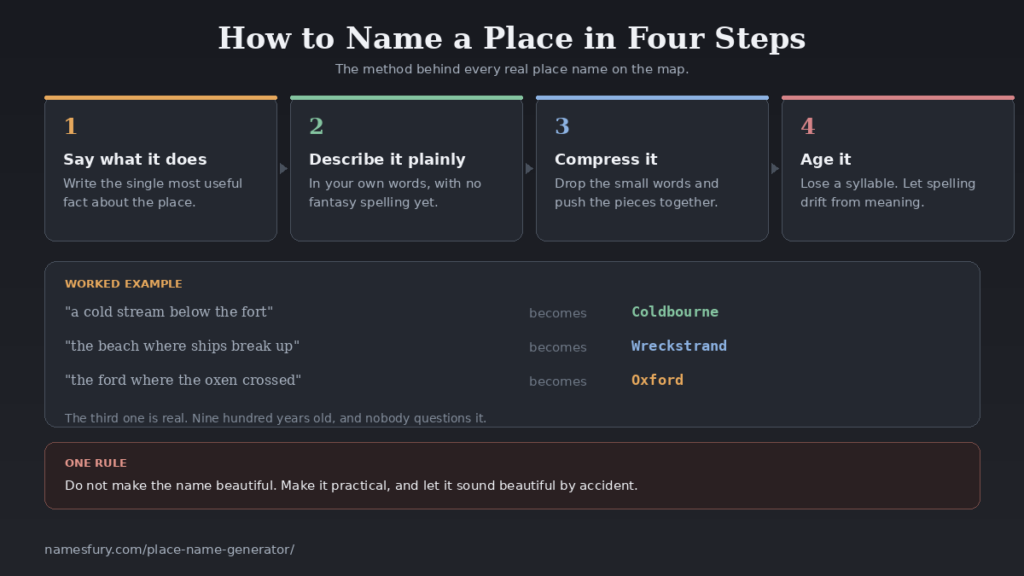
Step two: name it in plain words first. Write "the cold stream below the fort" or "the island where ships break". Do this in your own language, with no fantasy spelling at all. You now have a meaning, which is the part most invented names are missing.
Step three: compress it. Drop the connecting words and push the remaining pieces together. "The cold stream" becomes Coldbourne. "Where ships break" becomes Wreckstrand. This is exactly the process that produced Oxford, and it is why Oxford does not sound made up.
Step four: age it. Real names get worn down by being said. Lose a syllable, soften a consonant, let the spelling drift away from the meaning. Scunthorpe does not look like "Skúma's outlying farm" any more, but that is what it was. A name that has clearly been eroded reads as older than one that has not.
One warning. Resist the apostrophe. A single apostrophe in a name can signal an unfamiliar language, but three in a row signals a first draft. If you need a place to feel alien, change the rhythm rather than the punctuation.
Why Place Names Matter More Than Character Names
A reader meets a character and is given a face, a voice and a history to hang the name on. A place gets none of that. The name has to do all the work on its own, which is why a weak location name is so much more noticeable than a weak character name.
There is a practical reason too. Place names repeat. A character might be named twenty times in a novel, but the river their village sits on will be named in every chapter, on the map in the front matter, and in the mouth of every traveller who passes through. A name that is awkward to say gets quietly avoided by the writer, and the setting thins out as a result.
The test is simple. Say the name out loud, then imagine a farmer saying it, then a king, then a frightened child. If it survives all four, it belongs on the map.
Frequently Asked Questions
What is a place name generator?
It is a tool that builds names for locations rather than people: mountains, rivers, woods, ruins, inns and regions. A good one works from real naming patterns rather than random syllables, so the results sound like somewhere that existed before your story started.
How do I make a fantasy place name sound real?
Give it a meaning before you give it a sound. Decide what the place is for, describe it in plain words, then compress the description into one or two pieces. That is the process behind Oxford, Bradford and Blackburn, and it works just as well on invented maps.
What is the difference between a place name and a location name?
In practice, very little, though writers tend to use location for the wider region and place for the specific spot. A valley is a place. The province that contains it is a location. Both are covered on this page, and the generator above produces either.
Should fantasy place names have apostrophes?
Sparingly. One apostrophe can mark a glottal stop in an unfamiliar language and reads as deliberate. Several in the same name read as decoration. If the name needs to feel foreign, change the stress pattern or the vowel shape instead.
How long should a place name be?
Shorter than you think. The oldest names on any real map are usually one or two syllables, because they have been worn down by centuries of being spoken. Longer names tend to be newer, formal, or imposed by an outside authority, which is a useful thing to signal on purpose.
Can I use these place names in a published book or game?
Yes. Names built from ordinary descriptive words are not protected, which is why several real English counties each contain an Ashford. Avoid lifting a distinctive name whole from a specific published setting and you are on safe ground.
What are good place names for a DnD campaign?
Names your players can repeat after hearing them once. Most locations appear for a single session, so the name has to stick immediately. Short and picturable works best. Save the elaborate names for the two or three places the party will return to.
Where do real place names come from?
Mostly from description. Across England the common endings are farm, homestead, clearing, crossing, stream, valley and fort, attached to a tree, an animal, a colour or a person's name. The romance is accidental. The names only sound beautiful now because the words inside them stopped being everyday vocabulary.
Conclusion
A map fills up faster than people expect. One kingdom needs a capital, and then the capital needs a river, and the river needs a source, and the source is in a range of hills that someone has to name. The 520 names above exist so that you are never stuck in the middle of a sentence inventing a mountain.
Take whatever fits and change whatever does not. A name you have altered slightly always sits better in your own work than one lifted whole, and the four-step method further up will get you the rest of the way. If you need settlements rather than landscape, the fantasy town names and fantasy village names lists on this site pick up exactly where this one stops.