
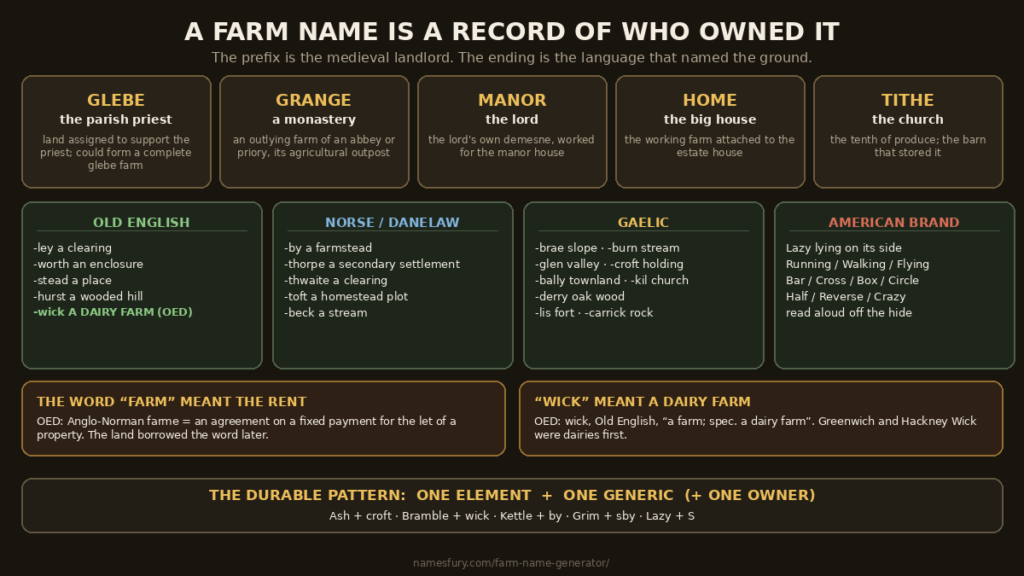
The word farm did not originally mean a piece of land. It meant a rent. The Oxford English Dictionary traces it to the Anglo-Norman farme, an agreement on a fixed payment for the let of a property, and only later did the word slide from the payment onto the ground that produced it. Which is a fitting start, because a farm name has always been a record of an arrangement: who held the land, who owned it, and what it was for.
That is why real farm names are so much more informative than they look. A Glebe Farm was land that supported the parish priest. A Grange Farm was an outlying agricultural outpost of a monastery, often with an abbey or priory as its mothership. A Manor Farm was the lord’s own demesne, and a Home Farm was the working farm attached to the big house. A name ending in -wick or -wich was, in Old English, specifically a dairy farm. A name ending in -by or -thorpe tells you Norse speakers settled it. And out west, a ranch very often takes its name from its cattle brand, so that Lazy S and Running W and Rocking Chair are not decoration but a reading of a mark burned into hide.
This page gives you 480 names across all of those systems: the cute and the funny registers people actually search for, the livestock-specific names for dairy, goat, horse, vineyard and fish operations, the Old English, Norse and Gaelic element names, the brand-read ranch names, and the cozy Stardew-flavoured register. Every invented entry says which element or system it was built from. The farm name generator below runs the same systems, ten names at a time.
Farm Name Generator
🌾 Farm Name Generator
Pick classic, ranch, cozy or funny and get ten farm names at once.
This farm name generator has four buttons and gives you ten names at a time. Classic runs the traditional English register, an element plus a generic. Ranch runs the brand-read American register. Cozy runs the cute and Stardew-flavoured register. Funny runs the pun register, which is a genuine and much-loved farm-naming tradition in its own right.
Every output is assembled from a documented naming system rather than random words, and the lists below show those systems in full with their sources. Tap any name to copy it, and press the same button again for a fresh ten.
Farm Names
The master list. These sit in the traditional English register: a landscape or plant element joined to a farm generic, or a single fused compound in the old place-name style. They read as real because they follow the same grammar as the real ones.
| Name | Built from |
|---|---|
| Ashcroft Farm | Ash tree + croft, a small holding |
| Bramblewick | Bramble + the Old English dairy-farm ending |
| Coldharbour Farm | A real old English place-element meaning a shelter, not a harbour |
| Dewfall Grange | Morning moisture + the monastic farm word |
| Elmsley Farm | Elm + -ley, a clearing |
| Fallowfield | Fallow land + open field, fused |
| Gorsebrook Farm | Gorse shrub + stream |
| Hawthornstead | Hawthorn + -stead, a place |
| Ivywrake Farm | Ivy + an old word for a row or boundary |
| Juniper Glebe | Juniper + the priest's-land word |
| Kettleby Farm | Kettle + the Norse -by, a farmstead |
| Larkspur Lea | Larkspur flower + -lea, a clearing |
| Meadowmarsh Farm | Meadow + marsh |
| Netherwick | Lower + the dairy-farm ending |
| Oatlands Grange | Oats + land + monastic farm |
| Plovercrest Farm | Plover bird + crest |
| Quarrybank Farm | Quarry + bank |
| Rookery Fold | Rook colony + fold, an enclosure |
| Stubblethwaite | Stubble + the Norse -thwaite, a clearing |
| Thistletoft Farm | Thistle + the Norse -toft, a homestead plot |
| Underwood Farm | Beneath the wood |
| Vetchway Farm | Vetch crop + way |
| Wheatgarth Farm | Wheat + garth, an enclosed yard |
| Yarrowbeck Farm | Yarrow herb + beck, a stream |
| Alderney Reach | Alder + a stretch of water or land |
| Barleycorn Hold | Barley + a unit of grain + holding |
| Cloverley Farm | Clover + clearing |
| Dunmow Fields | Dun, a hill + mow, a mown meadow |
| Everbloom Stead | Perpetual flower + place |
| Flaxmere Farm | Flax crop + mere, a lake |
| Grassgate Farm | Grass + gate |
| Hayloft End | Hay storage + end of the settlement |
| Ironplough Farm | Iron + plough |
| Jackdaw Grange | Jackdaw + monastic farm |
| Kilnsey Farm | Kiln + sey, a pasture |
| Linnetbrook Farm | Linnet bird + brook |
| Maltby Fields | Malt + the Norse -by |
| Nettlebed Farm | Nettle + bed, a plot |
| Orchardleigh Farm | Orchard + clearing |
| Ploughshare Point | Plough part + headland |
Cute Farm Names
Cute is the single biggest modifier keyword in this cluster at 1,100 searches a month, and the current top results handle it badly. The register is precise: small warm words, alliteration, diminutives, and food or flower fronts. Nothing harsh, nothing long. These thirty stay inside it.
| Name | Built from |
|---|---|
| Buttercup Hollow | Flower + a small dip |
| Sunnybrook Farm | Sun + stream |
| Cloverleigh | Clover + clearing, fused |
| Honeydew Acres | Melon + land measure |
| Pumpkin Patch Place | Squash + plot + place |
| Bumblebee Bend | Insect + river curve, alliterated |
| Peachdrop Farm | Fruit + fall |
| Snuggleton Farm | Comfort + -ton, a hamlet |
| Wafflecone Woods | Treat + trees |
| Daisydo Farm | Flower + doing, alliterated |
| Muffin Meadow | Bake + grassland, alliterated |
| Cuddlecat Croft | Affection + cat + small holding |
| Puddlejump Farm | Water + action |
| Cinnamon Row | Spice + line of houses |
| Blossomback Farm | Flower + ridge |
| Teddybear Turnip | Toy + root vegetable |
| Marshmallow Mill | Sweet + grinding building |
| Poppypockets Farm | Flower + small container |
| Cupcake Creek | Bake + stream, alliterated |
| Doodlebug Dell | Insect nickname + small valley |
| Fuzzyfur Fold | Texture + enclosure |
| Gingersnap Glen | Biscuit + valley |
| Huckleberry Hut | Berry + small building |
| Jellybean Junction | Sweet + crossing |
| Kittenheels Farm | Small cat + part of a hill |
| Lemondrop Lane | Sweet + road |
| Nutmeg Nook | Spice + corner |
| Pancake Pasture | Food + grazing land |
| Quiltblock Quarry | Sewing square + pit, a cosy mismatch |
| Roly-poly Ridge | Round insect + hill |
Funny Farm Names
Funny farm names are a real and beloved tradition, especially for farm shops, petting farms and game farms, and they run almost entirely on puns and gentle absurdity. The trick is a farming word colliding with an unrelated register. These thirty lean on that collision.
| Name | Built from |
|---|---|
| The Udder Place | Udder punned on "other" |
| Moo-seville | Moo fused into a city name |
| Hay Now Farm | Hay punned on "hey now" |
| Bales of Fun | Bales punned on "bags" |
| Lettuce Turnip the Beet | Three vegetables as an invitation |
| Pasture Bedtime | Pasture punned on "past your" |
| The Crop Drop | Crop + a haircut term |
| Ewe Nique Farm | Ewe punned on "you" + unique |
| Shear Delight | Shear punned on "sheer" |
| Oink Tank | Pig sound + think tank |
| The Silly Silo | Alliteration with a storage tower |
| Cluckingham Palace | Cluck fused into a palace |
| The Rolling Scone | Rolling stone punned into a bake |
| Tractor Factor | Tractor + X-Factor |
| Compost This | Compost as an imperative |
| The Wheely Barn | Wheely punned on "really" |
| Turnip the Volume | Turnip punned on "turn up" |
| Gone with the Windmill | A title punned into a mill |
| The Chicken Cooporate | Coop punned into cooperate |
| Dairy Airy Farm | Dairy punned on "very" |
| The Moo-vie Ranch | Moo punned into movie |
| Sow What Farm | Sow punned on "so" |
| The Beet Goes On | Beet punned on "beat" |
| Hay-seed Hotel | Hayseed as hospitality |
| The Plough and About | Plough punned on "out and about" |
| Rake It Easy Farm | Rake punned on "take" |
| The Grazing Dead | Grazing punned into a title |
| Comb Over Hills | Combine punned into a hairstyle |
| The Fenced Off | Fenced punned on "freaked" |
| Woolly Bully Barn | Wool + a song title |
Fantasy Farm Names
Fantasy farm names appear in games and fiction where the farm is enchanted, hidden or produces impossible crops. The register keeps the farm grammar but swaps the element for something magical, and often adds a possessive or a title. These thirty stay in that register.
| Name | Built from |
|---|---|
| Moonmilk Farm | Lunar + the old word for a cave deposit, here dairy |
| The Whispering Furrow | Sound + a ploughed line |
| Starseed Grange | Celestial + seed + monastic farm |
| Dragonhoard Hayloft | Hoard + storage |
| The Everfull Granary | Enchantment + store |
| Fae-fence Fold | Fairy + boundary + enclosure |
| Glowworm Glebe | Insect light + priest's land |
| The Singing Scythe | Sound + tool |
| Runebarley Row | Rune + crop + line |
| The Thirteenth Acre | Number + measure, an unlucky plot |
| Spellbound Stead | Enchantment + place |
| Wyrmrest Wheatfield | Dragon rest + crop |
| The Gilded Sheaf | Gold + a bundle of grain |
| Mistmorrow Farm | Fog + morning |
| Charmchick Croft | Charm + chicken + small holding |
| The Hollow Hedge | Empty + boundary |
| Emberseed Acres | Fire + seed + land |
| Frostfern Fold | Ice + plant + enclosure |
| The Lantern Ley | Light + clearing |
| Grimble's Grange | Invented owner + monastic farm |
| The Wishing Wellfield | Wish + water + open land |
| Shadowspindle Farm | Shade + spinning tool |
| Brightbale Barn | Light + bundle |
| The Cobweb Cowshed | Spider silk + cattle building |
| Moonfurrow Meadows | Lunar + plough line + grassland |
| The Enchanted Byre | Magic + a cattle shed |
| Starlit Staddle | Celestial + an old word for a farmstead |
| The Phoenix Paddock | Rebirth bird + enclosure |
| Riddleroot Ranch | Puzzle + root |
| The Veiled Vineyard | Hidden + grapes |
Old English Farm Names
Old English gives the deepest and most reliable kit, and every element below is a real place-name element with a real meaning. Using them correctly is what separates a convincing farm name from a costume one: -hurst is a wooded hill, -holt a wood, -shaw a small wood, -ley a clearing, -worth an enclosure, -stead a place, and -wick, per the OED, specifically a dairy farm. These thirty use the elements with their true meanings.
| Name | Element and its real meaning |
|---|---|
| Oakhurst Farm | -hurst, a wooded hill |
| Ashenholt | -holt, a wood |
| Birchshaw Farm | -shaw, a small wood |
| Fernley Farm | -ley, a clearing |
| Bramworth Farm | -worth, an enclosure |
| Hazelstead | -stead, a place |
| Milkwick Farm | -wick, a dairy farm, made literal |
| Greenwich-style: Greenvane Wick | -wick dairy element on a green front |
| Eldwick Farm | Elder tree + dairy-farm ending |
| Chalkworth Farm | Chalk soil + enclosure |
| Swanley Farm | Swan + clearing |
| Thornhurst Farm | Thorn + wooded hill |
| Woldsey Farm | Wold, open high land + clearing |
| Mossshaw Farm | Moss + small wood |
| Deerholt Farm | Deer + wood |
| Cransworth Farm | Crane + enclosure |
| Appleyard Stead | Apple orchard yard + place |
| Broomfield Farm | Broom shrub + open field |
| Honeyworth Farm | Honey + enclosure |
| Lambertsley Farm | Owner's name + clearing |
| Nettlestead Farm | Nettle + place |
| Pipersholt Farm | Piper + wood |
| Quabwick Farm | Quab, a marsh + dairy-farm ending |
| Redworth Farm | Red soil + enclosure |
| Sheephurst Farm | Sheep + wooded hill |
| Tarrowley Farm | An invented owner + clearing |
| Ulswick Farm | Ul, an old personal name + dairy farm |
| Voleworth Farm | Vole + enclosure |
| Whitshaw Farm | White + small wood |
| Yewstead Farm | Yew tree + place |
Norse and Danelaw Farm Names
Where the Danelaw reached, farm names change character entirely, and the endings tell you so. -by is a farmstead or village, -thorpe a secondary settlement, -thwaite a clearing, -toft a homestead plot, -kirk a church, -beck a stream. These twenty-six use the Norse kit, which reads older and harsher than the Old English one.
| Name | Element and its real meaning |
|---|---|
| Grimsby Farm | Grim, a by-name for Odin + -by farmstead |
| Whitby Fields | White + -by |
| Kettlethorpe Farm | Kettle + -thorpe secondary settlement |
| Asthwaite Farm | East + -thwaite clearing |
| Langtoft Farm | Long + -toft homestead plot |
| Birkbeck Farm | Birch + -beck stream |
| Skelkirk Farm | Skel, a shell or shelter + -kirk church |
| Ravensby Farm | Raven + -by |
| Thornthwaite Farm | Thorn + clearing |
| Ormsthorpe Farm | Orm, serpent + secondary settlement |
| Dalesby Farm | Dale + -by |
| Fenwick Farm | Fen + the dairy-farm ending, a Norse-English blend |
| Hrafnsey Farm | Hrafn, Old Norse raven + -sey island |
| Skogarth Farm | Skog, wood + garth yard |
| Torvaldstoft Farm | Torvald + -toft plot |
| Vikingby Fields | Direct Norse front + -by |
| Wathbrook Farm | Wath, a ford + brook |
| Yarwick Farm | Yar, a river name + dairy farm |
| Ergater Farm | Erg, a shieling or summer pasture + gate |
| Sævarstead Farm | Sævar, sea + stead place |
| Holmthwaite Farm | Holm, an island or raised ground + clearing |
| Nabtoft Farm | Nab, a hilltop + homestead plot |
| Fosskirk Farm | Foss, a waterfall + church |
| Brekkaby Farm | Brekka, slope + farmstead |
| Lundbeck Farm | Lund, a grove + stream |
| Myrktoft Farm | Myrk, dark + homestead plot |
Scottish and Irish Farm Names
The Gaelic kits are instantly recognisable and carry their own weather. Scottish gives -brae a slope, -burn a stream, -glen a valley, -croft a small holding, -bothy a hut; Irish gives -bally a townland, -kil a church, -derry an oak wood, -lis a fort, -carrick a rock. These twenty-six use them with their true meanings.
| Name | Element and its real meaning |
|---|---|
| Thistlebrae Farm | Thistle + -brae slope |
| Rowanburn Farm | Rowan tree + -burn stream |
| Heatherglen Farm | Heather + -glen valley |
| Mistycroft Farm | Mist + -croft small holding |
| Bothanui Farm | -bothy hut + a Gaelic front |
| Ballyharrow Farm | -bally townland + harrow |
| Kilmorrey Farm | -kil church + morrey, a moor |
| Derrynane Farm | -derry oak wood |
| Liscarrow Farm | -lis fort + carrow, a plot |
| Carricklee Farm | -carrick rock + lee, a shelter |
| Braefoot Farm | -brae slope + foot of it |
| Burnbanks Farm | -burn stream + banks |
| Glenshee Farm | -glen valley + shee, a fairy or sheep |
| Croftmore Farm | -croft holding + more, big |
| Bothbeg Farm | -bothy hut + beg, small |
| Ballyvaughan Farm | -bally townland + a personal name |
| Kilbride Farm | -kil church + Bride |
| Derrybeg Farm | -derry oak wood + beg small |
| Lismore Farm | -lis fort + more big |
| Carrickfergus-style: Carrickshane Farm | -carrick rock + Shane |
| Auchtertool Farm | Auchter, upper + a stream name |
| Inverurie Farm | Inver, river mouth + a river name |
| Tullochgorse Farm | Tulloch, hillock + gorse |
| Drumnadrochit Farm | Drum, ridge + a bridge |
| Strathpeffer Farm | Strath, broad valley + a river |
| Glenfarg Farm | -glen valley + a pass |
American Ranch Names
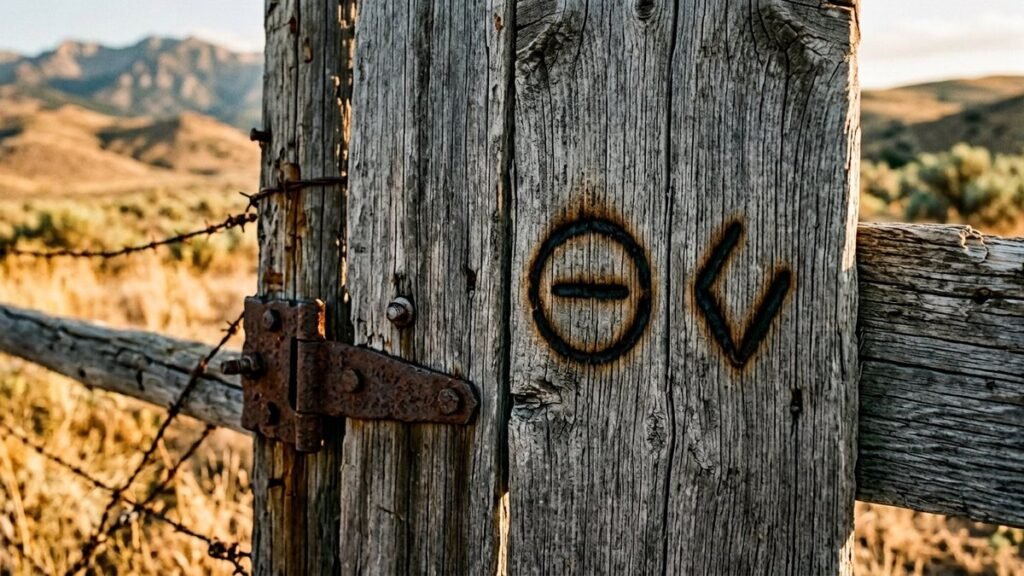
Ranch naming is its own discipline and it is brand-first. A working ranch very often takes its name from its cattle brand, and brands are read aloud using a fixed vocabulary of positions and motions: lazy, running, walking, flying, rocking, rolling, tumbling, bar, cross, box, circle, half, reverse, crazy. So "Lazy S" is not a slogan, it is the spoken form of a mark. The reading vocabulary is still used at brand inspections today, and cattle branding has a documented history of its own. These thirty are built the way real brands are read.
| Name | Brand reading |
|---|---|
| Lazy S Ranch | The S lying on its side |
| Running W Ranch | The W in motion |
| Flying V Ranch | The V airborne |
| Rocking Chair Ranch | A chair-shaped brand |
| Bar B Ranch | A bar through the B |
| Cross T Ranch | A cross over the T |
| Circle R Ranch | The R inside a circle |
| Box O Ranch | The O inside a box |
| Half Diamond Ranch | A diamond cut in half |
| Tumbling R Ranch | The R rolled over |
| Walking U Ranch | The U upright and moving |
| Rolling M Ranch | The M on its curve |
| Crazy C Ranch | The C askew |
| Reverse E Ranch | The E mirrored |
| Slash K Ranch | A slash through the K |
| Double Bar J Ranch | Two bars and a J |
| Three Bars Ranch | Three bars alone |
| Hanging H Ranch | The H suspended |
| Swinging P Ranch | The P on a swing |
| Lazy Heart Ranch | A heart lying down |
| Running Iron Ranch | Iron in motion |
| Broken Bow Ranch | A bow snapped |
| Whistling Arrow Ranch | An arrow in flight |
| Crooked Horn Ranch | A horn bent |
| Saddleback Ridge Ranch | A saddle-shaped ridge |
| Cottonwood Draw Ranch | Cottonwood + a dry gully |
| Redmesa Ranch | Red + a flat-topped hill |
| Sagebrush Basin Ranch | Sage + a basin |
| Drygulch Ranch | A dry ravine |
| Two Bit Ranch | A small-value brand, self-deprecating |
Cattle Brand Readings
This is the reference table for the section above: the actual vocabulary used to read a brand aloud in the American west. If you want a ranch name that sounds authentic rather than invented, pick a letter or shape and read it with one of these positions. The convention is documented in western ranching lore and still used at brand inspections today.
| Reading word | What it means on the hide |
|---|---|
| Lazy | The letter lying on its side |
| Running | The letter with motion legs |
| Walking | The letter upright with legs |
| Flying | The letter with wings |
| Rocking | The letter on a curved rocker |
| Rolling | The letter turned over |
| Tumbling | The letter upside down |
| Bar | A horizontal line through or beside |
| Cross | A cross over the letter |
| Box | The letter inside a square |
| Circle | The letter inside a circle |
| Half | The shape cut in half |
| Reverse | The letter mirrored |
| Crazy | The letter askew |
| Hanging | The letter suspended from a bar |
| Swinging | The letter on a pivot |
| Slash | A diagonal through the letter |
| Double | The element repeated |
| Broken | The element snapped |
| Connected | Two elements joined |
Dairy Farm Names
Dairy names have their own soft register, and the oldest element in it is -wick, which the OED records as Old English for a farm and specifically a dairy farm. Modern dairy names lean on milk, cream, butter, churn and meadow words, and on gentle alliteration. These twenty-six stay in that register.
| Name | Built from |
|---|---|
| Creamery Hollow | Dairy building + dip |
| Butterwick Farm | Butter + the Old English dairy ending |
| Milkmaid Meadow | Role + grassland |
| Churnbrook Farm | Churn + stream |
| Clovercream Farm | Clover + cream |
| Sweetcurd Croft | Curd + small holding |
| Velvetmilk Farm | Texture + milk |
| Dairydell Farm | Dairy + small valley |
| Morningmilk Farm | Time + milk |
| Wheyfield Farm | Whey + open field |
| Buttermilk Bend | Product + river curve |
| Creamcup Farm | Cream + flower cup |
| Softmoss Dairy | Texture + moss |
| Glebe Creamery | Priest's land + dairy building |
| Pail and Paddock | Two dairy objects |
| Meadowmilk Grange | Grassland + milk + monastic farm |
| Curdlew Farm | Curd + a coined tail |
| Whipcream Wick | Product + dairy ending |
| Snowmilk Stead | White + milk + place |
| Bellcow Barn | The lead cow + building |
| Juniper Dairy | Tree + dairy |
| Lacteal Lea | Milk adjective + clearing |
| Milkstone Farm | Milk + stone |
| Creamgate Farm | Cream + gate |
| Butterbell Farm | Butter + bell |
| Dewmilk Farm | Dew + milk |
Goat Farm Names
Goat names are the punniest livestock register after chickens, because goat vocabulary (kid, nanny, billy, bleat, browse, horn, beard) puns so easily. These twenty-four lean on that without becoming silly unless they want to.
| Name | Built from |
|---|---|
| The Kid Corral | Young goat + enclosure |
| Nanny's Nook | Female goat + corner |
| Bleatwood Farm | Goat sound + wood |
| Browsehill Farm | Goat feeding + hill |
| Hornhollow Farm | Horn + dip |
| Billygoat Bluff | Male goat + cliff |
| Caprine Croft | Goat adjective + small holding |
| The Bearded Byre | Goat feature + cattle shed |
| Cloven Lea | Cloven hoof + clearing |
| Grazing Gable Farm | Feeding + roof end |
| Kidnap Knoll | Kid + a hill, a pun |
| Bleating Brook Farm | Sound + stream |
| Nanny McPhee-style: Nanny McFarland | Female goat + a surname pun |
| The Goat Gather | A collective pun |
| Hornpipe Hollow | Horn + a dance + dip |
| Browsethwaite Farm | Feeding + Norse clearing |
| Capricorn Croft | The goat constellation + holding |
| The Bounding Billy | Motion + male goat |
| Milkbeard Farm | Goat feature + dairy |
| Scraggly Stead | Goat coat + place |
| Tinhorn Turn | Tin horn + river bend |
| The Woolly Goat | A texture mismatch joke |
| Bleatley Farm | Sound + clearing |
| Kidding Creek Farm | Birthing goats + stream |
Horse Farm and Stable Names
Horse and stable names borrow from equestrian vocabulary and from the aristocratic register of breeding studs: gallop, canter, bridle, saddle, mane, hoof, stirrup, plus words for grace and speed. These twenty-six sit in that register.
| Name | Built from |
|---|---|
| Canterbury Fields | Canter + a place suffix, a real-place echo |
| Bridleway Farm | Bridle + path |
| Saddletree Ranch | Saddle part + tree |
| Mane Meadow Farm | Mane + grassland |
| Hoofbeat Hollow | Hoof sound + dip |
| Stirrup Stead | Stirrup + place |
| Gallopgate Farm | Gallop + gate |
| Thoroughbred Thicket | Breed + small wood |
| Paddock Pines | Enclosure + trees |
| Fetlock Farm | Leg joint |
| Witherswood Farm | Withers, the shoulder + wood |
| Chestnut Canopy | Coat colour + tree cover |
| Bayard's Byre | An old horse name + shed |
| Roan Ridge Farm | Roan coat + hill |
| Palomino Pasture | Gold coat + grazing |
| Dun Drift Farm | Dun coat + drove path |
| Skittles Stable | A young-horse term + building |
| Farrier's Fold | Horseshoe-maker + enclosure |
| Halterhill Farm | Halter + hill |
| Reinwater Ranch | Rein + water |
| Currycomb Croft | Grooming brush + holding |
| Longrein Lea | Rein + clearing |
| Maremot Farm | Mare + a coined tail |
| Trotters' Turn | Gait + river bend |
| Whinnywick Farm | Horse sound + the dairy ending, a crossover joke |
| Saddlebow Stead | Saddle part + place |
Vineyard and Orchard Names
Vineyard and orchard names draw on grafting, trellis, press, cider, pomace and fruit varieties, and they favour the latinate and the sun-struck. These twenty-six stay in that register.
| Name | Built from |
|---|---|
| Trellisrow Vineyard | Support structure + line |
| Pomace Press | Fruit residue + pressing |
| Cidergarth Orchard | Cider + enclosed yard |
| Grafting Glen | Graft + valley |
| Vintner's Vale | Wine-maker + valley |
| Sunripe Rows | Sun + ripe + lines |
| Mustard Vine | A crossover plant joke |
| Cellardoor Vineyard | Cellar + door, a sound pun |
| Orchardleigh | Orchard + clearing |
| Pippin Plot | Apple variety + plot |
| Quince Quarter | Fruit + a land division |
| Russet Reach | Apple variety + stretch |
| Damson Dell | Plum variety + small valley |
| Medlar Meadow | Medlar fruit + grassland |
| Cobnut Croft | Hazel nut + holding |
| Pressing Stone Farm | Press + stone |
| Barrelback Vineyard | Barrel + ridge |
| Lateharvest Lea | Harvest time + clearing |
| Firstfrost Vines | Frost event + plants |
| Goldenrusset Row | Colour + variety + line |
| Trellised Thorne | Support + thorn |
| Pomona's Paddock | The Roman fruit goddess + enclosure |
| Corkbark Croft | Bark + holding |
| Sweetcider Stead | Product + place |
| Veraison Vale | The ripening term + valley |
| Oldpress Orchard | Age + press |
Fish Farm Names
Fish and aquaculture names borrow from water, net, weir, pond, race and species words, and they read cooler and wetter than every other register on this page. These twenty-two stay in it.
| Name | Built from |
|---|---|
| Weirwater Farm | Weir, a fish trap + water |
| Nettlepond Farm | Net pun + pond |
| Troutbeck Farm | Trout + stream |
| Silverrace Farm | Silver fish + a water channel |
| Kelpie Kelps | Water spirit + seaweed |
| Stillpool Stead | Calm pool + place |
| Breambrook Farm | Bream + stream |
| Fryfold Farm | Young fish + enclosure |
| Roe-row Farm | Fish eggs + line |
| Charrchase Farm | Char fish + channel |
| Pikepool Farm | Pike + pool |
| Smolt Stream Farm | Young salmon + stream |
| Alderney Weir | Alder + fish trap |
| Lochline Farm | Lake + line |
| Brackish Bend | Salt-mix water + curve |
| Gillnet Glen | Net type + valley |
| Carpcorner Farm | Carp + corner |
| Eelwear Farm | Eel + weir |
| Tidepool Terraces | Tide pool + stepped land |
| Minnowmere Farm | Small fish + lake |
| Salmonladder Lea | Fish pass + clearing |
| Oystercatcher Croft | A shorebird + holding |
Farm Names by Who Owned the Land
This is the section that makes a farm name feel historically true, because the prefix records the medieval owner. A Glebe Farm was land assigned to support the parish priest; a Grange Farm was an outlying holding of a monastery, usually with an abbey or priory nearby as its mothership; a Manor Farm was the lord's own demesne; a Home Farm was the working farm attached to the big house; and Church, Abbey, Priory and Tithe farms all record religious income. Pick the owner first and the name carries a story for free. These twenty use the prefixes correctly. The church connection is well documented, and glebe land is described in more depth than any name list can give. The owners themselves need names too, and the medieval names list supplies the reeves, haywards and freeholders who would have held this land.
| Name | Owner it records |
|---|---|
| Glebe End Farm | The parish priest's land, at its edge |
| Great Grange Farm | A monastic outpost, the larger of two |
| Manorfields Farm | The lord's demesne strips |
| Home Farm at Ash | The working farm of the big house |
| Church Acre Farm | Land whose income went to the church |
| Abbeylands Farm | An abbey's holding |
| Priory Wick | A priory's dairy farm |
| Tithe Barn Farm | Land paying the tenth, named for its barn |
| Rectory Rise Farm | The rector's land on a slope |
| Vicarage Vole Farm | The vicar's land |
| Monks' Meadow Farm | A monastic grassland |
| Friars' Fold Farm | A friary's enclosure |
| Bishopscroft Farm | A bishop's small holding |
| Deanery Dell Farm | A dean's small valley |
| Chantry Chase Farm | Land funding a chantry chapel |
| Almoner's Acre | Land funding alms |
| Templar's Toft | A knightly order's homestead plot |
| Hospitaller's Holt | A hospital order's wood |
| Crownlease Farm | Held directly from the crown by rent |
| Freehold Fern Farm | Held outright, no lord above |
Cozy and Stardew-Style Farm Names
Stardew Valley drives a real 500-search-a-month keyword, and its register is distinct: cosy, slightly whimsical, nature-forward, with soft consonants and compound words that feel hand-painted. It borrows from the cute register but drops the joke. These thirty sit in that register and work equally well for a game farm, a cottage garden brand or a cosy fiction setting. It is also, not coincidentally, the register that D&D's farming race lives in, and the halfling names list is where that race gets a kit of its own.
| Name | Built from |
|---|---|
| Fernhollow Farm | Fern + dip |
| Willowwick Farm | Willow + the dairy ending |
| Pebblebrook Farm | Stone + stream |
| Lanternlea Farm | Lantern + clearing |
| Mossback Farm | Moss + ridge |
| Starfall Stead | Celestial + place |
| Juniper Junction | Tree + crossing |
| Hearthstone Hollow | Fireplace stone + dip |
| Clovercrest Farm | Clover + top |
| Dewdrop Dell | Moisture + small valley |
| Brambleby Farm | Bramble + the Norse farmstead |
| Sunpatch Farm | Sun + plot |
| Quietquay Farm | Calm + landing place |
| Honeyhill Farm | Honey + hill |
| Petalpath Farm | Flower + way |
| Roostrow Farm | Birds + line |
| Softwind Stead | Gentle air + place |
| Timbertop Farm | Wood + summit |
| Underleaf Farm | Beneath foliage |
| Violetvale Farm | Flower + valley |
| Warmwindow Farm | Light + opening |
| Yarnyard Farm | Wool + yard |
| Zephyrzee Farm | West wind + a coined tail |
| Appleattic Farm | Fruit + loft |
| Breezybyre Farm | Airy + cattle shed |
| Candlecroft Farm | Candle + small holding |
| Dappledown Farm | Light pattern + hill |
| Eggbasket Farm | Two farm objects, plainly |
| Featherfen Farm | Feather + wetland |
| Glowgrove Farm | Light + small wood |
Farmer Surnames and Farm Last Names
Farm last names are a separate product people search for, usually for characters, and they follow the occupational and topographic rules of English surnames: the job (Reeve, Hayward, Carter, Plowman), the place (Atwell, Underhill, Bywater), or the feature (Ashdown, Brooksbank). These twenty-six are plausible surnames in those three families.
| Name | Type |
|---|---|
| Hayward | Real occupational surname, the fence- and hedge-warden |
| Reeve | Real occupational surname, the manor officer |
| Plowman | Real occupational surname |
| Carter | Real occupational surname |
| Bywater | Topographic, beside the water |
| Underhill | Topographic |
| Atwell | Topographic, at the well |
| Ashdown | Topographic |
| Brooksbank | Topographic, the brook's bank |
| Fielden | Topographic, of the fields |
| Meadows | Topographic |
| Crofter | Occupational, a small holder |
| Dairyman Dell | Occupational + place |
| Shepherdson | Occupational patronymic |
| Neatherd | Real old occupational term, the cattle herder |
| Swainson | Patronymic of a herdsboy |
| Gleeson | A real surname, here read as glebe-son |
| Granger | Real occupational surname, the grange keeper |
| Spencer | Real occupational surname, the dispenser of stores |
| Bailiff | Occupational, the estate manager |
| Thresh | Occupational, the grain thresher |
| Winnow | Occupational, the grain cleaner |
| Gleaner | Occupational, the field gatherer |
| Mucklow | A real surname from a midden hill |
| Furlong | Real topographic, the field strip length |
| Acreman | Occupational, the ploughman |
Farm Business and Market Names
Farm shops, farmers-market stalls and agritourism businesses need names that sell rather than describe, and the winning pattern is a personal or place front plus a warm generic: Barn, Pantry, Larder, Table, Stand, Patch. These twenty-four are built for a sign above a door. A farm shop rarely stands alone, and the fantasy village names list builds the settlement it serves.
| Name | Built from |
|---|---|
| The Bramble Pantry | Plant + store |
| Hollow Hill Larder | Place + store |
| Sunrise Stand | Time + stall |
| The Clover Table | Plant + eating place |
| Old Oak Orchard Market | Tree + place + market |
| The Friendly Furrow | Warmth + plough line |
| Basket and Bine | Container + hop stem |
| The Honest Acre | Virtue + measure |
| Morning Mist Market | Weather + market |
| The Rusty Gate | A worn feature, charmingly |
| Second Spring Farm Shop | Renewal + shop |
| The Full Bushel | Abundance measure |
| Halfway Hollow Market | Position + dip |
| The Good Ground | Virtue + soil |
| Creaking Gate Farm Shop | Sound + feature |
| The Long Table | Communal eating |
| Pick and Patch | Action + plot |
| The Weighed Sheaf | Measured bundle |
| Sunday Loaf Farm | Day + bake |
| The Open Barn | Access + building |
| Turnip and Twine | Two farm objects |
| The Counted Chickens | An idiom played straight |
| Last Light Larder | Time + store |
| The Shared Furrow | Community + plough line |
Homestead, Cottage and Barn Names
Homesteads, cottages and barns are the smallest holdings and their names are the most personal: often a single feature, a texture, or the name of whoever built it. Barn names, a small keyword in its own right, favour function and age. These twenty mix all three. For the wider land around the holding, the regions and landmarks rather than the fences, the place names list is the neighbouring system.
| Name | Built from |
|---|---|
| Thatchend Cottage | Roof material + end |
| The Old Byre | Age + cattle shed |
| Cobblenook | Stone + corner, fused |
| Wattle and Daub Barn | The two wall materials |
| Cruck Cottage | The curved timber frame type |
| The Tithe Barn | Function, storing the tenth |
| Smokeblack Barn | Age evidence + building |
| Dovetail Barn | The joint type |
| The Threshing Floor | Function |
| Haymow Hollow | The hay loft + dip |
| Granary Gate | Store + gate |
| The Cart Shed | Function |
| Staddlestone Cottage | The mushroom-shaped barn supports |
| Lintel Lea Cottage | Beam part + clearing |
| The Waggon Roof | The curved barn roof type |
| Owlhole Barn | The ventilation opening |
| Gable-end Cottage | Feature |
| The Winnowing Door | The draught door of a barn |
| Middenstead Cottage | The midden place |
| The Lean-to at Lark | Structure + place |
How Farm Names Are Actually Built
Farm naming is one of the few naming traditions where the grammar is fully documented, because it is the same grammar as English place-name study. A farm name is almost always an element plus a generic, or a fused compound of two elements, or an owner's name plus a generic. The elements carry the meaning and the generics carry the type.
| Element family | Examples | What it tells you |
|---|---|---|
| Tree and plant | Ash, Elm, Bramble, Hawthorn, Rowan | What grew there |
| Landform | Hurst, Holt, Shaw, Lea, Worth, Stead, Toft, Thwaite | The shape and use of the ground |
| Water | Beck, Brook, Burn, Mere, Wick-by-water | Drainage and crossing |
| Ownership | Glebe, Grange, Manor, Home, Church, Abbey, Tithe | Who held it in the middle ages |
| Norse | By, Thorpe, Thwaite, Toft, Kirk, Beck | Danelaw settlement |
| Gaelic | Brae, Burn, Glen, Croft, Bally, Kil, Derry | Scottish or Irish origin |
| Brand reading | Lazy, Running, Flying, Bar, Cross, Circle, Half | American ranch, read off the hide |
| Register word | Cute, Funny, Cozy, Fantasy | The tone the owner wants |
The second decision is the generic: Farm, Grange, Croft, Stead, Homestead, Ranch, Acres, Fields, Fold, Byre, Wick. The generic sets the size and the region. A croft is small and Scottish; a grange is monastic and English; a ranch is brand-read and American; a wick is a dairy.
Third, and most often skipped, is the owner. Real farm names very frequently preserve a person, from Lambert's Ley to Grim's By. Adding an owner, real or invented, is the fastest way to make a farm name feel like it has been on a map for three hundred years.
How to Name a Farm in Four Steps
Step one: decide who owned it in 1300, even if nobody will ask. Church, monastery, lord, freeholder or crown. This single choice hands you the prefix (Glebe, Grange, Manor, Freehold) and instantly gives the name a history. If you want no history, choose a landscape element instead and skip this step knowingly.
Step two: pick one landscape element and one generic. Ash plus croft. Bramble plus wick. Kettle plus by. Two pieces. The fused compounds that read oldest (Staddlethwaite, Butterwick) are just two elements that stopped being two words.
Step three: match the generic to the region and the size. Croft and bothy read Scottish; bally and kil read Irish; by and thwaite read Danelaw; ranch and brand readings read American; grange and glebe read medieval English. Mixing a Scottish generic onto a Norse element is the most common tell of a fabricated farm name.
Step four: say it on a sign and on a windy road. A farm name has to work painted on a gate and shouted over a field. If it needs explaining aloud, cut the second element. If it sounds like a housing development, add an owner.
Farm Naming Mistakes Worth Avoiding
Mixing regional kits. A "Ballythwaite" joins an Irish townland element to a Norse clearing and reads as nonsense to anyone who knows either. Pick one tradition per name.
Using -wick without knowing it meant dairy. The OED is explicit that -wick is a farm and specifically a dairy farm. Putting it on a sheep ranch is a small error that a knowledgeable reader will notice immediately.
Four elements. Real farm names are two pieces, occasionally three with an owner. Ashen-holt-wick-by is not a farm name, it is a tongue-twister.
Calling a grange a house. A grange is a farm building complex and grain store, historically monastic. Using it for a suburban cottage loses the best part of the word.
Forgetting the brand on a ranch. If your setting is American west, a ranch named without any reference to its brand misses the single most characteristic feature of ranch naming.
Conclusion
A farm name is a deed, a brand and a weather report compressed into two words. It tells you whether a priest, a monastery, a lord or a freeholder held the ground, whether Norse or Gaelic speakers named it, whether it was a dairy or a clearing or a homestead plot, and out west, exactly which mark was burned into the cattle. Very few naming traditions keep their records this openly.
Use the generator when you need ten names fast and the tables when you need one that will survive a reader who knows what a thwaite is. Pick the owner, pick one element, pick the generic that matches the region, and say it aloud over a windy field. If it holds, it is a farm name.
Farm Name Generator and 480 Farm, Ranch and Homestead Names
Frequently Asked Questions
What is a farm name generator?
It is a tool that builds farm, ranch and homestead names from documented naming systems, Old English and Norse place elements, ownership prefixes like glebe and grange, Gaelic endings, and the American cattle-brand reading vocabulary, rather than from random word pairs.
Why do so many English farm names sound alike?
Because they share a small set of place-name elements. -ley means clearing, -worth enclosure, -stead place, -by a Norse farmstead, and so on. Thousands of farms were named by combining one landscape word with one of these, which is why the patterns repeat across whole counties.
What does wick mean in a farm name?
Per the Oxford English Dictionary, wick is Old English for a farm and specifically a dairy farm. Names ending in -wick or -wich, including many town names, originally marked dairying ground.
What is the difference between a grange and a manor farm?
A grange was an outlying farm of a monastery, an agricultural outpost usually with an abbey or priory nearby. A manor farm was the lord's own home farm, the demesne worked for the manor house. Both survive as farm names across England.
How do ranch names work?
Very often they are cattle brands read aloud. The western brand vocabulary uses words like lazy, running, flying, rocking, bar, cross, box, circle and half to describe a mark's shape, so Lazy S and Running W are spoken descriptions of a brand burned into hide.
What are good cute farm names?
The cute register uses small warm words, alliteration and food or flower fronts: Buttercup Hollow, Sunnybrook, Cloverleigh, Honeydew Acres. The rule is nothing harsh and nothing longer than three words.
Can I use these names for Stardew Valley or other games?
Yes. The cozy section is built for exactly that register, and the cute and funny sections work for game farms, farm shops and agritourism brands. For commercial use of any name, check existing trademarks first.
Do farm names have real meanings?
Historical ones do, precisely: the elements record trees, landforms, water, ownership and settlement language. Invented ones on this page list the element or system each was built from, which is more useful than an invented virtue.