
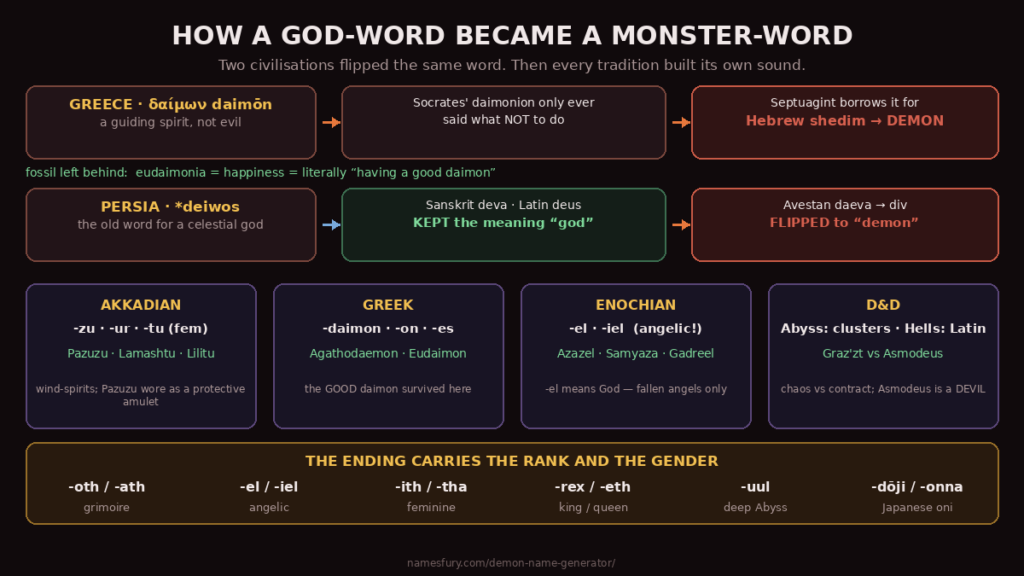
The word demon is a mistranslation that stuck. In ancient Greek a daimon was not evil at all. It was a spirit somewhere between a god and a mortal, and in its most famous form it was the inner voice Socrates described: a companion that never told him what to do, only warned him what not to do. Having a good one was literally the Greek word for happiness — eudaimonia, “good daimon”, is where our word euphoria’s cousin comes from and what Aristotle meant by a life going well.
Then the word changed owners. When the Hebrew scriptures were rendered into Greek, the translators reached for daimonia to describe foreign gods and unclean spirits, the shedim and se’irim of the original text. Psalm 96 in that Greek version says plainly that all the gods of the nations are daimonia. By the time the New Testament was written, daimonion meant only an evil spirit to be cast out, and by the time the word reached English around 1200 the guardian had become the tempter. The same reversal happened independently in Persia, where the old word for a celestial being, daeva, gave Sanskrit its deva and Latin its deus for god, but became div, a demon, after the Zoroastrian reform. Two civilisations took the word for a god and turned it into the word for a monster.
That history is the reason demon names are interesting to build rather than merely to invent. Every tradition that has demons also has a naming logic: Akkadian wind-spirits ending in -lilu, Greek tutelary spirits ending in -daimon, Enochian fallen angels ending in -el, D&D’s Abyss-spawn with their hard clusters and double apostrophes, and a seventeenth-century grimoire whose first entry, Bael, is the Canaanite storm god Ba’al wearing a demon’s name. This page gives you 520 names across all of those traditions plus the invented ones, and every entry says where its sound came from.
If you only want a name right now, the demon name generator below produces ten at a time. If you want to know why a name works, keep reading, because the answer is older than any of the games that use them.
Demon Name Generator
This demon name generator has four buttons and gives you ten names at a time. Abyssal runs the chaotic, hard-consonant register of D&D’s tanar’ri; Infernal runs the lawful, contract-flavoured register of the baatezu devils; Demoness narrows to the feminine endings used from Lamashtu to Lilith; and Ancient pulls from the oldest attested sounds, Akkadian and Greek.
Every name it produces is built from a documented phonetic pattern rather than random syllables, and the lists below show the same patterns worked out in full with their sources. Tap any name to copy it, and press the same button again for a fresh ten.
🔥 Demon Name Generator
Pick abyssal, infernal, demoness or ancient and get ten demon names at once.
Demon Names
The master list. These work for any setting because they sit in the middle of the phonetic range: harsh enough to read as fiendish, short enough to shout across a battle map. Each entry names the sound-pattern or root it was built from, which is the difference between a demon name and a keyboard accident.
| Name | Built from |
|---|---|
| Vharroth | Hard cluster front plus the -oth stop common to grimoire names |
| Kazzul | Doubled sibilant with the Akkadian -ul ending |
| Morthai | Death-root mor- with the Enochian -ai tail |
| Szekkar | Hungarian-style sz cluster, a trick horror naming borrows |
| Druun | Long vowel and a single blunt consonant, the manes register |
| Ashmodai | A respelling of Asmoday, Goetia no. 32, softened for a player character |
| Velgrath | Norse vel- front with the -rath ending of wrath |
| Ixuul | Vowel-cluster front, the sound D&D gives the deepest Abyss layers |
| Baalzor | The Ba'al root, demonised further, which is exactly what the grimoires did |
| Nharuk | Breathy n- cluster with a hard stop |
| Gorgath | Reduplicated gor- with a single -ath, a reduplication older than any modern fantasy |
| Thessik | Greek -ss- middle with a blunt ending |
| Umbros | Latin umbra, shadow, with a Greek-style close |
| Kaelith | Fallen-angel -el inverted to -ith, the Lilith ending |
| Rhuust | Double-u vowel drag with a final cluster |
| Zimrioth | The -oth stop over a Semitic-style front |
| Vhoss | Single syllable, sibilant close, the imp register |
| Dakkai | Japanese -kai (world/sea) over a hard stop |
| Malphar | From Malphas, Goetia no. 39, truncated |
| Ossruk | Double sibilant plus a blunt back consonant |
| Yeggoth | The -oth stop over an open front |
| Ctharra | Lovecraftian ct- cluster, a modern demon-naming convention |
| Naberi | From Naberius, Goetia no. 24, softened |
| Qurax | Uvular q- with the sharp -ax |
| Heskath | H- front with the -ath of oath-breaking |
| Vrokkai | From vrock, the 5e demon type, extended |
| Szorruk | sz cluster again with a doubled r |
| Elturath | The -el angelic front buried inside a longer name |
| Draazul | Long vowel with the Akkadian -ul |
| Kethvhar | Two clusters joined, the balor register |
| Molochai | From Moloch, the name later tradition demonised, with the -ai tail |
| Ishkaz | Sibilant middle with the -az ending |
| Thurzak | th- front with a hard back stop |
| Azzaroth | Doubled z with the -oth stop |
| Grelloth | gre- front with the -oth stop |
| Vhaskir | Cluster front with a rolled ending |
| Nyxuul | Greek nyx, night, with the deep-Abyss -uul |
| Barzai | From Barzai, a name from later occult fiction, softened |
| Korvath | cor- (heart/raven) with the -vath of oaths |
| Zhellun | zh- sibilant with a long vowel close |
| Vharzu | Cluster front with the Akkadian -zu, the Pazuzu ending |
Male Demon Names
Male demon names across every tradition lean on stops and clusters rather than flowing vowels, and the grimoire kings are the extreme case: Bael, Beleth, Belial, Paimon are all one or two blunt syllables. These forty keep that shape. Each one lists the pattern it follows.
| Name | Built from |
|---|---|
| Karnoth | Hard k- with the -oth stop |
| Vrazzul | vr- cluster with doubled z |
| Mordrek | mor- death-root with a hard back stop |
| Szarnak | sz cluster with a blunt close |
| Drukkar | Doubled k, the grunt register |
| Ashgor | ash- with the -gor of gore |
| Belkor | A truncation of the Belial/Baal front |
| Nharrok | Breathed n- with doubled r |
| Thrazzan | th- with doubled z |
| Vhorg | Single blunt syllable, the manes register |
| Zuggar | From Zuggtmoy's front, masculinised |
| Kaelzor | Fallen-angel front with a harsh ending |
| Rhuum | Long vowel, single consonant |
| Ixkar | Vowel-cluster front with a hard stop |
| Baalzek | The Ba'al front with a sharp close |
| Gorvath | gor- with the -vath ending |
| Dakkor | Doubled k with a rolled r |
| Malthus | From Malthus, a Goetia count, left nearly whole |
| Szorrek | sz cluster with doubled r |
| Vhastir | Cluster front with a rolled ending |
| Qurruk | Uvular q- with doubled r |
| Heskai | H- front with the -ai tail |
| Zimrik | Semitic-style front with a hard close |
| Osskar | Double sibilant with a hard k |
| Thurrok | th- with doubled r |
| Azzar | Doubled z, single syllable |
| Grekkor | gre- with doubled k |
| Vharn | Cluster front with a nasal close |
| Nyxar | Greek night-root with a hard ending |
| Barzuk | bar- with the Akkadian-style -uk |
| Korvex | cor- with the sharp -ex |
| Zhelgor | zh- sibilant with -gor |
| Drazzul | dr- with doubled z |
| Molrek | Moloch front truncated with a hard stop |
| Ishkur | From Ishkur, an old storm god name, demonised |
| Tharnax | th- with the sharp -ax |
| Vrokkar | From vrock with doubled r |
| Eltarok | Buried -el front with a hard close |
| Kazzar | Doubled z with a sibilant front |
| Nharzuk | Breathed n- with the -uk ending |
Female Demon Names
This is the biggest keyword in the cluster at 3,600 searches a month, and no page currently holds position one for it. The attested female demons give a clear phonetic rule: they end in an open vowel or a soft consonant, and they frequently carry the -tu, -tha, -lith and -ra endings. Lamashtu, Lilith, Lamia, Empusa, Mormo, Druj, Nasu, Rusalka. Every name below follows that rule and says which ending it uses.
| Name | Built from |
|---|---|
| Lamasza | Lamashtu's front with the soft -a |
| Lilitha | Lilith with an open vowel tail |
| Lamira | Lamia's front with the -ra ending |
| Empuza | Empusa with a voiced middle |
| Mormona | Mormo extended |
| Drujha | Zoroastrian Druj with a breathed close |
| Nasura | Zoroastrian Nasu with the -ra ending |
| Rusalka | The Slavic water spirit, left whole |
| Yukionna | Yuki-onna, the Japanese snow woman, joined |
| Onryora | Onryō, the vengeful ghost, given a feminine rank tail |
| Kuchisa | Kuchisake-onna truncated |
| Strigga | From strix, the Roman night-bird spirit |
| Gellona | Gello, the Greek child-snatching spirit, extended |
| Alkhra | A feminine reshaping of the Akkadian lilu class |
| Ardatla | From Ardat-Lili, the Akkadian night demoness |
| Vhessa | Cluster front with the soft -a |
| Morthia | Death-root with the -ia feminine ending |
| Nyxara | Greek night with the -ra ending |
| Szellea | sz cluster softened with -ea |
| Kaelitha | Fallen-angel front with the Lilith -tha |
| Umbrae | Latin shadow with a plural-feeling close |
| Druuna | The manes register feminised |
| Ixuula | Deep-Abyss vowel cluster with -a |
| Baalzera | The Ba'al front feminised |
| Velgratha | Norse front with the -tha ending |
| Thessika | Greek -ss- with the -ka ending |
| Zimria | Semitic front with the -ia ending |
| Vhossha | Sibilant close softened |
| Dakkaira | Japanese -kai with the -ra ending |
| Malphara | Malphas front feminised |
| Ossruka | Double sibilant with -ka |
| Yeggotha | The -oth stop opened to -tha |
| Cthirea | Lovecraftian ct- cluster with a feminine -ea |
| Naberia | Naberius softened |
| Quraxa | Uvular q- with the -a ending |
| Heskatha | H- front with the -tha ending |
| Vrokkaira | Vrock extended with a feminine tail |
| Szorruka | sz cluster with -ka |
| Elturatha | Buried -el with the -tha ending |
| Draazula | Long vowel with the Akkadian -ul opened |
Demoness Names
Demoness is its own small keyword and it deserves its own answer, because it asks for something narrower than female: a title-bearing woman of the pit, the consort and the queen rather than the foot soldier. The pattern here is a feminine name plus a rank word, or a name that already contains one. Think Lilith as Adam's first wife in later folklore, Lamashtu as a daughter of Anu, Glasya-Labolas as a Goetia president. These twenty-six lean on rank.
| Name | Built from |
|---|---|
| Lilithra | Lilith with a rank-feeling -ra |
| Lamashtuqa | Lamashtu with an Akkadian-style rank tail |
| Mormessa | Mormo with the -essa of countess |
| Empressa | Empusa folded into the rank word empress |
| Drujhana | Druj with a queenly -ana |
| Nasubeth | Nasu with the -beth of royal Hebrew names |
| Rusalkara | Rusalka with the -ra of rank |
| Hannyara | Hannya with the -ra ending |
| Strigessa | Strix with the -essa ending |
| Gellorena | Gello extended into a queenly shape |
| Ardatna | Ardat-Lili truncated with a rank tail |
| Vharissa | Cluster front with the -issa of mistress |
| Morthessa | Death-root with -essa |
| Nyxeth | Night-root with the -eth of old queens |
| Szellara | sz cluster with the -ra of rank |
| Kaelithra | Fallen-angel front with -ra |
| Umbressa | Shadow-root with -essa |
| Druunara | Manes register with -ra |
| Ixulessa | Deep-Abyss cluster with -essa |
| Baalzira | Ba'al front with the -ira of royal names |
| Velgressa | Norse front with -essa |
| Thessira | Greek middle with -ra |
| Zimrieth | Semitic front with the -eth ending |
| Vhossara | Sibilant with -ra |
| Dakkessa | Japanese -kai with -essa |
| Malphessa | Malphas front with -essa |
Demonic Names
Demonic is the adjective form and it carries a slightly different job: it names the quality rather than the creature, so these work as titles, epithets and second names as much as first names. The pattern is a demon root fused to a descriptive tail, which is how real demonology builds its compound names, from Akkadian lilu-demon to the Goetia's double-barrelled Glasya-Labolas.
| Name | Built from |
|---|---|
| Daimonakh | The Greek root with a harsh agentive ending |
| Demoniar | The English root with a Latinate tail |
| Fiendrel | Old English fiend with a relational ending |
| Sheddim | From Hebrew shedim, the word the Septuagint translated as daimonia |
| Seirrim | From Hebrew se'irim, the goat-spirits, pluralised |
| Liluthic | Lilith with an adjectival -ic |
| Abyssal | Left whole because D&D already made it a technical term |
| Tanarric | From tanar'ri with an adjectival ending |
| Baatezan | From baatezu with a -an tail |
| Goeetic | From Goetia, the grimoire's own name |
| Infernai | Infernal respelled with the -ai tail |
| Perdithion | Perdition with a demonised middle |
| Maledictor | Latin maledictio, curse, given an agent ending |
| Execrath | Execration with the -ath stop |
| Anathemar | Anathema with a martial ending |
| Blasphar | Blasphemy truncated |
| Sacrilex | Sacrilege with the sharp -ex |
| Profanor | Profane with a rank ending |
| Desecrath | Desecrate with the -ath stop |
| Corruptai | Corrupt with the -ai tail |
| Vilegrim | Vile plus grim, a compound in the Old English manner |
| Malvhar | Mal- prefix with a cluster |
| Nequarth | Nequity, wickedness, with the -arth ending |
| Scelgor | Old English scelg, wicked, with -gor |
| Wreccai | Wreck with the -ai tail |
| Havokar | Havoc with a rank ending |
| Ruinar | Ruin with a Latinate tail |
| Dreadmor | Dread plus the death-root |
| Terrorai | Terror with the -ai tail |
| Horreth | Horror with the -eth ending |
Cool Demon Names
Cool here means the name looks good written on a character sheet and sounds good said aloud, which is a narrower target than scary. The trick the good ones use is a single strong image plus a clean ending: Umbraz is shadow, Nyxar is night, Vhoss is a hiss. Nothing long, nothing with three clusters in a row.
| Name | Built from |
|---|---|
| Umbraz | Latin umbra, shadow, with the -az of Azazel |
| Nyxos | Greek nyx, night, with a Greek-style close |
| Vhirr | A single sibilant syllable with a rolled close |
| Kael | Fallen-angel -el kept bare, which reads as cool precisely because it is short |
| Ravok | Raven with a hard stop |
| Sableth | Sable, black, with the -eth ending |
| Cindra | Cinder with an open ending |
| Ashvane | Ash plus a flowing tail |
| Obsidai | Obsidian with the -ai tail |
| Onyxar | Onyx with a hard ending |
| Vesperai | Vesper, evening, with the -ai tail |
| Nocturn | Nocturne truncated |
| Eclipsar | Eclipse with a rank ending |
| Umbrion | Shadow-root with a Latinate -ion |
| Duskmor | Dusk plus the death-root |
| Gloomvhar | Gloom with a cluster |
| Shadewyn | Shade with a flowing Welsh-style ending |
| Nightvhar | Night with a cluster |
| Stygian | Left whole, from the river Styx |
| Acheron | Left whole, the second river of the Greek underworld |
| Cocytus | Left whole, the river of wailing |
| Phlegeth | Phlegethon, the river of fire, truncated |
| Lethei | Lethe, the river of forgetting, softened |
| Tartrai | Tartarus with the -ai tail |
| Erebai | Erebus, primordial darkness, with the -ai tail |
| Skotai | Greek skotos, darkness, with the -ai tail |
| Melanor | Greek melas, black, with a rank ending |
| Kenvhar | Cenotaph-front with a cluster |
| Sepulchr | Sepulchre truncated hard |
| Carnifex | Latin carnifex, executioner, left whole |
Good Demon Names
Searches for good demon names mean good as in well-made, not good as in virtuous, and it is worth saying so plainly because the alternative reading is nonsense. A well-made demon name does three things: it is short enough to shout, it carries one clear sound-image, and its ending matches its rank. These thirty are the strongest builds on the page by that test, each with the reason it works.
| Name | Why it works |
|---|---|
| Velkath | Two syllables, one hard stop, shoutable across a table |
| Szaroth | The sz cluster signals foreignness, the -oth signals grimoire |
| Morthun | Death-root with a blunt close and nothing extra |
| Kaelvhar | A fallen-angel front grounded by a cluster |
| Rhuza | A dragged vowel with a feminine close, short enough to yell |
| Drazgor | dr- plus -gor, balanced weight |
| Ixvane | Vowel-cluster front reading as very old, flowing tail |
| Baalvun | The Ba'al root with a blunt close |
| Gorvane | One clear image, gore, with a flowing tail |
| Dakketh | Doubled k with the royal -eth |
| Malzhar | mal- prefix with a breathed close |
| Ossvane | Double sibilant with a flowing tail |
| Yeggath | Open front with the strongest stop on the page |
| Cthvane | The accepted ct- cluster with a flowing tail |
| Nabvun | A grimoire root compressed to a soldier's name |
| Qurvane | Uvular q- for non-European feel, flowing tail |
| Heskvun | Oath-breaking front with a blunt close |
| Vroketh | A canon 5e demon type's front with the royal -eth |
| Eltvane | A buried angelic -el with a flowing tail |
| Draazeth | Long vowel then the royal -eth |
| Kethgor | Oath-front with the -gor of gore |
| Azzvun | Doubled z with a blunt close, two syllables |
| Grevane | gre- front with a flowing tail |
| Vharneth | Cluster front with the royal -eth |
| Nyxvane | Night-root with a flowing tail |
| Barzvun | bar- front with a blunt close |
| Korveth | Heart-or-raven ambiguity with the royal -eth |
| Zhelvane | The rare zh- sibilant with a flowing tail |
| Drazvun | dr- front with a blunt close |
| Molvane | Moloch truncated to a flowing tail |
Scary Demon Names
Scary is a different build from cool. Where cool wants clean endings, scary wants friction: consonant clusters that resist the mouth, doubled letters, and vowels dragged out. The attested scary names do this too, which is why Lamashtu and Pazuzu feel heavier than Bael. These thirty push friction as far as it goes while staying pronounceable.
| Name | Built from |
|---|---|
| Kthrrak | Triple consonant front, maximum friction |
| Szkrath | sz plus kr cluster |
| Vhzzur | Doubled z with a uvular close |
| Ngrath | Nasal-cluster front |
| Xkull | x- cluster with a doubled l |
| Qrrzun | Uvular q with doubled r |
| Dhskkar | Breathed d plus sk cluster |
| Zzghal | Doubled z with a voiced velar |
| Kthrax | kt cluster with the sharp -ax |
| Vhrrun | Cluster front with a dragged vowel |
| Szxal | sz plus x |
| Ngurroth | Nasal-cluster with the -oth stop |
| Xhazul | x- with the Akkadian -ul |
| Qtharr | q plus th cluster |
| Dzzrak | Doubled z with a hard k |
| Kvhss | Cluster with a sibilant close |
| Zthrax | z plus th with the -ax |
| Vhkkur | Doubled k with a uvular r |
| Sgrrath | sg cluster with the -ath stop |
| Xvul | x plus v, shortest of the set |
| Qzzhar | Doubled z with a breathed close |
| Kthul | kt cluster, one syllable |
| Dhrzz | Breathed d with doubled z and no vowel resolution |
| Ngkath | Nasal-cluster with the -ath stop |
| Vxrr | v plus x with doubled r |
| Zqull | z plus q cluster |
| Skrzz | sk plus doubled z |
| Xhrrun | x plus hr cluster with a dragged vowel |
| Qvzz | q plus doubled z, two syllables of friction |
| Kthsz | kt plus sz, the harshest close on the page |
Demon King and Lord Names
A demon king name has to carry weight without carrying length, and the real examples show two strategies. The grimoire kings are brutally short: Bael, Beleth, Belial, Paimon. The D&D demon lords are long and doubled: Demogorgon, Fraz-Urb'luu, Graz'zt. Both work, but they signal different things, short reading as ancient and long reading as titled. These thirty give you both registers.
| Name | Built from |
|---|---|
| Baalmoloch | Two demonised god-names fused, Ba'al and Moloch |
| Belzareth | The Belial front with a royal -eth |
| Paimorax | Paimon with the sharp -ax of command |
| Belethar | Beleth extended by a rank syllable |
| Demogor | Demogorgon truncated to a shoutable form |
| Orcusrex | Orcus plus rex, king, which is blunter than the original |
| Grazthal | Graz'zt with the apostrophe removed for playability |
| Baphoth | Baphomet with the -oth stop |
| Yeenogor | Yeenoghu with a hard close |
| Juiblex | Juiblex left whole, already a king's name |
| Zuggmor | Zuggtmoy with the death-root |
| Kostchthar | Kostchtchie hardened |
| Malcanth | Malcanthet truncated |
| Frazurb | Fraz-Urb'luu compressed |
| Lolthra | Lolth with a feminine rank tail |
| Asmodrex | Asmoday plus rex |
| Belialkar | Belial with a martial ending |
| Astarrex | Astaroth plus rex |
| Vharrex | Cluster front plus rex |
| Kazzulmor | Kazzul with the death-root |
| Morthrex | Death-root plus rex |
| Nyxreth | Night-root with the royal -eth |
| Szarkai | sz cluster with the Japanese -kai, a world-ruler sound |
| Druunrex | The manes register plus rex |
| Ixuulkar | Deep-Abyss cluster with a martial ending |
| Baalzureth | Ba'al front with the royal -eth |
| Velgorex | Norse front plus rex |
| Thessirex | Greek middle plus rex |
| Zimrikai | Semitic front with the -kai world-ending |
| Ossrumar | Double sibilant with a rank ending |
Ancient Demon Names From Real Demonology
These are not inventions. Every name below is attested in a real historical tradition, with its culture and its actual function, because the oldest demon names are also the most useful models: they show what a demon name was originally for. Note the recurring irony, verified against museum and scholarly sources, that several of these were protective as much as harmful.
| Name | Culture and what it was |
|---|---|
| Pazuzu | Akkadian. "King of the lilu-demons", son of Hanbu, lord of the southwest wind. Worn as a protective amulet against Lamashtu, which is the great irony of Mesopotamian demonology |
| Lamashtu | Akkadian. Demoness who harmed mothers and infants; lion-headed with donkey ears. Pazuzu was invoked against her |
| Lilitu | Akkadian. A class of wind-demons; the root of the later name Lilith |
| Alû | Akkadian. A sexless nightmare demon that crushes sleepers |
| Gallû | Akkadian. A great demon of the underworld |
| Edimmu | Akkadian. The spirit of the unburied dead, draining the living |
| Ardat-Lili | Akkadian. A night demoness |
| Ugallu | Akkadian. A lion-headed storm-demon that also appears as a protector in Assyrian palace reliefs |
| Rabisu | Akkadian. A lurking, ambush demon |
| Angra Mainyu | Avestan, later Ahriman. The destructive spirit, chief of the daevas |
| Aeshma | Avestan. The daeva of wrath |
| Druj | Avestan. A female daeva of deceit and decay |
| Nasu | Avestan. The corpse-demon of contamination |
| Jahi | Avestan. A female daeva associated with seduction |
| Azi Dahaka | Avestan. The three-headed dragon-demon |
| Bushyasta | Avestan. The daeva of sloth |
| Apaosha | Avestan. The daeva of drought |
| Khrafstra | Avestan. Noxious creatures, the category of harmful beings |
Greek and Roman Spirits, Before They Were Demons
This is the section that explains the whole page. Before the word turned evil, Greek and Roman religion had a full taxonomy of intermediate spirits, and several of them were explicitly good. If you want a demon name that carries the original, pre-Christian weight rather than the medieval one, build from these; the classical daimon is documented in more depth than any name list can give it.
| Name | What it originally was |
|---|---|
| Agathodaemon | The good daimon, a personal guardian spirit, often depicted as a serpent |
| Kakodaemon | The bad daimon, the other half of the spectrum |
| Eudaimon | One who has a good daimon; the root of eudaimonia, happiness |
| Daimonion | Socrates' personal inner voice, which only warned him what not to do |
| Genius | The Latin translation of daimon, a man's guiding spirit |
| Juno | The female equivalent of genius for women, in its original protective sense |
| Lares | Roman household guardian spirits |
| Lemures | Roman restless dead, warded off at the festival of Lemuria |
| Manes (Roman) | Roman ancestral spirits, euphemistically called "the good ones" |
| Keres | Greek female spirits of violent death |
| Empusa | A shape-shifting spirit in Hecate's retinue |
| Lamia | A queen turned child-snatching spirit |
| Mormo | A bogey spirit used to frighten children |
| Strix | A night-bird spirit that preyed on infants |
| Gello | A child-snatching spirit of Greek folklore |
| Onoskelis | A female daimon named in the Testament of Solomon |
| Alastor | An avenging spirit, later recast as a demon |
| Maniai | Spirits of madness |
Grimoire Names, The Ars Goetia As A Historical Document
The Ars Goetia, the first book of the seventeenth-century Lesser Key of Solomon, catalogues seventy-two spirits with ranks and legion counts. It is a literary and historical artifact, and the Mesopotamian demons at the Getty overview shows how much older the real demonologies are than the grimoires. Scholars note that several Goetia entries are corrupted names of older deities: Bael, the first entry, is the Canaanite storm god Ba'al of the Ugaritic texts, and Astaroth is the goddess Astarte. The table below gives a representative subset with the ranks the book assigns. It is presented as bibliography, exactly as a historian would list it.
| Name | Rank in the Goetia | Note |
|---|---|---|
| Bael | King, 66 legions | The Canaanite storm god Ba'al, demonised |
| Agares | Duke, 31 legions | Teaches languages, returns runaways |
| Vassago | Prince, 26 legions | Declares past and future, finds hidden things |
| Samigina | Marquis | Also spelled Gamigin |
| Marbas | President | Answers truly on hidden matters |
| Valefor | Duke | A thief-spirit |
| Amon | Marquis | Not to be confused with the Egyptian god Amun, though the names collide |
| Barbatos | Duke | A hunter-spirit |
| Paimon | King | Requires obedience from the operator, in the book's own framing |
| Buer | President | Healing, in the book's claims |
| Gusion | Duke | Answers on past, present and future |
| Sitri | Prince | Inflames love, per the text |
| Beleth | King | One of the more feared entries in the book |
| Astaroth | Duke | The goddess Astarte, demonised |
| Asmoday | King | Also Asmodeus; appears earlier in the Book of Tobit |
| Furfur | Count | A thunder-spirit |
| Marchosias | Marquis | A wolf-griffin, per the book |
| Stolas | Prince | Teaches herbs and stones, per the book |
| Malphas | President | A builder-spirit |
| Focalor | Duke | A wind-and-sea spirit |
| Belial | King | Appears in the Dead Sea Scrolls long before the Goetia |
| Dantalion | Duke | Knows all thoughts, per the book |
| Andromalius | Count | The seventy-second and final entry |
Japanese Demon and Spirit Names
Japanese demonology gives a completely different phonetic kit: open syllables, long vowels, and the -dōji and -onna suffixes that mark a named oni or a female spirit. The word akuma is itself a borrowing, the Christian devil rendered into Japanese, while oni is the older native creature. These are attested figures and categories, and several of them sit closer to what the site's ghost names list covers than to a pit fiend, which is exactly why they sound so different from the Abyss kit.
| Name | What it is |
|---|---|
| Oni | The horned ogre-demon of Japanese folklore |
| Akuma | The Christian devil borrowed into Japanese |
| Majin | A magic demon or spirit |
| Yōki | A bewitching demon |
| Hannya | The vengeful-woman oni of Noh theatre |
| Onryō | A vengeful ghost |
| Gaki | A hungry ghost, from the Sanskrit preta |
| Shuten-dōji | The great oni of Mount Oe |
| Ibaraki-dōji | The oni of the Rashomon gate |
| Datsue-ba | The old woman who strips clothes at the Sanzu river |
| Enma | The king of the dead, from Yama |
| Yuki-onna | The snow woman |
| Kuchisake-onna | The slit-mouthed woman |
| Ubume | The bird-woman of childbirth |
| Funayūrei | Ship ghosts |
| Ikiryō | The vengeful spirit of a living person |
D&D Fiends, Demons Versus Devils Versus Daemons
Dungeons & Dragons made the distinction most name sites miss, and it is worth learning because it changes how a name should sound. Demons are tanar'ri, chaotic evil, from the Abyss, many-layered and savage, with little hierarchy. Devils are baatezu, lawful evil, from the Nine Hells of Baator, rigidly ranked and contract-minded. And yugoloths, the neutral evil mercenaries, are the fiends who actually get called daemons, keeping the old Greek spelling for the neutral party. The Blood War is the eternal demon-versus-devil conflict that keeps both sides too busy to overwhelm the Material Plane. One common error to avoid: Asmodeus is a devil, not a demon.
| Name | Type and plane |
|---|---|
| Balor | Demon, tanar'ri, Abyss |
| Marilith | Demon, six-armed general of the Abyss |
| Hezrou | Demon, Abyss |
| Vrock | Demon, Abyss |
| Nalfeshnee | Demon, Abyss |
| Barlgura | Demon, Abyss |
| Chasme | Demon, Abyss |
| Goristro | Demon, Abyss |
| Manes (Abyss) | Demon, the lowest Abyss spawn; D&D borrowed the Roman word |
| Quasit | Demon, a familiar-sized fiend |
| Yochlol | Demon, servant of Lolth |
| Lemure | Devil, the lowest of the Nine Hells |
| Imp | Devil, a familiar-sized fiend |
| Erinyes | Devil, Nine Hells |
| Pit Fiend | Devil, the Hells' heavyweight |
| Asmodeus | Devil, ruler of the Ninth Hell — a devil, not a demon |
| Mephistopheles | Devil, ruler of the Eighth Hell |
| Baalzebul | Devil, ruler of the Seventh Hell |
| Zariel | Devil, ruler of the First Hell |
| Demogorgon | Demon lord of the Abyss |
| Orcus | Demon lord of the Abyss |
| Graz'zt | Demon lord of the Abyss |
| Lolth | Demon lord, the Spider Queen |
| Zuggtmoy | Demon lord of the Abyss |
| Yugoloth | Neutral evil fiend, the ones actually called daemons |
Fallen-Angel Style Demon Names
There is one ending that people reach for when they want a demon name and it is actually an angelic ending: -el and -iel, from the Hebrew -el meaning God. Azazel, Samyaza, Gadreel, Ramiel. That is why it works for fallen angels specifically and reads wrong on an Abyss spawn. If your character is a cast-down celestial rather than a pit creature, this is the correct kit, and the names keep the -el but darken the front of the word.
| Name | Built from |
|---|---|
| Azraelith | The angelic -el fused to the Lilith -ith, a fall made audible |
| Samyaz | Samyaza, an Enochian watcher, truncated |
| Gadrelok | Gadreel with a hard stop, the grace gone |
| Ramieth | Ramiel with the royal -eth |
| Kokabiel | Kokabiel, watcher of the stars, left nearly whole |
| Penemue | Penemue, an Enochian scribe-demon, left whole |
| Baraqiel | Baraqiel, lightning-of-God, kept and darkened by context |
| Arakiel | Arakiel, an Enochian watcher |
| Shamsiel | Shamsiel, sun-of-God |
| Zephonai | Zephon with the -ai tail |
| Ariokh | Arioch truncated hard |
| Masthemak | Mastema with a hard close |
| Belialel | Belial fused to the angelic -el, a contradiction on purpose |
| Lucifel | The Lucifer front with the -el kept, the fall implied |
| Abaddel | Abaddon with the -el, destroyer plus divine |
| Apollyel | Apollyon with the -el |
| Semyaz | Semyaza compressed |
| Kasdejak | Kasdaya with a hard stop |
| Penemkar | Penemue with a martial ending |
| Gadreth | Gadreel with the royal -eth instead of -el |
| Razeloth | Raziel with the grimoire -oth, the angelic ending replaced |
| Urielith | Uriel fused to the -ith, a feminine fall |
| Sarielith | Sariel fused to the -ith |
| Phanuelith | Phanuel fused to the -ith |
| Hahasael | Hahasael, an Enochian watcher, left whole |
| Zephonel | Zephon with the -el restored |
Abyss-Style Demon Names (Tanar'ri Register)
If your demon is a D&D tanar'ri, the sound kit is chaos: doubled vowels, apostrophes used sparingly but present, consonant clusters that refuse to resolve, and no Latinate polish. These twenty-six stay in that register and deliberately avoid the clean endings used in the Hells section, because the two planes should not sound alike.
| Name | Built from |
|---|---|
| Uu'grath | Doubled vowel front with a hard cluster |
| Skrrazul | sk cluster with the Akkadian -ul borrowed into chaos |
| Vh'zuul | Cluster with an apostrophe and a dragged vowel |
| Nggoloth | Nasal-cluster with the -oth stop |
| Ix'xaarn | Vowel-cluster with an apostrophe and doubled a |
| Qrr'vash | Uvular cluster with an apostrophe |
| Dzz'uul | Doubled z with a dragged vowel |
| Kth'raaz | kt cluster with an apostrophe |
| Szz'gorn | Doubled z cluster with a blunt close |
| Vhh'uurn | Breathed cluster with a dragged vowel |
| Xx'oloth | Doubled x with the -oth stop |
| Grr'zakul | Doubled r cluster with the -ul |
| Zz'harr | Doubled z with a breathed close |
| Kk'uulth | Doubled k with the -ulth ending |
| Vv'raaz | Doubled v with a sharp close |
| Nn'goth | Doubled n with the -oth stop |
| Qq'zull | Doubled q with a doubled l |
| Dd'hrax | Doubled d with the sharp -ax |
| Ss'kurn | Doubled s with a blunt close |
| Tt'vhol | Doubled t with a vowel drag |
| Rr'zuul | Doubled r with a dragged vowel |
| Mm'grath | Doubled m with a hard cluster |
| Ll'xaarn | Doubled l with a doubled a |
| Bb'zuul | Doubled b with a dragged vowel |
| Hh'krath | Doubled h with the -ath stop |
| Jj'vorn | Doubled j with a blunt close |
Devil Names (Infernal, Baatezu Register)
Devils are the opposite build. Where the Abyss wants friction, the Nine Hells want paper: Latinate endings, contract-flavoured precision, and names that would look correct on a legal document. Asmodeus, Mephistopheles, Dispater, Glasya, Levistus. These twenty-six sound like signatories, which is exactly the point.
| Name | Built from |
|---|---|
| Asmodius | Asmoday given a fully Latinate ending |
| Mephistar | Mephistopheles truncated to a title |
| Dispaterr | Dispater with a doubled r |
| Glasyara | Glasya extended |
| Levistarr | Levistus with a rolled close |
| Mammonar | Mammon with a rank ending |
| Fiernessa | Fierna with a feminine rank tail |
| Beliallus | Belial given a Latinate double-l |
| Zarielith | Zariel with the -ith, a fallen-angel devil |
| Contractai | Contract with the -ai tail, a joke that reads as a real name |
| Sigillum | Latin sigillum, seal, left whole |
| Pactum | Latin pactum, agreement, left whole |
| Obsidion | Obsidian with a Latinate -ion |
| Usurath | Usury with the -ath stop |
| Interest | Left whole, the driest devil name possible, which is why it works |
| Forfeitai | Forfeit with the -ai tail |
| Clausal | Clause with an adjectival ending |
| Stipulor | Stipulate with a rank ending |
| Covenant | Left whole |
| Surety | Left whole |
| Escrow | Left whole, the most bureaucratic devil name on the page |
| Bailiff | Left whole |
| Notarius | Latin notarius, notary, left whole |
| Sequester | Left whole |
| Arbitrath | Arbitrate with the -ath stop |
| Adjudai | Adjudge with the -ai tail |
Funny Demon Names
Comedy demon names work when the demon takes itself completely seriously and the name refuses to. The grimoires accidentally did this for centuries, which is why the Dictionnaire Infernal is still funny to read. These twenty-one lean on bureaucracy, domesticity and underwhelming specificity.
| Name | Built from |
|---|---|
| Gary of the Seventh Circle | A middle-management name with an over-specified address |
| Beelzebrunch | Beelzebub moved to a late morning |
| Damien from Accounts | The Omen reference given a department |
| Kevin, Demon | The comma doing all the work |
| Lucifehr | The fall caused by a typo |
| Satan's Kevin | Possessive, which makes it worse |
| Baal Parking | Ba'al given a municipal function |
| Asmodays | Asmodeus pluralised into a weekday feeling |
| The Debt Collector Belial | Belial with a job title |
| Mephistopheles (Mike) | The parenthetical doing the undercutting |
| Dave the Damned | Alliteration with no payoff |
| Gorgath Middle-Management | A title that cancels the name |
| Succubus HR | A department nobody wants to visit |
| Pazuzu, But Friendly | The amulet irony taken literally |
| Lamashtu's Stand-In | A demon who is covering a shift |
| Imp of Mild Inconvenience | A rank and a specialism |
| Quasit Customer Service | The smallest demon with the longest hold music |
| Bureaucrath | Bureaucracy with the -ath stop |
| Form-666-B | A demon that is only paperwork |
| The Slightly Cross Demon | An emotion one notch below the job requirement |
| Mildew, Demon of | A domain nobody fears enough |
Fantasy Demon Names and OC Names
These are for original characters in games and fiction, which is most of what this traffic is for. The rule that separates a usable OC name from noise is narrow: two or three syllables, one clear sound-image, an ending that matches the character's rank, and no apostrophe unless the character is specifically Abyssal. Apostrophes are a tanar'ri marker, not a general demon marker, and sprinkling them everywhere is the most common tell of a name that was generated rather than chosen.
| Name | Built from |
|---|---|
| Veskarath | Evening-root with the grimoire -ath |
| Morvain | Death-root with a flowing Breton-style tail |
| Kaelthun | Fallen-angel front with a blunt close |
| Szarvane | sz cluster with a flowing tail |
| Nyxvain | Night-root with the same tail |
| Druvhar | The manes register with a cluster |
| Ashkarr | Ash with a doubled r |
| Velgrun | Norse front with a blunt close |
| Thessvan | Greek middle with a blunt close |
| Umbraun | Shadow-root with a flowing tail |
| Korzul | Heart-or-raven front with the Akkadian -ul |
| Vhairun | Cluster front with a blunt close |
| Nyxzul | Night-root with the -ul |
| Szolvan | sz cluster with a blunt close |
| Draith | A single syllable with a th-close |
| Khevran | Breathed k with a blunt close |
| Morthvain | Death-root with the flowing tail |
| Zulvhar | The -ul front with a cluster close |
| Ravkun | Raven with a blunt close |
| Vhoskun | Sibilant with a blunt close |
| Elthrun | Buried -el with a blunt close |
| Drazvane | dr- with a flowing tail |
| Kethvun | Oath-front with a blunt close |
| Szarthun | sz cluster with a blunt close |
How Demon Names Are Actually Built
Every tradition on this page uses a different phonetic kit, and the kits do not mix. An Abyss name with a Latinate ending sounds like a mistake; a Hells name with a double consonant cluster sounds like a mistake in the other direction. Here are the kits, which is the whole craft in one table.
| Tradition | Sound kit | Attested examples |
|---|---|---|
| Akkadian / Mesopotamian | -zu, -ur, -tu for feminine, lilu- fronts | Pazuzu, Lamashtu, Lilitu, Ugallu |
| Avestan / Persian | -u, -sha, daeva- fronts, harsh fricatives | Aeshma, Druj, Nasu, Angra Mainyu |
| Greek | -daimon, -on, -es, eu- fronts | Agathodaemon, Eudaimon, Alastor |
| Hebrew / Enochian | -el, -ael, -iaz endings (angelic) | Azazel, Samyaza, Gadreel |
| Grimoire / Latin | -oth, -us, -or, -eth, short kings | Bael, Beleth, Asmoday, Belial |
| Japanese | open syllables, -dōji, -onna, -akuma | Shuten-dōji, Yuki-onna, Hannya |
| D&D Abyss (tanar'ri) | clusters, doubled letters, spare apostrophes | Graz'zt, Fraz-Urb'luu, tanar'ri |
| D&D Hells (baatezu) | Latinate, precise, contract-flavoured | Asmodeus, Mephistopheles, Dispater |
The second half of the craft is the ending, because the ending carries the rank and the gender.
| Ending | Reads as |
|---|---|
| -oth / -ath | grimoire-authentic, oath-breaking |
| -el / -iel | angelic, therefore fallen-angel style only |
| -ith / -tha | feminine, from Lilith and Lamashtu |
| -uul / -ul | deep Abyss, or Akkadian depending on the front |
| -zu / -ur | Akkadian |
| -dōji / -onna | Japanese oni, or female spirit |
| -rex / -eth | rank, king or queen |
| one blunt syllable | ancient grunt, a manes or lemure |
| Latinate -us / -es | Hells, a signatory |
How to Name a Demon in Four Steps
Step one: pick the tradition before you pick a sound. This is the step everyone skips and it is the one that matters most. An Abyssal tanar'ri, a Hells baatezu, an Akkadian wind-spirit and an Enochian fallen angel are four different naming systems. Decide which one your character belongs to, because the phonetic kits do not mix and the mix is what makes a name feel fake.
Step two: choose one root image, not three. The strong demon names carry a single clear image: Umbraz is shadow, Nyxar is night, Karnoth is hard stop and nothing else. Names that stack three images (death-shadow-night) read as generated. Pick the one thing the demon is and build the sound around it.
Step three: apply exactly one operation. Add a cluster, add an ending, truncate a real root, or fuse two roots. One. The grimoire names are almost all single operations on older words: Bael is Ba'al barely changed, Asmoday is a Hebrew root lightly Latinate, Astaroth is Astarte with a th. Two operations and the name stops being pronounceable, which is not the same as being scary.
Step four: shout it as a warning. The real test for any monster name is whether it survives being yelled across a table: "Karnoth, behind you!" works; "Kthrrakszzth, behind you!" does not, and your players will simply call it Kevin, which is a worse fate than a bad name. If it cannot be shouted in one breath, cut a syllable.
Demon Naming Mistakes Worth Avoiding
Asmodeus is a devil, not a demon. This is the single most repeated error in the niche. Asmodeus rules the Ninth Hell of Baator and is a baatezu, lawful evil. The great demon lords of the Abyss are Demogorgon, Orcus and Graz'zt. Getting this wrong in a D&D context reads as not knowing the setting.
Demon and devil are not synonyms in D&D. Demons are chaotic evil tanar'ri from the Abyss; devils are lawful evil baatezu from the Nine Hells; and the neutral evil yugoloths are the fiends who actually inherit the old Greek word, daemons. Three different peoples with three different naming registers.
The -el ending is angelic, not demonic. Hebrew -el means God. Azazel and Samyaza carry it because they are fallen angels, not because they are pit demons. Putting -el on an Abyss spawn is like putting "McDonald" on a sushi menu.
Computing's daemon is the neutral spelling on purpose. A background process is called a daemon, with the classical spelling, precisely to keep the Socrates sense of an unseen guiding spirit and to drop the Christian evil sense. It is the original meaning surviving in software.
Succubus is a specific fiend, not a synonym for demon. It belongs to its own tradition and its own page, and the succubus names list covers that fiend properly. A general demon list that quietly becomes a succubus list loses the plot and duplicates work already done elsewhere.
Frequently Asked Questions
What is a demon name generator?
It is a tool that builds names for fictional demons by following documented phonetic patterns rather than random syllables. A good one knows that an Abyss demon, a Hells devil, an Akkadian wind-spirit and a fallen angel are four different naming systems, and it lets you pick which one you want before it generates anything.
Why did demon originally mean something good?
Because the Greek word behind it, daimon, meant a spirit between gods and mortals, often a guardian. Socrates described his daimonion as a voice that only warned him what not to do, and eudaimonia, happiness, literally means having a good daimon. The word turned negative when Greek translators of the Hebrew scriptures used daimonia for foreign gods and unclean spirits, and Christianity completed the reversal.
What is the difference between a demon and a devil?
In everyday English they are synonyms. In Dungeons & Dragons they are different species: demons are chaotic evil tanar'ri from the Abyss, devils are lawful evil baatezu from the Nine Hells, and they fight an eternal war called the Blood War. The neutral evil yugoloths are separately called daemons. Asmodeus, often mislabelled a demon, is a devil.
What are good female demon names?
The attested ones give the pattern: open vowels and soft consonant endings, frequently -tu, -tha, -lith or -ra. Lamashtu, Lilith, Lamia, Empusa, Mormo, Druj, Nasu and Rusalka are the historical models. Invented names that follow those endings, like Lamasza, Lilithra and Nyxara, read as authentic; hard -k and -x endings read as male in nearly every tradition on this page.
Are the Ars Goetia names real?
They are real as a historical document. The Ars Goetia is a seventeenth-century grimoire, part of the Lesser Key of Solomon, listing seventy-two spirits with ranks and legion counts, and several of its names are corrupted forms of older deities, Bael being the Canaanite Ba'al and Astaroth the goddess Astarte. It is studied as literature and folklore. This page presents it that way, as bibliography rather than belief.
What is a demoness?
A female demon, usually with a title or rank implied. The word asks for something narrower than female: a queen, consort or noblewoman of the pit rather than a foot soldier, which is why demoness names tend to fuse a feminine name with a rank element, as in Mormessa and Strigessa.
Can I use these names for D&D?
Yes. The Abyss and Hells sections are built to sit inside the tanar'ri and baatezu registers, and the canon tables list the official 5e fiend types and the Nine Hells' rulers so you can place an original character correctly. Just keep the planes straight: Abyss names get friction, Hells names get paperwork.
Do demon names have meanings?
Real historical ones do: Pazuzu names a wind, Lamashtu a harm, Aeshma wrath, Druj deceit. Invented ones do not have meanings so much as sound-roots, and this page lists the root for every invented name, which is more honest than attaching a fake virtue like brave-hearted to a made-up syllable string.
Conclusion
Demon names are old in a way most monster names are not. Behind every invented -oth and -zul on this page sits a real lineage: an Akkadian wind-demon worn as a protective amulet, a Greek guardian spirit that became the word for happiness, a Persian god-word that flipped into a demon-word, a Canaanite storm god wearing a grimoire's first entry, and a game that split the whole category into chaos and law and gave the neutral party the original Greek spelling.
Use the generator if you need a name in the next ten seconds, and use the tables if you need the name to hold up under a player who asks where it came from. Pick the tradition first, keep to one root image and one operation, and shout it once before you commit. If it survives being yelled, it is a demon name. And if the creature you are naming turns out to be something else entirely, the wider monster names list holds the neighbouring traditions.