Mongolian last names do not work the way last names work almost anywhere else. There is no inherited family name passed from father to son down the generations. Instead, your surname is your father’s first name — which means it changes with every generation, and your children will not carry the name you carry.
This catches almost everyone out, including the lists you will find elsewhere. Most pages offering “Mongolian last names” are actually offering Mongolian given names, because in Mongolia those are the same pool of words. Mongolian last names only became a legal requirement in 1997, after a seventy-year ban, and what happened next produced one of the strangest naming situations in the world.
Below you will find how the system works, the clan names that were almost lost, and 300 real names with their meanings — split by how they are actually used.
Mongolian Last Name Generator
The Mongolian last name generator below builds names three different ways, because Mongolia uses three different things as a surname. Patronymic gives you a father’s name in the genitive form, the way it appears on an ID card. Clan gives you one of the historical ovog names, Borjigin, Besud, Jalair and the rest. Compound builds a name from the real root words Mongolian names are made of: bat for firm, gan for steel, erdene for jewel, baatar for hero.
Every name it produces is built from genuine Mongolian elements rather than invented syllables. Click any result to copy it.
🐎 Mongolian Last Name Generator
Mongolia uses three different things as a surname. Pick which one you want.
Every name is built from genuine Mongolian roots. Click any name to copy it.
Do Mongolians Have Last Names?
Not in the way most countries do. A Mongolian’s legal “surname” is their father’s given name, called the etsgiin ner. If a man named Bat-Erdene has a son called Munkh-Tulga, the son’s full legal name is Bat-Erdenegiin Munkh-Tulga — the -giin on the end is a possessive suffix, so it reads roughly as “Munkh-Tulga of Bat-Erdene.”
The important part is what happens next. When Munkh-Tulga has a child, that child’s surname becomes Munkh-Tulga. The name does not persist. There is no family name that three generations share, which is why asking for a list of Mongolian family names is a slightly different question than it looks.
In everyday life Mongolians shorten this to an initial. Bat-Erdenegiin Munkh-Tulga writes his name as B. Munkh-Tulga, with the father’s name reduced to one letter in front. This is the form you see on school registers, business cards and news articles. On the back of an athlete’s shirt at an international event, though, the father’s name is usually written out in full, because foreign organisers expect a surname there — which is why Mongolian athletes are frequently referred to by their father’s name by mistake.
There is also a third name, the clan name or ovog, which appears on national ID cards. That one does not change between generations, and it is the closest thing Mongolia has to a Western surname. The story of how it came back is in the next section.
| Mongolian term | What it is | Changes each generation? | Where you see it | |
|---|---|---|---|---|
| Given name | ner | Your actual name | No — yours for life | Everywhere. This is what people call you |
| Father’s name | etsgiin ner | Your father’s given name | Yes | ID, passport, official forms. Usually as an initial |
| Clan name | ovog / urgiin ovog | Historical lineage name | No | National ID card only. Rarely used in speech |
The Clan Names That Were Banned and Came Back
Mongolia did have clan names, and they mattered enormously. Borjigin was the clan of Genghis Khan, and descent from it carried real political weight for seven centuries. Besud, Jalair, Khongirad, Naiman, Merkit, Oirat and dozens of others organised Mongolian society into recognisable lineages.
In the 1920s the socialist government banned them. The stated reason was modernisation; the practical effect was to erase the aristocracy. Clans that traced their line to Genghis Khan — the “golden lineage” — lost the one thing that made them noble, which was the ability to name it. The ban held for roughly seventy years, long enough for three generations to grow up without ever being told which clan they belonged to.
When the 1997 law required surnames again, most families genuinely did not know. And this is where it gets strange: given a free choice, enormous numbers of people simply picked the most prestigious name available. Around 700,000 Mongolians are now registered as Borjigin — Genghis Khan’s clan — in a country of roughly 3.4 million. Some Mongolian commentators put the figure far higher. The overwhelming majority have no documented connection to it at all.
| Clan (ovog) | Who they were |
|---|---|
| Borjigin | Genghis Khan’s clan. The “golden lineage“. Now registered by around 700,000 people |
| Besud | An old clan, one of the more commonly chosen after 1997 |
| Jalair | A major tribe absorbed into the Mongol confederation early |
| Khongirad | The clan that produced many Mongol queens, including Börte |
| Naiman | A western tribe of Turkic origin, defeated by Genghis Khan in 1204 |
| Merkit | A rival tribe. They abducted Börte; Genghis destroyed them for it |
| Taichiud | Genghis Khan’s own kinsmen, who abandoned his family after his father died |
| Kereit | A powerful pre-empire tribe, largely Christian (Church of the East) |
| Oirat | A western confederation formed in 1399, ancestors of the Kalmyks |
| Uriankhai | Forest-dwelling northern clan |
| Mangghud | An old steppe warrior clan |
| Tatar | Northeastern rivals of the early Mongols |
| Onggud | A Turkic-Mongolian clan on the northern Chinese frontier |
| Barga | A Buryat-related clan of the northeast |
| Zakhchin | A western Mongolian group, “border people” |
| Dörvöd | One of the four original Oirat tribes |
Most Common Mongolian Last Names
These are the names that appear most often in the father’s-name position on Mongolian documents, which makes them the closest equivalent to common surnames. Almost all are compounds of two words — bat (firm), gan (steel), erdene (jewel), baatar (hero), bayar (joy) and munkh (eternal) do most of the work.
| Name | Roots | Meaning |
|---|---|---|
| Batbayar | bat + bayar | Firm joy |
| Batbold | bat + bold | Firm steel |
| Bat-Erdene | bat + erdene | Firm jewel |
| Batjargal | bat + jargal | Firm happiness |
| Batsaikhan | bat + saikhan | Firm and handsome |
| Battulga | bat + tulga | Firm hearth-stand |
| Batmunkh | bat + munkh | Firm and eternal |
| Batbaatar | bat + baatar | Firm hero |
| Batzorig | bat + zorig | Firm courage |
| Ganbold | gan + bold | Steel |
| Ganbaatar | gan + baatar | Steel hero |
| Ganzorig | gan + zorig | Steel courage |
| Gantulga | gan + tulga | Steel hearth-stand |
| Gansukh | gan + sükh | Steel axe |
| Gantumur | gan + tömör | Steel iron |
| Ganbat | gan + bat | Steel firm |
| Munkhbat | munkh + bat | Eternal firmness |
| Munkhbayar | munkh + bayar | Eternal joy |
| Munkhjargal | munkh + jargal | Eternal happiness |
| Enkhbayar | enkh + bayar | Peaceful joy |
| Enkhbat | enkh + bat | Peaceful and firm |
| Enkhbold | enkh + bold | Peaceful steel |
| Enkhbaatar | enkh + baatar | Peaceful hero |
| Bayarsaikhan | bayar + saikhan | Beautiful joy |
| Bayarjargal | bayar + jargal | Joyful happiness |
| Erdenebat | erdene + bat | Firm jewel |
| Erdenebaatar | erdene + baatar | Jewel hero |
| Altangerel | altan + gerel | Golden light |
| Sukhbaatar | sükh + baatar | Axe hero |
| Tumurbaatar | tömör + baatar | Iron hero |
| Chuluunbaatar | chuluun + baatar | Stone hero |
| Khurelbaatar | khürel + baatar | Bronze hero |
| Otgonbayar | otgon + bayar | Youngest child’s joy |
| Dorjsuren | dorj + süren | Diamond majesty |
| Tserendorj | tseren + dorj | Long-life diamond |
Mongolian Last Names for Men
In practice these are male given names that end up in the surname slot when the man becomes a father. The pattern is consistent: a quality word plus baatar (hero), bold (steel), zorig (courage) or sükh (axe).
| Name | Roots | Meaning |
|---|---|---|
| Amgalan | amgalan | Peaceful, calm |
| Ariunbold | ariun + bold | Pure steel |
| Baatar | baatar | Hero |
| Baasandorj | baasan + dorj | Friday diamond |
| Badarch | badar | To flourish, to blaze |
| Baljinnyam | Tibetan roots | Sun of prosperity |
| Bataa | bat + -aa | Affectionate form of Bat |
| Batdorj | bat + dorj | Firm diamond |
| Batkhuyag | bat + khuyag | Firm armour |
| Batochir | bat + ochir | Firm vajra |
| Batsukh | bat + sükh | Firm axe |
| Bayanmunkh | bayan + munkh | Rich and eternal |
| Boldbaatar | bold + baatar | Steel hero |
| Byambadorj | byamba + dorj | Saturday diamond |
| Chinbat | chin + bat | Truly firm |
| Chinzorig | chin + zorig | True courage |
| Chuluunbat | chuluun + bat | Stone firm |
| Damdinsuren | Tibetan | Protector’s majesty |
| Davaadorj | davaa + dorj | Monday diamond |
| Demberel | demberel | Omen, good sign |
| Dorjpalam | dorj + palam | Diamond of diamonds |
| Enkhtaivan | enkh + taivan | Peace and calm |
| Erdenechuluun | erdene + chuluun | Jewel stone |
| Galbadrakh | gal + badrakh | Blazing fire |
| Gankhuyag | gan + khuyag | Steel armour |
| Gombosuren | Tibetan gombo | Protector’s majesty |
| Khatanbaatar | khatan + baatar | Hard, resolute hero |
| Lkhagvasuren | lkhagva + süren | Wednesday majesty |
| Luvsandorj | Tibetan luvsan | Good-minded diamond |
| Myagmarsuren | myagmar + süren | Tuesday majesty |
| Narmandakh | nar + mandakh | Rising sun |
| Natsagdorj | Tibetan | Diamond of the ten directions |
| Nyamdorj | nyam + dorj | Sunday diamond |
| Ochirbat | ochir + bat | Firm vajra |
| Purevdorj | pürev + dorj | Thursday diamond |
| Purevsuren | pürev + süren | Thursday majesty |
| Sodnom | Tibetan | Merit, virtue |
| Tsogtbaatar | tsog + baatar | Fiery hero |
| Tuvshinbayar | tüvshin + bayar | Level, steady joy |
| Zorigtbaatar | zorigt + baatar | Courageous hero |
Mongolian Last Names for Women
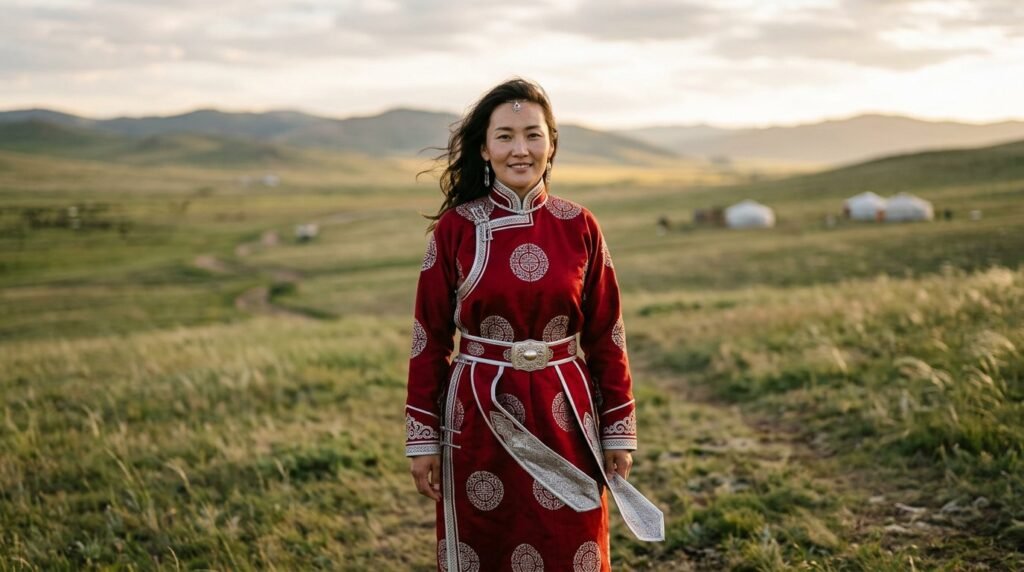
Female names take a different set of endings — maa (mother), tsetseg (flower), gerel (light), chimeg (ornament) and tuya (ray). They appear as surnames in exactly the same way when a woman’s name passes to her child, which happens when the father’s name is not legally recorded.
| Name | Roots | Meaning |
|---|---|---|
| Altantsetseg | altan + tsetseg | Golden flower |
| Ariunaa | ariun + -aa | Pure one |
| Badamtsetseg | badam + tsetseg | Lotus flower |
| Bayarmaa | bayar + maa | Mother of joy |
| Bolormaa | bolor + maa | Crystal mother |
| Battsetseg | bat + tsetseg | Firm flower |
| Delgermaa | delger + maa | Abundant mother |
| Dolgorsuren | Tibetan dolgor | White Tara’s majesty |
| Enkhjargal | enkh + jargal | Peaceful happiness |
| Enkhtuyaa | enkh + tuya | Ray of peace |
| Enkhtsetseg | enkh + tsetseg | Peaceful flower |
| Erdenechimeg | erdene + chimeg | Jewel ornament |
| Ganchimeg | gan + chimeg | Steel ornament |
| Gerelmaa | gerel + maa | Mother of light |
| Gereltuya | gerel + tuya | Ray of light |
| Khaliun | khaliun | Dun-coloured, golden-brown |
| Khulan | khulan | Wild ass of the steppe |
| Munkhtsetseg | munkh + tsetseg | Eternal flower |
| Naran | naran | Sun |
| Narangerel | naran + gerel | Sunlight |
| Narantsetseg | naran + tsetseg | Sunflower |
| Narantuya | naran + tuya | Sun ray |
| Nominchimeg | nomin + chimeg | Turquoise ornament |
| Odgerel | od + gerel | Starlight |
| Oyunbileg | oyun + bileg | Gift of wisdom |
| Oyunchimeg | oyun + chimeg | Wisdom ornament |
| Oyuntsetseg | oyun + tsetseg | Wisdom flower |
| Sarangerel | saran + gerel | Moonlight |
| Sarantuya | saran + tuya | Moon ray |
| Sarnai | sarnai | Rose |
| Solongo | solongo | Rainbow |
| Tsetsegmaa | tsetseg + maa | Flower mother |
| Tsolmon | tsolmon | Venus, the morning star |
| Tungalag | tungalag | Clear, transparent |
| Tuyatsetseg | tuya + tsetseg | Ray flower |
| Undrakh | undrakh | To rise, to spring up |
| Uranchimeg | uran + chimeg | Skilful ornament |
| Yanjmaa | Tibetan yanjin | Saraswati, goddess of learning |
Ancient and Historical Mongolian Names
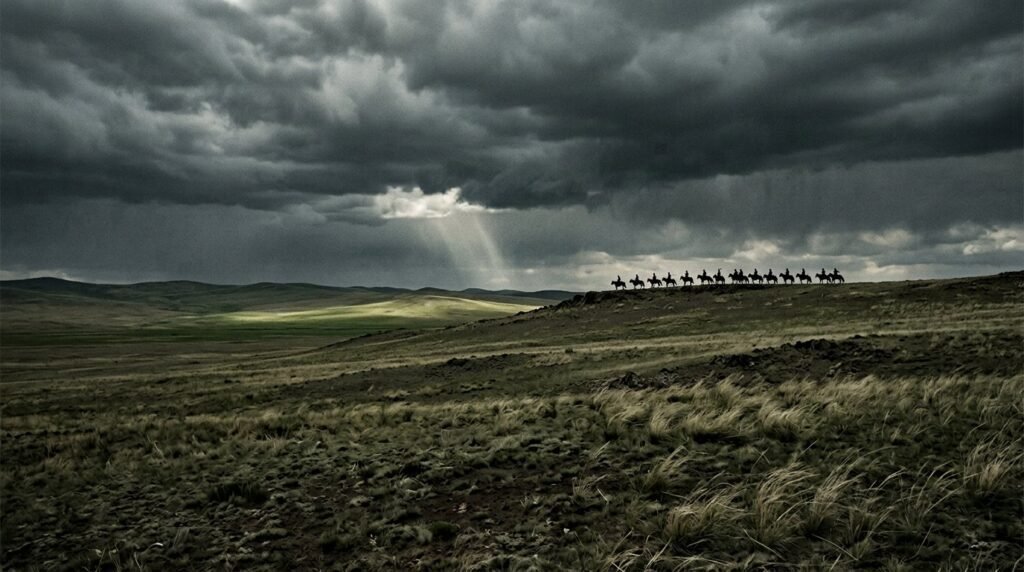
These come from the Mongol Empire and before — the names recorded in The Secret History of the Mongols and in Persian and Chinese chronicles. Spellings vary because they were written down by people using four different scripts. The Mongol Empire reached Japan’s doorstep twice, and if you are naming characters on that frontier the names from the other side of the steppe follow a completely different logic.
| Name | Meaning / who |
|---|---|
| Temüjin | Genghis Khan’s birth name. From temür, iron — “blacksmith” |
| Börte | Genghis Khan’s first wife. From börte, greyish-blue |
| Jochi | Genghis Khan’s eldest son. Means “guest” |
| Chagatai | Genghis Khan’s second son |
| Ögedei | Third son, second Great Khan |
| Tolui | Youngest son. Means “mirror” |
| Möngke | Fourth Great Khan. “Eternal” |
| Khubilai | Fifth Great Khan, founder of the Yuan dynasty |
| Hulagu | “Surplus”. Founded the Ilkhanate |
| Berke | “Difficult, hard” — of Turkic origin |
| Batu | “Firm”. Founder of the Golden Horde |
| Sorkhaqtani | Tolui’s wife, mother of Möngke and Khubilai |
| Töregene | Ögedei’s widow, regent of the empire |
| Yesügei | Genghis Khan’s father |
| Jamukha | Genghis Khan’s blood-brother and rival |
| Subutai | The empire’s greatest general |
| Jebe | “Weapon, arrowhead”. A general, originally an enemy archer |
| Muqali | A general, viceroy of North China |
| Chagha’an | “White” |
| Köke | “Blue” |
| Esen | “Good health”. A 15th-century Oirat ruler |
| Toqto’a | “Stability” |
| Buqa | “Bull” |
| Qongqor | Middle Mongolian for chestnut, a horse colour |
| Ülgen | “Magnificent”. Also a Turkic sky deity |
| Yisü | “Nine” — a lucky number meaning abundance |
| Altan | “Gold” |
| Bolad | “Steel” |
| Buyantu | “Blessed”. The 8th Great Khan |
| Gegeen | “Enlightened, bright” |
Mongolian Name Elements — Build Your Own
Almost every modern Mongolian name is two words joined together, and the vocabulary is surprisingly small. Learn about twenty root words and you can read the meaning of most names you encounter, and build new ones that are genuinely correct rather than invented.
The pattern is nearly always quality + noun, in that order. Bat (firm) plus baatar (hero) gives Batbaatar, the firm hero. Altan (gold) plus tsetseg (flower) gives Altantsetseg, the golden flower. Some roots work in either position — bat and gan both appear at the start and the end — but most have a preferred slot, and putting them in the wrong one is what makes an invented name sound wrong to a Mongolian ear.
One more rule worth knowing: endings are gendered. -maa, -tsetseg, -chimeg, -tuya and -gerel are overwhelmingly female. -baatar, -bold, -sükh, -zorig and -dorj are overwhelmingly male. The middle ground — -bat, -bayar, -jargal, -munkh — can go either way.
| Root | Meaning | Usual position |
|---|---|---|
| bat | firm, strong, solid | Either |
| gan | steel | Start |
| bold | steel | End |
| tömör | iron | Either |
| chuluun | stone | Start |
| khürel | bronze | Start |
| altan | gold | Start |
| mönggö / mönkh | silver / eternal | Start |
| erdene | jewel, treasure | Either |
| bolor | crystal | Start |
| nomin | turquoise | Start |
| baatar | hero | End (male) |
| zorig | courage | End (male) |
| sükh | axe | End (male) |
| dorj | vajra, diamond sceptre | End (male) |
| ochir | vajra | Either (male) |
| khuyag | armour | End (male) |
| bayar | joy | Either |
| jargal | happiness | End |
| enkh | peace | Start |
| amgalan | calm, tranquil | Either |
| naran | sun | Start |
| saran | moon | Start |
| od | star | Start |
| gerel | light | End (female) |
| tuya | ray | End (female) |
| tsetseg | flower | End (female) |
| chimeg | ornament | End (female) |
| maa | mother | End (female) |
| oyun | wisdom | Start |
| ariun | pure | Start |
| delger | abundant, wide | Start |
| saikhan | beautiful, good | End |
| otgon | youngest child | Start |
| tseren | long life (Tibetan) | Either |
| süren | majesty, awe | End |
Mongolian Last Names A to Z
A quick index. Names here are drawn from the Mongolian civil registry pool — every one is a real name in current use.
A — Amgalan · Amarjargal · Altangerel · Altantsetseg · Ankhbayar · Ariunbold · Avirmed
B — Baatar · Badarch · Baljinnyam · Bataa · Batbayar · Bat-Erdene · Bayarsaikhan · Bolormaa · Byambajav
C — Chimeddorj · Chinbat · Chinzorig · Chuluun · Chuluunbaatar
D — Dagvadorj · Damdinsüren · Dash · Dashzeveg · Davaa · Davaadorj · Demberel · Dolgor · Dorjsüren
E — Enebish · Enkhbayar · Enkhjargal · Enkhtaivan · Enkhtuyaa · Erdene · Erdenebat · Erdenechimeg
G — Galbadrakh · Ganbaatar · Ganbold · Gansükh · Gantulga · Ganzorig · Gegeen · Gombosüren
J — Jadamba · Jambal · Jamsran · Jargal · Jigjid
K/Kh — Khaltar · Khatanbaatar · Khishig · Khulan · Khürelbaatar
L — Lkhagva · Lkhagvadorj · Lkhagvasüren · Lkhamsüren · Luvsandorj
M — Mandakh · Mendbayar · Möngke · Mönkhbat · Mönkhbayar · Myagmar · Myagmarsüren
N — Naidan · Namsrai · Naran · Narangerel · Narantsetseg · Natsagdorj · Nergüi · Norov · Nyamdorj
O — Ochir · Ochirbat · Odgerel · Oidov · Otgon · Otgonbayar · Oyuunchimeg · Oyuuntsetseg
P — Puntsag · Pürev · Pürevdorj · Pürevjav · Pürevsüren
S — Samdan · Sandag · Sanjaa · Sarnai · Sharav · Sodnom · Solongo · Sükhbaatar · Sumyaa
T — Temüjin · Terbish · Togtokh · Tömör · Tömörbaatar · Tsedev · Tseren · Tserendorj · Tsetsegmaa · Tsolmon · Tungalag · Tüvshinjargal
U — Ulambayar · Ulziibayar · Uranchimeg · Urtnasan · Uuganbayar
Y — Yadamsüren · Yanjmaa · Yesün · Yondon
Z — Zorigt · Zorigtbaatar · Zundui
Fun Facts About Mongolian Names
Nergüi means “no name.” It was given deliberately to protect a child. If a family had lost children before, they would name the next one Nergüi — or Enebish, “not this one” — so that evil spirits looking for the child would not find one. Both are still in use as real names today.
Around 700,000 people share one clan name. When clan registration reopened in 1997, most families no longer knew their lineage after seventy years of prohibition. A very large number chose Borjigin, Genghis Khan’s clan. In a country of about 3.4 million, that is roughly one person in five claiming the same royal descent.
Seven of the most common name-elements are days of the week. Davaa (Monday), Myagmar (Tuesday), Lkhagva (Wednesday), Pürev (Thursday), Baasan (Friday), Byamba (Saturday) and Nyam (Sunday) all come from Tibetan, and children are often named for the day they were born. This is why Lkhagvasüren, Davaadorj and Byambajav are so widespread.
Mongolian has no F, K, Q, V or W. Native Mongolian names never begin with these letters. The K sound only occurs inside the cluster Kh. Any “Mongolian name” you see starting with one of them has come in from Russian, Tibetan or Chinese.
The longest common names run to fifteen letters. Lkhagvasüren, Chuluunbaatar, Erdenechimeg and Oyuunchimeg are entirely ordinary. Because the writing system handles compounds easily, Mongolian tolerates name lengths that would be unusual almost anywhere else.
How to Use Mongolian Names Correctly
If you are naming a character, writing a document, or addressing someone, the single most useful rule is this: call people by their given name, not their surname. Referring to a Mongolian by their father’s name is the equivalent of calling someone by their father’s first name in English. It is not rude, but it is wrong, and it happens constantly in international sport and media.
Write the name the way Mongolians write it. The everyday form is an initial and a given name: B. Munkh-Tulga, N. Altankhuyag, Ts. Elbegdorj. Note that some initials are two letters — Ts, Kh, Ch and Ya are single sounds in Mongolian and cannot be split. If you need the full form, the father’s name takes the genitive suffix: Tsakhia becomes Tsakhiagiin, Bat-Erdene becomes Bat-Erdenegiin.
For fiction, decide which era you are in. Empire-period characters had one name and a clan — Temüjin of the Borjigin, Jamukha of the Jadaran. Socialist-period characters had one name and a patronymic and no clan at all, because clans were banned. Modern characters have all three. Mixing these up is the most common mistake in historical fiction set in Mongolia.
Finally, be careful with the transliterations. Mongolian is written in Cyrillic in Mongolia and in the traditional vertical script in Inner Mongolia, and neither maps neatly onto the Latin alphabet. Sükhbaatar, Sukhbaatar and Sühbaatar are the same name. Möngke, Munkh and Mönkh are the same word, seven hundred years apart. None of them is wrong.
If you are writing anything set in the thirteenth century outside Asia, the medieval names from the same centuries in Europe make a useful contrast — the Mongol system was doing something Europe would not try for another six hundred years.
Conclusion
The short version: Mongolian last names are not family names. Your surname is your father’s first name, it changes when you have children of your own, and the only name that stays with a family is the clan name — which most families had to guess at when the ban lifted in 1997. Once you know that, the lists above stop looking like a jumble of similar words and start reading as what they are: compounds of about thirty root words, assembled the same way for eight hundred years.
Use the Mongolian last name generator at the top of the page if you want names built from those roots on demand, whether for a character, a story set on the steppe, or simply to see how the system fits together. Click any name it gives you to copy it.
Frequently Asked Questions
Do Mongolians have last names?
Not inherited ones. A Mongolian’s legal surname is their father’s given name, which means it changes every generation — your children will not share your surname. Since 2000, national ID cards also carry a clan name (ovog), which does not change, but it is rarely used outside documents.
What is the most common Mongolian last name?
Borjigin, by a very large margin, but not for the usual reasons. It was Genghis Khan’s clan name, and when clan registration reopened after a seventy-year ban most families had forgotten their own lineage and chose the most prestigious option. Around 700,000 people are now registered under it.
Why do Mongolian names have an initial in front?
That initial is the first letter of the father’s given name. B. Munkh-Tulga means Munkh-Tulga, son of someone whose name begins with B. It is the standard everyday way of writing a full name in Mongolia, used on everything from school registers to newspapers.
Are Mongolian last names the same as first names?
Effectively yes — they come from the same pool of words. Any given name can become a surname the moment its bearer has a child. This is why lists of “Mongolian surnames” and “Mongolian first names” look almost identical, and why most name sites present the same list twice under two different headings.
What does the -giin ending mean on Mongolian names?
It is a genitive suffix, meaning “of”. Tsakhia becomes Tsakhiagiin, so Tsakhiagiin Elbegdorj reads as “Elbegdorj of Tsakhia”. The exact form varies with the vowels in the name — you will also see -iin, -yn and -ийн.
Why were Mongolian surnames banned?
The socialist government banned clan names in the 1920s. Officially it was modernisation. In practice it removed the basis of aristocratic power, since noble status in Mongolia rested on descent from Genghis Khan’s line — and a lineage you are forbidden to name stops functioning as a lineage.